by Mayumi-H | Jun 25, 2012 | Excerpts, Fearless, Process
Sometimes, we write little moments and interactions that we love…but they serve no extra purpose to the overall story. For me, this represents one of those moments:
Ross snorted and laughed in the same breath, at once recalling that afternoon on the beach when he’d been just shy of twenty-one, freshly returned from Torpoint and eager to be a civilian again, free to ride the waves, with Neville sitting beside him in the sand. And how Neville had started to have The Talk with him, only to be interrupted by Ross’s pointed and unconcerned recognition of the reason behind his friend’s mumbling and hawing:
“Are you trying to tell me that you’re gay?” Ross had asked, with some impatience.
Neville had stared at him for a long pause of time, his expression unreadable. Then he’d murmured, quite quietly: “…Yeah.”
Ross had considered that for a moment, then asked: “Do you fancy me?”
“Wh-?” Neville had sputtered, as he’d given a quick shake of his head. “God, no! You’re a breeder…!”
“Well, then, no worries, mate,” Ross had told him then, hitting him in the shoulder with the back of his hand before forcing himself to his feet. “Now, come on; I want to catch some waves before supper.”
And that had been the end of the discussion, so far as Ross had been concerned. Neville was simply Neville; and if his friend being gay meant that Ross didn’t have to compete with him (handsome, stylish, good-guy Neville) for the attentions of any pretty girls in the village, all the better.
So the very thought that their friendship could be about anything more than the mutual platonic interests in their surfing or the shop made Ross laugh again.
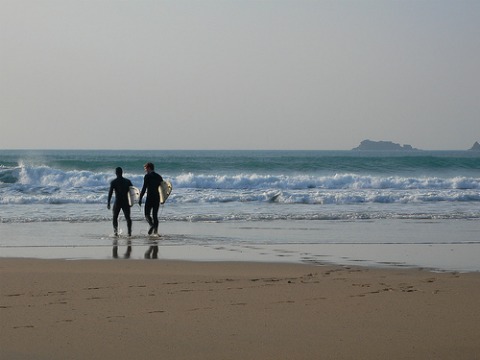
I really like the flashback exchange that happens between Ross and Neville, but it’s unnecessary explanation. By the time this flashback occurs, the reader should already know that Ross and Neville are good friends, and each one’s sexual preference has no bearing on that friendship.
Readers are free to read into text what they want, of course, and Ross’s perspective might even be different from Neville’s. But to take valuable reader time to make that explanation seemed like a lot of extra words, no matter how much I enjoyed the flow of them.
Have you ever edited out a scene or conversation that you really liked? Did you agree with that decision? Or, did you regret it?
by Mayumi-H | Jun 18, 2012 | Fearless, Process
One of the themes with which I like to play in my stories is juxtaposition.
Trait (or character) juxtaposition can manifest in different ways. In the last big story I wrote (1 More Chance!), the heroine is a small-town girl who falls for a big-city boy. Nothing new, there…except she was the fighter (and the dominant) in this relationship, while her boyfriend filled the role of gentle artist (and submissive, for the most part). During the course of the story, though, they ended up changing roles depending on the situations that arose, and they learned you don’t have to be just one type of person or another. They grew together to trade off responsibilities and character traits, where warranted.
I prefer these relationships.
One of the aspects of “typical” romances that really bugs me is how women (seemingly) have to be powerful in business, money, skills, whatever, and then the man (usually) breaks them down into a damsel, for sake of the typical role fulfilment. When I wrote 1 More Chance!, I was dealing with pre-conceived characters, so I was thankfully able to ignore that. With Fearless, the situation is different.
I wanted Amber to be a strong woman. But I didn’t want to make her powerful. Part of what Ross (the main character and point of view) finds so alluring about her is that she’s audacious, worldly, and intrepid…but she’s still very much a girl. She likes clothes and shoes and wants to be pretty. She also wants to prove herself (and that gets her into trouble). But she isn’t someone who threatens or emasculates him, which is what I see many supposedly “strong” women characters do to men.
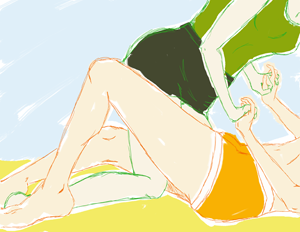
Woman on top
http://bonusparts.deviantart.com/
I’m perhaps playing into a more masculine mentality with this story, and that will likely alienate romance readers. But Amber as she is feels so true to me. I don’t want to make her a genius or a tough fighter or something else that feminism might demand me to do with her, to make her more modern.
And I really enjoy writing the role reversals that come with the conflict of the story. Not only does it show what Amber’s capable of…but it lets Ross grow, too.
I’m interested to see what my beta readers think of Ross and Amber (and the rest of the crew) when they get to reading it. Not that I think I’ll be willing to change who they are. Because I’m just stubborn like that.
What are your feelings on “strong” women?
by Mayumi-H | May 30, 2012 | Excerpts, Fearless, Process
What is it about us writers, that we put our beloved characters through an emotional wringer?
Ross has his share of lucky, happy moments, but he’s got to deal with a lot of heavy seriousness, too. Here’s an excerpt from (the recently-rewritten) Chapter 11, that always touches me a little:
Ross walked into her room, to find Amber still asleep, just as Sam had said. Still propped up by the thick, confining torso brace moulded around her, to keep her back in position. Still hooked up to those tubes and monitors he hated. And yet, despite all of that, still so lovely, like the faery tale sleeping beauty whose story she’d once told him was her favourite.
He blinked; the thought was ridiculous. But that didn’t stop him from bending close, to press a kiss to the ridge of her cool brow, his heart pattering with anxious hope.
She didn’t wake.
Not that he’d really thought she would, because that would have been mad. But it brought a low smile to his lips anyway, and he kissed her again, leaving her with a promise for tomorrow.
I’ve always enjoyed writing parallels in my stories. In my last big story, one of my favorite moments was a retelling of the Orihime/Hikoboshi myth, as it related to my two protagonists. For this story, there’s a throwback to Brier-Rose, or Sleeping Beauty.
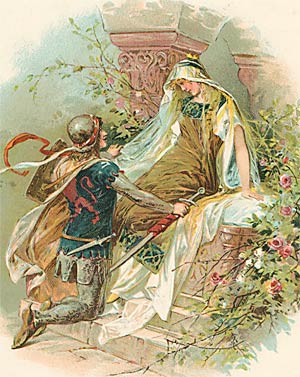
I think faery tales and folklore are a charming way to draw parallels to situations in modern tales. Do you use classical stories references in your own work? How? Why?
by Mayumi-H | May 26, 2012 | Process
I’m a fan of DVD extra features, but this one kind of blew my mind.
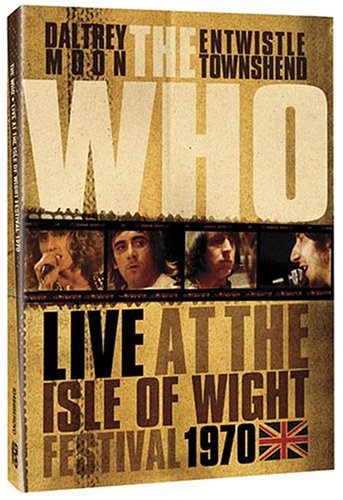
Come for the music. Stay for the insight.
I’ve always enjoyed the music and songs of The Who, and that has a lot to do with Pete Townshend’s storytelling. Yes, that’s right: the lyricist as a storyteller, just like a novelist or poet (or any of the fancy-schmancy names we dream up for ourselves as people who just want to tell stories).
Watch the Isle of Wight Festival concert footage, because it’s amazing to see an honest-to-God rock band in their prime kicking out hit after hit for the better part of 100 minutes. But then click on over to the Special Features, and watch the interview with Townshend. About 2/3 of the way through, he describes the difference between an Artist and a Craftsperson.
The Artist, he says, tells a story from inside, a story made for the Artist, first. The Craftsperson, on the other hand, tells a story to meet demand, a story made for selling. He likens a Craftsperson to a Hollywood screenwriter, who can churn out blockbuster hits, what audiences and studios want. An Artist, meanwhile, can’t do that; an Artist is too engaged with his own story to let it be compromised by anyone else.
There is nothing wrong with being either an Artist or a Craftsperson, in my opinion. (Townshend seems to agree; he says with some admiration about the Hollywood blockbuster writer, “I don’t know how they do it.”) And, I think that a storyteller can be both, at the same time. But one side will have dominance over the other.
I don’t know whether I can call myself an Artist. I definitely prefer to tell stories that are personal to me, though. And I admire real Craftspeople, who can sacrifice parts of their stories to give them more mass appeal, to succeed with a wider audience. I think that’s necessary, if a storyteller wants to be monetarily successful. But there’s a part of me that considers it a Faustian bargain, too: What part of my soul will I have to give up, to give my stories the success I think they deserve?

“Just sign on the line, Miss….”
Not having reached that point of decision-making, yet, I can’t say for certain my answer.
I’m willing to edit my stories, if I think they’re worthy of the effort (some aren’t). But I don’t know if I could, say, change an ending to make the story more widely accessible, or change a character’s sexual orientation to appeal to a different audience. I think I’d rather just print up the story on my printer, in that case, make myself a personal cover, and call it a day.
What do you think? Are you an Artist or a Craftsperson? Both, or neither?
by Mayumi-H | May 21, 2012 | Excerpts, Fearless, Process
I came across this writing meme a while ago, but only recently did it come back to me.
The rules are:
Go to page 7 or 77 in your work-in-progress.
Go to line 7.
Copy the next 7 lines (or 7 sentences), and paste them into your blog. (No cheating!)
Tag 7 authors to do the same.
Now, I don’t particularly care to get tagged in these things, so I didn’t do the last step. But I did like this idea, especially since the way this worked out, it highlights a piece of the story and character/romantic development that comes back into play later in the story (and which I recently felt the need to rewrite).
So, here’s my 7 lines from page 77:
But Amber just stepped over to him and lifted the book from his hands.
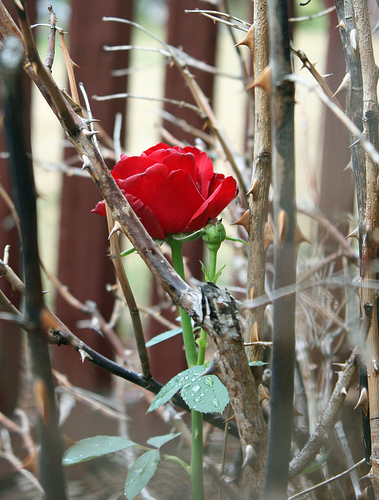
“That’s all right,” she said, as she sat down beside him. She flipped open to what seemed a random page, but the way she touched her fingers to the picture of a pretty princess laid out upon a bed of spiralling thorns told him differently.
“This one’s my favourite,” she said. “Brier-Rose.” She looked up from the pages and faced him with a tiny smile. “Sleeping Beauty.”
He smiled back, easing close to her on one arm. “You are quite the romantic,” he said.
She shrugged. “Faery tales are simple. The villain is always defeated; the hero always wins. The princess always finds true love.” She paused, her gaze falling once more to the half-coloured illustration beneath her fingertips. “And the father never forgets his children.”

Prince Florimund finds the Sleeping Beauty [Public domain image via Project Gutenberg]
Ross is right: Amber’s an incurable romantic. But I really like the way that she’s telling him a lot, here, even though she’s not spelling things out for him. That’s the way I like to tell stories, too: letting the reader decide how dialogue, action, or interactions can be interpreted beyond a surface level.
This excerpt happens all the way back in Chapter 5 (which feels like a lifetime of writing ago, though really just November 2011)…but it has repercussions throughout the rest of the story.
If you decide to participate in the Lucky 7 Writing Meme, let me know in the comments. I’ll happily link over to you!


Recent Comments