by Mayumi-H | May 7, 2012 | Excerpts, Fearless, Process
I know I’ve said a million times that you shouldn’t go back and re-write until you’re finished…but, rules are made to be broken.
The “original” draft of Chapter 11 moved things along at what I thought was too quick a pace. There was too much pluperfect recap in the first two pages or so that just felt rushed, to me; an “info dump,” of sorts. So, while this does not change anything that happens in the chapters following, and while it may very well end up hitting the floor when I do my first big edit (in which I’ll likely cut about 10-15% of text), I’ll at least have gotten the words down.
The sofa wasn’t very cosy – it was too short for him to stretch out properly, for one thing – but it was a hundred times better than the chairs in the CCU lounge or in Amber’s room, which were barely comfortable enough for sitting, let alone dozing. And it was hours closer than his own bed, to which he wasn’t quite ready to retreat, yet, with Amber still alone at hospital. Still, he managed to drift into a fitful sort-of sleep, waking just past six with a crick in his legs and a rotten-tasting dryness in his mouth.
Stumbling to the bathroom, he managed to find a bottle of mouthwash and freshened up a bit with that. He washed his face, too, pausing to take note of the dark circles under his reddened eyes, and the uneven two-day growth of beard on his face. He smelled of nervous sweat and musk, as well, but there was little to be done about that, beyond a cursory wash of pits and appendages at the sink.
As shit as he looked, though, and as shit as he felt, he knew that it wasn’t anything compared to what was waiting for Amber. And it was for that reason more than any other that he frowned at his own ridiculous vanity, swiped the spare keys from the kitchen counter, and jogged back to hospital as quickly as he could do, ignoring the fresh rain that pattered down around him.

There are few things worse than waiting in one of these damned chairs.
(photo courtesy visualphotos.com)
Maybe I originally glossed over a lot of the hospital scenes because writing them has been so difficult for me. It means going to a place inside of my memories that I don’t like to visit. Except that the pain and uncertainty in those moments of just waiting, not knowing, can’t be approximated any other way. Not by me, at least.
I don’t enjoy hurting these characters, who are such a part of myself. But through pain, we grow. And Ross needs to grow, if he’s going to be fearless.
Have you ever relived a painful part of your past, to get more in touch with the heart of your story?
by Mayumi-H | May 5, 2012 | Fearless, Process
“Sell-out!”
My husband makes this casual accusation all of the time, mostly of visual or musical artists. His perspective is that an artist is true to their work or vision only if they’re suffering in obscurity and relative poverty. I argue back at him that, sure, an artist has a vision and should stay true to that. But how many people really get into music or writing or art and don’t want to be successful and make money at it? Green Day, for example, lost a lot of their punk “cred” (at least with my husband and his friends) when they signed to a big record label and became international superstars.
My answer to that? “…What?”

“No, guys, I don’t want to make a bajillion dollars playing stadium shows. Let’s just go back to playing in our garage.”
This brings me to my point (such as it is): What’s the right balance of creating art for yourself, and creating it for other people?
Theresa Stevens over at Edittorrent has a great post about Complexity in stories. In it, there’s a terrific bit about writers who spell things out for the reader, and weaving a bit of mystery and complexity into the words.
When I’ve written fiction stories before, I try to write on two levels: on a very basic level, a reader can just read the words and get a hopefully fulfilling story. On another level, though, I try to introduce deeper meaning for the moment or characters. It’s not super-obvious, but if you’re willing to think about what’s happening on the page, there’s another layer to the story.
This invariably takes more concentration and skill, though. And I occasionally think that maybe I’m just creating more work for myself. After all, I’m an unproven writer, and most readers likely won’t take a chance on whatever I produce, without a name to myself.
But I don’t want to write for a genre or audience – or in a style – simply because it’s popular or the latest new thing. It’s impossible for me not to emulate the stories I’ve loved since I was a little girl, but I don’t want to study a Twilight or Hunger Games to change the way I write, to make my novel more mainstream and publishable. I want to tell my story, in my voice, with all of the sexy, fluffy, ugly stuff that goes along with it.
So, I ask you. Which is more realistic for the starving starting novelist? To be the artist, or the hack?

Ben Skinner – one of the inspirations for Ross – strutting his stuff on the water.
photo courtesy and copyright Geoff Tydeman
by Mayumi-H | Apr 28, 2012 | Fearless, From Hell (A Love Story), Process
One of the things that Mr. Guy talks about over at The Red Pen of Doom is keeping your pitch simple. Four words or less, he suggests, to give a basic summary of your novel. From there, you can elaborate to a sentence and then a paragraph, but those four words need to sum up the gist of your story.

Brought to you by the number 4.
Four words? Even my comics creator friend, Pete Stathis, suggested the seven-word synopsis. I had issues coming up with seven words to sum up my story, but, compared to four, seven would be cake.
Anyway, since reading that article about the simple pitch, I’ve been trying on and off for the last several weeks to come up with something suitable. Everything sounds so trite, though. I’m trying to stay universal, since one of the other suggestions made over at the Red Pen of Doom is that the hero doesn’t matter (not to the pitch, anyway): it’s the conflict that’s really important.
That piece of advice should probably make my task easier…except that it doesn’t.
I asked my mother for advice about this (so you know that I’m desperate). She asked what a pitch was, to start, and then said, “So, if I were to write my life story, my pitch would be something like, Memoirs of a Gaido-san, yes?” (Gaido-san is Engrish for “Miss/Madame Tour Guide.”)
Damn it if my mother isn’t better at this than I am.

Your typical "gaido-san"
For anyone who’s taken a peek at Fearless, it’s about this carefree and callous surfer-type who falls in love with the bold new girl in the village, blah blah blah, and I’ve likely lost you already. The main focus of the story is really about their relationship, coming to terms with their past and present mistakes and misconceptions, and how a single accident can change the way that they approach their lives. There are no invaders from space, no marauding pirates. So, how do I compress that story of love and relationships into four words and still make it interesting?
Whenever I consider my four-word pitch, I’m dogged by cliched, general phrases that ultimately say nothing about the story. If I read these on a poster with a graphic, maybe something would click, but probably not. To give you an idea, I’m stuck with such trite fare as: “Healing isn’t just physical,” and “One accident changes everything.” Or the oh-so basic, “What’s love without fear?” (Because the story deals a lot with these people’s fears: fear of trust, fear of loss, fear of letting go of the people whom you love.)
But none of these have really grabbed me. And if they don’t grab me, they don’t have a chance in Hell of grabbing you.

Painting by Dolk.
If only I could use this as my pitch.
http://www.thegiant.org/wiki/index.php/Dolk
So, it’s back to the drawing board, for me and this project. I’m coming in to the home stretch on my first draft (denouement left, now), and then it’s off for some light (followed by heavy) editing. In the meantime while I finish up the big text, though, I guess I have plenty of work to do on the little text.
(Wait, wait! How about “Love, by accident“? Nah. Didn’t think so.)
by Mayumi-H | Apr 21, 2012 | Fearless, Process
How many words should a story be? Or, to take it to a more manageable level for a novel: How many words should a chapter be?

…flip…flip…flip…
I have always been of the opinion that a chapter should be as long – or as short – as it needs to be, to make its point and to fulfill the theme or minor conflict presented therein. (I’m a big fan of themes.) Of course, sometimes you write yourself into a bit of a corner. When I was writing 1 More Chance!, I created an artificial parameter: that each chapter would cover what happened in any given day of my heroine’s life. That worked all right…for a while. But, as the story progressed into the later chapters, there was so much going on for her in a chosen day that my chapters were over 10,000 words long! (Occasionally, far over 10K words…!)
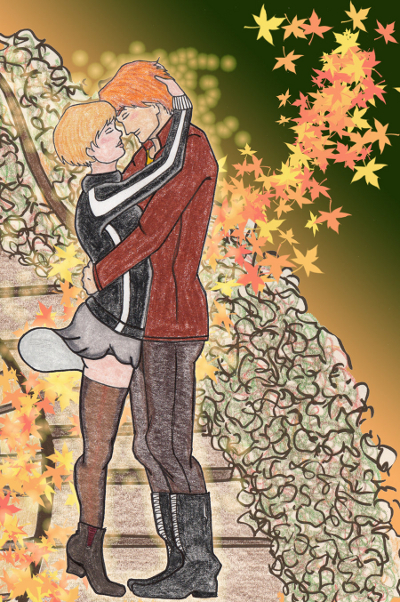
A drawing I did of my protagonists from 1 MORE CHANCE!.
Now, 1MC! was a fan fiction endeavour, so it was really just me playing around in another world. There was never any chance of it being published beyond the regular fan sites, and my readers were gobbling up the words regardless, so I didn’t have a problem with it. But, once I started doing research for Fearless – a real novel, that I hoped to publish – I started rethinking my no-holds-barred approach to chapters.
One blogger mentioned that the average chapter (for a new, unproven writer, not a King or Crichton) should run between ten and fifteen pages. Any less, and you risk rushing things. Any more, and you risk losing your readers from boredom. I took this advice mostly to heart…except that pagecount is rather arbitrary.
Think about it: If I type at 10-point Times New Roman font, my wordcount for ten pages is going to be different from someone else who types at 12-point Courier font. (As a side note, use standard professional fonts when you type, especially if you’re going to submit your manuscript to anyone professional. Comic Sans is always a no-no.)

Unless you are a 10-year-old with your own homemade comic, NEVER use Comic Sans. Just…Never.
So, I started to think. What’s the best average length – in wordcount – for a chapter?
You’ll recall from a few paragraphs ago that my fan fiction story, 1 More Chance!, had chapters running into the teens and twenty-thousands of words. That is way, way too much. So, for Fearless, I started concentrating on the pagecount. I came to find that – in my style – I was comfortable with chapters running, on average, between 6,000 and 8,000 words each. I think that’s a respectable length. It gets the themes across to the reader, and it resolves the smaller conflicts that are part of the larger whole. So, if you’re reading the story as a book, you can put it down at the end of the chapter if you so choose…or you can keep reading to find out what’s going to happen next.
Maybe you think I’m writing this the wrong way. I don’t know. To be honest, though, I care more about the story than the mechanics of the format. I suppose that’s short-sighted of me, given that I do want to sell this book, and I do want to make it a good read for others. I know what I like, though; I know how I enjoy reading a book. Shouldn’t that count for something?
by Mayumi-H | Apr 16, 2012 | Excerpts, Fearless, Process
Before I’d even really started plotting or researching Fearless, I’d had this confrontation scene in mind. I think it’s one of the reasons why I’ve always been able to see the relationship between Ross and Neville so clearly. You may (or may not) agree.
(Warning: some adult language to follow.)
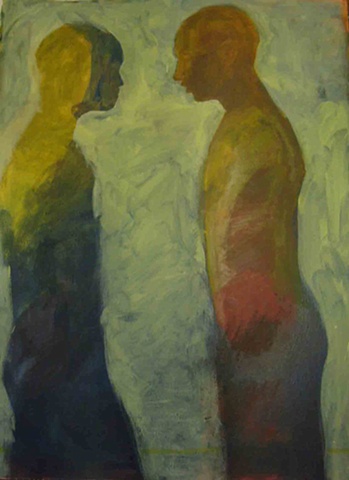
Painting by Jackie Knight: http://thejackieknightsite.com/home.html
A familiar itch niggled at the back of Ross’s neck. But he didn’t say anything, so Neville straightened up and dropped his hand to his side, and filled the sudden gap with:
“I stood by you, through all that Susanna shit you insisted on putting yourself through, even though I knew – I knew! – it would end badly. But I kept my gob shut because, despite every stupid, self-centered thing you have ever done, you are my friend. And because I held out some foolish hope that, just maybe, you would be clever enough to sort out on your own that Susanna Braden didn’t see you as anything more than a pretty face attached to a pretty cock she could use to pass the time between posh society luncheons and holidays with her husband.”
Ross glowered at this scathing recapitulation of events he knew far too well, and took no joy in reliving. “Thanks for that,” he rumbled.
“Shut it,” Neville snapped. “I haven’t finished.” He took a breath, looking Ross up and down, and finally shook his head. The expression on his face relaxed then, no longer so angry, as though sensing the rawness of the nerve he’d scraped. “Do you remember what you said to me,” he asked, “when that was all over?”
Ross just frowned, tonguing the back of his teeth as he recalled sitting on this same pier, sniffing seawater and snot as he’d kept his red eyes trained on the horizon. Then the words came back, so ripe with righteous loathing for the woman who’d used him so, even as Neville reminded him of them, too:
“You said you were done,” Neville told him. “That no woman was worth that kind of trouble. And you know,” he said with a snort of wry laughter, “I thought you were right! I thought it was better for you to just…close yourself down, shut yourself off, than to have to watch you go through another Susanna debacle again. Even if it did turn you into a compassion-less shit,” he squeezed out through thinly-pressed lips, making Ross frown again. Because of course, Neville was right; of course, that was true.
“I mean, you are my best friend, mate,” Neville said, now. “But that does not mean I did not think you were an arse-hole.” He paused, as though to let those words sink in, then said: “Because you were.”
Knowing this to be the truth and actually hearing it said aloud to his face were quite different things, and Ross glanced away. He drew a breath, some half-hearted protest perched on his tongue, when Neville spoke again:
“Until Amber came along,” he said, and, at that, Ross blinked back at him, silently struck dumb.
It’s never fun to be confronted by someone, often because that usually means that we’ve done something stupid or are currently in the process of doing so. But it’s your true friends who will call you on your crap, slap you in the face, and make you see the truth, no matter how ugly or frightening it may be. I had a friend like that, one who took me aside and told me the harsh reality of my actions. It’s one of the things I’m trying to convey in the relationship between these two characters. The main love story is about Ross and Amber, of course…but Neville has his own kind of love story with Ross, too. Perhaps not the squealing kind of story between two men for which sparkly-eyed fangirls might be clamoring, these days, but it is about love.

And now, a picture of two kittens hugging. For those who don’t like to think about two men who can be emotionally intimate without being lovers.



Recent Comments