by Mayumi-H | Jun 25, 2012 | Excerpts, Fearless, Process
Sometimes, we write little moments and interactions that we love…but they serve no extra purpose to the overall story. For me, this represents one of those moments:
Ross snorted and laughed in the same breath, at once recalling that afternoon on the beach when he’d been just shy of twenty-one, freshly returned from Torpoint and eager to be a civilian again, free to ride the waves, with Neville sitting beside him in the sand. And how Neville had started to have The Talk with him, only to be interrupted by Ross’s pointed and unconcerned recognition of the reason behind his friend’s mumbling and hawing:
“Are you trying to tell me that you’re gay?” Ross had asked, with some impatience.
Neville had stared at him for a long pause of time, his expression unreadable. Then he’d murmured, quite quietly: “…Yeah.”
Ross had considered that for a moment, then asked: “Do you fancy me?”
“Wh-?” Neville had sputtered, as he’d given a quick shake of his head. “God, no! You’re a breeder…!”
“Well, then, no worries, mate,” Ross had told him then, hitting him in the shoulder with the back of his hand before forcing himself to his feet. “Now, come on; I want to catch some waves before supper.”
And that had been the end of the discussion, so far as Ross had been concerned. Neville was simply Neville; and if his friend being gay meant that Ross didn’t have to compete with him (handsome, stylish, good-guy Neville) for the attentions of any pretty girls in the village, all the better.
So the very thought that their friendship could be about anything more than the mutual platonic interests in their surfing or the shop made Ross laugh again.

I really like the flashback exchange that happens between Ross and Neville, but it’s unnecessary explanation. By the time this flashback occurs, the reader should already know that Ross and Neville are good friends, and each one’s sexual preference has no bearing on that friendship.
Readers are free to read into text what they want, of course, and Ross’s perspective might even be different from Neville’s. But to take valuable reader time to make that explanation seemed like a lot of extra words, no matter how much I enjoyed the flow of them.
Have you ever edited out a scene or conversation that you really liked? Did you agree with that decision? Or, did you regret it?
by Mayumi-H | Jun 9, 2012 | Uncategorized
I have a friend whose young daughter is interested in fantasy comics and anime. This is not a bad thing. This friend’s daughter is so inspired by these comics and cartoons that she has decided she wants to write her own stories in these worlds. This is not a bad thing, either.
The bad thing is that I’ve read some of those stories, and they’re…pretty terrible.
She’s young, impressionable. I want to help foster her love for stories and creating worlds with words. I was like her, once, and I know how valuable it can be to have your work accepted and – yes – praised. Because when all we hear is criticism, it often leads to a quick trip to the toilet, to flush our stories and ideas down the drain forever.
I do not want to do that to this girl. Because I’ve been there, standing over that bowl of bluish water with the words of my dreams half-crumpled in my fist, wishing for all of the world that somebody would just understand me. (Cue melodramatic pre-teen angst.)

I now wish some of my ideas were this clear…!
I’ve worked with a lot of students here at university, and I have no trouble talking with them about what works and what doesn’t in their stories. They are (usually) mature enough – both emotionally and intellectually – to understand that any critique they’re given is not a personal attack. (“You asked me for help. I am trying to help you.”)
I don’t want to dash this girl’s hopes and excitement by pulling out a red pen. But I also know that if she receives only praise for her work, that will hurt her in the long run. She needs a balance. (“I really like what you did with part A. But you might want to rethink part B.”) How do I walk that line of supporter and critic without turning this young woman off to a joy of writing?
For those of you who edit, teach, or have aspiring young writers in your family: what would be your approach to my conundrum?
by Mayumi-H | Jun 4, 2012 | Fearless, Persona 4 Fan Fiction, Process
I read somewhere that it can be helpful to take a step back and just look at your work. Not from an artistic perspective or a storytelling or an editing one, but from a visual one. The idea is that, if every page looks the same (whether it’s big blocks of text or lots of lines of dialogue), you may need to switch up your storytelling style a bit. It’s just another subtle way of keeping your readers’ attention, I guess.
So, on a recent revision of my manuscript, that’s what I did. I took a step back, and looked at the first page and a half of a chapter.
I have to point out, here, that the reason I did this was because I was leery about starting another chapter with a lot of textual explanation, as I’d done the last chapter. Anyway, here’s what the initial draft looked like:
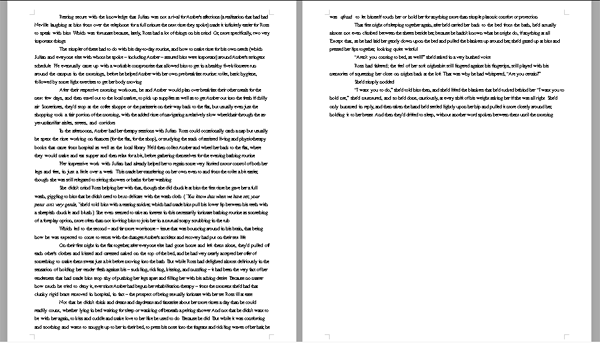
The original start to Chapter 15.
Whoa. What a wall of text. It’s necessary text, though. There’s a fair amount of explanation that happens, to set up the minor conflict of this chapter. But there’s already a lot of description and setup that happens in the surrounding chapters, and I didn’t want to subject the reader to having to read these huge intros every time.
So, here’s the second draft:
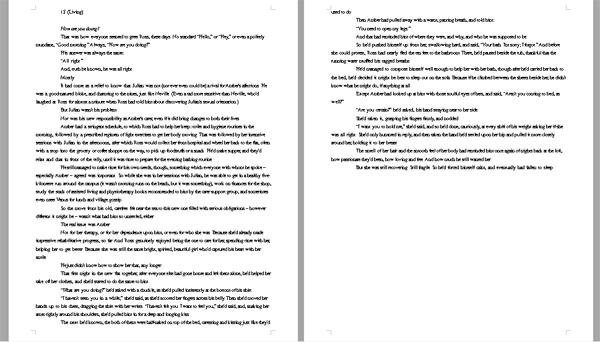
The revised Chapter 15 start. Looks nicer, yes?
All I did differently was break up the blocks of description and explanation with some more personal insight from my main character, answering questions from other people. The same information is offered, but it’s broken up into what I consider more manageable pieces.
And, doesn’t it look a little nicer to read, too?
I’m not afraid to read lush description, but sometimes you just need to change it up, for sake of your reader’s eyes. What about you? Would that wall of text have scared you off? Do you find it helpful to look at your stories in a visual way?
by Mayumi-H | Jun 2, 2012 | Process
My sister runs an online RPG (role-playing game). One of her players writes his group interactions – including combat – with a wall of text: probably about thirty different actions in one response.
This isn’t how you run a game in person, let alone one played over the Internet, where everyone has to read everything.
When I played these games (usually around a table with a half-dozen similar geeks), we were told that our “actions” – what we did in the game, usually as a reaction to a stimulus (such as a club being swung at our heads) – would be about ten seconds. If it takes you longer than ten seconds to describe what you’re doing, that’s too long, and it requires more than one action. (And we’d get smacked by our Game Master for such a transgression. This is likely why my default answer for most conflicts was, “Uh…I fire another arrow, I guess.”)
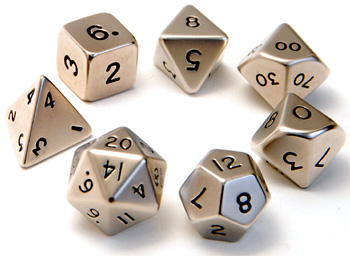
Rolling the dice for a fight
This short-but-sweet technique can help with writing, too, especially when it comes to fights.
My first “real” fight scene – a thankfully brief tussle between a spearman and a cavalryman – read like Kirk fighting the Gorn captain. I described everything in detail, which slowed everything down. Then I remembered the 10-second rule. Any action in a fight scene should be able to be read in at most the same amount of time it would take to perform such an action. Time to read description =< action itself.
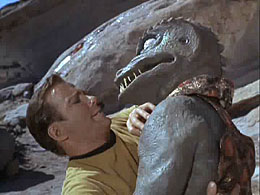
Rrg. Arg.
Kirk “fights” the Gorn in the episode “Arena”
Of course, you can vary it a bit, depending on the situation. I wrote one fight scene that was supposed to be very balletic, so I described a lot of it. I thought that was warranted (even if maybe it wasn’t; that’s my story, and I’m sticking to it). But most of my fight scenes, I prefer to keep short. Hack, slash, fall, run. I’ve also found that writing fight scenes with a quicker tempo works better for creating tension.
If a sensei and a gakusei (teacher and student) are having a sparring match, they might be talking and explaining during the moves. A slower, more descriptive block of text might be warranted. But in a life-or-death situation, the curses, punches, and kicks should be flying. One of the best ways I’ve found to keeping this excitement up is not to dwell on any one action for more than ten seconds. Really, more than two seconds is probably too long. But I’ll grant ten seconds, to start.
[youtube http://www.youtube.com/watch?v=rcoVryJmCX0?rel=0&w=560&h=315]
This isn’t homework, necessarily, but take a look at the video above, from the excellent Fist of Legend. Now, decide how you’d write it. (I can tell you how I wrote it…but that would be cheating.) Remember that stylish action should be quick and to the point. You can drop some elaborate moves in there once in a while, but a fight scene is not a dinner party; don’t waste your reader’s time with a lot of unnecessary detail.
So, what’s your technique for writing fight and battle scenes?
by Mayumi-H | May 26, 2012 | Process
For four solid years at university (okay, three-and-a-half; I had a lot of Advanced Placement credits), I studied the art of understanding and writing the English language. I love reading, and I love writing. And I take a lot of pride in my knowledge of both.
But is that a good thing?
English major; writer; theatre tech: You name it, I nerded it.
(Panda necklace available from http://www.etsy.com/shop/panduhmonium)
I’ve read publishers and professionals who say that a good editor will take care of any grammar or punctuation issues you may have, and that you – the storyteller – should concentrate on all of the things that will make your story sell: plot, characters, conflict, dynamics. That’s great to hear, especially for those writers who have more skill with story than they do with pesky matters like proper capitalization and use of commas or quotation marks.
But I’m the type of person who lives and breathes that stuff. Before I send any manuscript off to a beta reader or an editor, I want it to already look its best. I want to be proud of it. If I send off a manuscript that is half-assed in its grammar or spelling, that’s going to make me look like an idiot to my editor. At least, I think so.

Idiot: when Captain Picard can’t even look at you.
I know that any editor is going to return my manuscript with lots of notes and corrections; I’m preparing myself for an ocean of red mark-ups. But I think I’m doing that poor person a favor by at least making the manuscript as clean as it can be, the first time around.
For all of you experienced writers out there: Am I worrying too much about the rules of my language? Should I leave all of that to the beta readers and editors? Or am I right to be muscling up on my words and punctuation as well as my plots and characters?



Recent Comments