by Mayumi-H | Feb 16, 2013 | Fearless, Short Stories
My go at this week’s Five Sentence Fiction prompt from Lillie McFerrin: CHERISH.
If you aren’t familiar with Five Sentence Fiction, Lillie gives us a one-word prompt, and we’re to write a five-sentence story on what it means to or evokes in us. We don’t have to use the specific prompt word, by the way.
If the word strikes a chord in you, too, why not pop by Lillie’s site and have a go? Challenges are up Thursday through Wednesday, so there’s still plenty of time to join in on the fun!
“You Never Forget Your First”
Blowing a breath of appreciation between his lips, he laid her down in the sand, smoothing his hands along her curves. The touch of her sparked a familiar rush, a deep longing like ancestral memory aeons old. Soon, he’d press his body to her, and they’d be together, like one, fast and free and eternal, if only for a moment.
From over his shoulder, Amber gave a tsk, and muttered, “Sometimes, I think you love that board more than you love me.”
Ross just snickered, replying, “You never forget your first.”
The memories of first loves tend to linger, no matter who – or what – they are. Sometimes, you just have to accept them along with the one you love. (Ross’s custom Keahana board, for anyone interested, is a variation on the Skindog pintail Noserider design. Because you always remember your first.)
[vimeo 2300726 w=297 h=216]
What part of your past – or present – do you CHERISH?
by Mayumi-H | Feb 13, 2013 | Fearless, Persona 4 Fan Fiction, Process
I was going to put up a post about how to give good (amateur) critique, but I decided to go a different direction, because I saw this come up in my hit statistics…again:
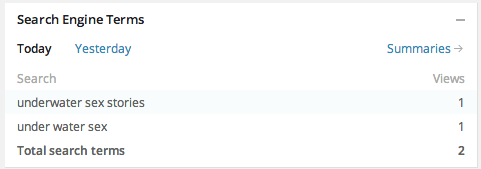
Am I really this predictable?
For those of you who are sensitive to the subject of sex, you may want to steer clear of this post and come back on Saturday, when I’ll post some original fiction. For those of you brave enough to continue, though, let’s get wet!
“So…did you?” Niall asked, and Ross blinked.
“Did I what?”
“Have a bang on the beach last night,” Niall said, and gave a distasteful waggle of his tongue.
Ross scowled. “Sex on a beach is tacky,” he said, which was true…not to mention, sand had a tendency to get everywhere, which also made it damn uncomfortable.
Every good romance has some naughtiness to it, whether it’s of the fade-to-black kind or the in-your-face variety. I’ve written both, and I’m of the opinion that each version has its merits…and demerits. No matter how you choose to write your raunch, though, there are a few practicalities to keep in mind:
1.) Sex on a beach is tacky.

It’s an orgasm metaphor.
Let me save you the trouble: having saltwater shoot up your nose while you’re snogging your lover is not a pleasant feeling, no matter how locked your lips are. We’re not even going to talk about how crashing water will make a swimsuit move all over the place, creating uncomfortable ripples and folds more likely to cause laughter than lust, or how sand does, in fact, have a tendency to get everywhere. Even a wetsuit won’t keep that pesky stuff off your skin. Which is why you should always rinse off before you hit the sheets for a post-surf romp, unless you want to be cleaning sand out of your bed for weeks.
A beach can be a romantic place for a tryst, to be certain. Just be certain to remember what else is on a beach, too.
2.) Water is not the same as lube.
“Come on in! The temperature’s fine!”
But, when it comes to sex, be aware of the surroundings, especially if it’s water. We’ve all heard the story that you can drown in even a puddle of water, but water can also counteract the benefits of personal lube. The human body produces its own lubricant, which is designed to smooth out the sometimes-rough mechanics of sex. Water, on the other hand, being the excellent cleaner it is, has a tendency to wash away that lubricant.
Yikes.
So, next time you think about putting that steamy sex scene in a steamy shower, keep in mind the details of such a situation. And that’s not even mentioning the aforementioned issue of rushing water in the face and up the nose….
3.) You’d never mistake a pool for a condom.
A swimming pool offers all the joy and excitement of a midnight skinny-dip without the associated danger of salt poisoning and night feeders.

The dating scene is full of sharks of all kinds….
Which brings me to my last point:
4.) Lovemaking can be lovely, any place.
Don’t let me discourage you, or your characters. On the beach, underwater, in a pool, even in the rain: sex between two people brought together by love can be beautiful, in any location and under any circumstance, so long as you make it so. Even in the typical locale of a shared bed, sex can be thrilling, romantic, ecstatic, funny, relaxing, fulfilling…all this and more. It’s truly about what your characters – and your readers – feel from that love that’s important.
Just remember to think before you put them in a wet situation. 😉
Have you ever written a watery sex scene? Would you ever write one? Why, or why not?
by Mayumi-H | Feb 9, 2013 | Short Stories, Songbirds
 Only one prompt this time, for 100-Word Challenge for Grown-Ups. This week (76), Julia’s prompt is:
…beneath the surface…
We are to “keep to the 100 words plus the 3 above,” giving us a total of 103 words to tell the story.
This one came pretty easily to me, as I cranked it out in about an hour. But, then, I think this is likely a situation close to many of our hearts, not just my own….
“A Deeper Reflection”
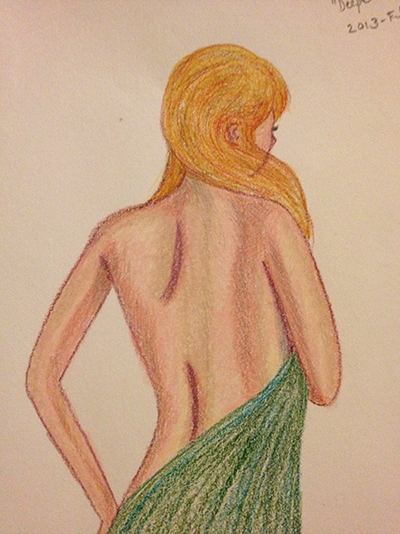
Doodling the bod
Fixing her gaze on her disrobed reflection, Sally sighed.
What lay beneath the surface was more important, she knew…but, what had happened to that surface? The flat belly, high breasts, slim hips – where had they gone?
The creak and click of the bedroom door, signalling Larry’s return, made her scramble for pants and bra.
His warm, damp embrace stopped her. “Just a mo’.”
Cringing from his tickling hair, she laughed, despite herself. “You’re wet!”
“You’re gorgeous,” he replied, nuzzling her neck.
She hummed. “You think?”
He plucked her clothes from her hand; they fell to the floor with his towel. “I know.”
I have some writerly friends who can use this short form of storytelling to weave tales of excitement, danger, whimsy, and mystery. I can manage that, on occasion. Mostly, though, these prompts tend to lead me to more mundane places, such as Sally’s fretting over her aging, motherly body…and Larry’s still-full love of the same.
Writing for these Songbirds often feels like writing my own life (sans the fantastic timey-wimey stuff, of course). Maybe that’s why I keep coming back to them. I suppose I should feel blessed that my life and loves are basically happy. And, I certainly am. It doesn’t exactly make for riveting storytelling, though.
How did you look beneath the surface, this week? Let me know!
by Mayumi-H | Feb 6, 2013 | Persona 4 Fan Fiction, Process
I think all of us writers write for joy: we’re driven to create worlds with words, just as painters create with their palettes and brushes. But, some of us are looking to push further with our words, to reach a greater audience. We want that valuable place on someone’s bookshelf (or a tab in their e-reader).
There are many, many stages to becoming a published writer. First, you’ve got to have a story. You write, you edit, you tweak. You set it aside, write something else, come back again. You send out copies to betas. You find a critique partner. You get yourself a story editor and a copy editor (maybe they’re one and the same, maybe not). You tap the brain of your old journalism buddy to help you write a tagline. You treat your friend in advertising for help with your sales pitch. You scour the Internet for tips on writing a great query letter. I could keep adding to this list forever…!
There are some terms and abbreviations many if not all writers use, these days. I’m going to start off a list of them, because I know some of them puzzled me when I first saw them. So, hopefully, you can learn from my ignorance. (Hey, at least I’m good for something!)

I write in English…yet, sometimes, it feels like a foreign language!
- ARC – Advance Reading Copy (or sometimes Advance Review Copy), an almost-ready-for-publication copy of the manuscript (which may still have a few errors) that is sent out prior to publication in order to be reviewed. (provided by Vanessa-Jane Chapman)
- Beta Reader (beta): A beta reader is a draft-reader. Often, someone with whom you can bounce off your early draft ideas. Some folks like to offer beta readers a very loose first draft; others give their betas a close-to-finished product. That’s your decision, as a writer. Many family members or friends should be considered beta readers, since – odds are – they’re not professional writers and/or editors…and their job is really to boost your confidence. Beta readers can also become Critique Partners.
- Bio: Not the class at school, but your Author’s Biography. Your biography is where you can toot your own horn about your writing/publishing experience, your outlook, what awards you’ve won, and so on. Be careful to keep this short and sweet, especially if you’re writing a Query letter.
- Critique Partner (CP): For the longest time, I’d see people mention CP and think they were talking about Unix commands! Then, I realized they meant Critique Partners. A critique partner is like a beta reader on steroids. This is someone you truly trust with your story, to show you where there are plot holes and lag, but also where your dialogue is fresh and your description vivid. It’s a marriage relationship between writer/reader: you give honest, helpful critique, and you get honest, helpful critique in return. It’s not a relationship to enter into lightly. Critique Partners are sometimes a writer’s last personal step before they ship a manuscript off to an editor or agent.
- Draft: A story in not-yet-finished form. Some writers make only one – their first – draft, before shipping their story off to an editor, agent, or publisher. (I think I’m on draft 6 or 7 of my novel….) It all depends on the type of writer you are.
- Graf/Graph: A shortened way of writing “paragraph.” It’s got nothing to do with statistics or charts.
- Ed: Not just some random guy (or horse), “Ed” is short for “Editor,” one of the most valuable partners for your book you’re likely going to have. You might already have a good story, but a competent and careful editor can make that good story a great one.
- Hook: A concise summary of your story, usually no more than one sentence. AKA the Tagline for your book.
Some folks also use the term “hook” to refer to the bit at the end of a chapter that will make the reader want to keep turning your pages. No matter how you use the term, though, it almost universally refers to the reason to keep reading.
- Manuscript (MS): MS is just a faster way to write “manuscript,” which is just another word for your story. Stories in many stages can be manuscripts, but I personally favor reserving the term for a story in its completed form (edited or not); I wouldn’t call a series of scenes mashed together into the same document a “manuscript.”
- Mini-Synopsis: Used for Query letters. See “Synopsis” for an explanation … only the Mini-Synopsis is much more concise, usually only one paragraph.
- Multiple Submissions/Simultaneous Submissions – Important to understand the difference because some publishers/agents specify that they don’t accept one or the other. So, Multiple Submissions is sending more than one book idea or proposal to a particular publisher or agent at the same time. Simultaneous Submissions is sending out one book idea or proposal to more than one publisher or agent at the same time. (provided by Vanessa-Jane Chapman)
- Protag: Short for “protagonist,” or, the hero(ine) of your story. Funnily enough, I see/use the term protag all the time, yet I don’t think I’ve ever seen anyone use the shortened “antag” for “antagonist.” Go figure.
- Query: A query is the letter you send to agents and publishers. It consists of three parts (usually a paragraph each): your Hook, your Mini-Synopsis, and your Author’s Bio. Go here for some more in-depth discussion on writing a query letter.
- Synopsis: Um, just what it says: a concise synopsis of what your story is about. Pluck a book from your shelf and look at the back cover or inside jacket. Usually, that’s where you’ll find the synopsis. Study how to write these, especially if you want to write a successful Query letter.
- Tagline: See “Hook.”
- WIP – Work in Progress. The current writing piece you are working on. (provided by Vanessa-Jane Chapman)
I know I’m missing terms you probably use all the time. So, please feel free to add them in the comments section, and I’ll update this list periodically. If you supply the definition, I’ll be certain to link back to your blog or site, too, so don’t be shy!
by Mayumi-H | Jan 26, 2013 | Persona 4 Fan Fiction, Short Stories
I’m doing another double-up of writing prompts this week (because I’m not-so-secretly a masochist, I guess): for Lillie McFerrin’s Five Sentence Fiction prompt (“RINGING“), and Julia’s 100 Word Challenge for Grown-Ups prompt (“…the extreme weather meant….“, week 74). Since we’re to incorporate this specific phrase in Julia’s prompt, we’re allowed to go to 104 words, as opposed to the usual 100; Lillie’s guideline, as always, is to write the story in five sentences.
We’re suffering from some extreme weather of our own out here, with temperatures dropping well into the teens (that’s c-c-c-cold, for us), so my head went instantly to winter storm conditions, of which I have my fair share of personal experience. Of course, there are all kinds of storms….
“Storm Warning”

Robert Salmon (1775-circa 1851), via Wikimedia Commons [public domain]
Any moment, now, she’d stagger in, drenched and pale from fatigue, then become delightfully surprised by his quaint, candlelit effort…even if those candles were swiftly burning away. The extreme weather meant the whole lifeboat squad was out tonight, but they’d be back soon, and he’d have her to himself, tonight, and forever.
A knock; it wasn’t her, but her captain, looking drenched, pale: “You’d best sit down, son….”
He stumbled, the rest of the words drowning in the ringing in his head.
***
Sorry to go so dark, here. I wrote several versions of this post, and they were all similarly grim. I suppose the prompts just led me down that road.
Incidentally, does anyone else write multiple efforts for these prompts, until the “right one” clicks? If not (or if so), how did the extreme weather affect you, this week? Did you ring another kind of bell? Feel free to let me know!
by Mayumi-H | Jan 23, 2013 | Fearless, Process
Your story’s world is a full one. The story itself may be about only one or two main characters, but those people have family, friends, acquaintances, and enemies. And those people have beliefs, fears, experiences all their own. And, even if the reader never discovers these facets in full detail, it’s important for you to know who those people are. From the way they dress to the way they dance, their dietary habits or exercise routines, what they do for work and play, the magazines they read and the television programs they watch…all of these details will help you solidify in your head who each person is, and – in turn – make it easier for your readers to differentiate each character outside of name alone.
You don’t have to do all of these, of course (your time is likely better spent in the guts of your story), but pick a few for each of your characters, to help realize them more fully. Music is a great way to do this.
You’ve heard people say, “This is my song,” when they hear a particular tune. The same holds for the characters in your story. Whether a song describes that character, or it’s their own favorite song, music provides a way for you to make your world bloom. The best part? Unlike plotting your story or designing your world, giving your characters their own songs doesn’t have to take very much work at all!

If you hear a song on the radio (or on your mp3 player of choice), and you’re reminded of a particular character or story moment, set it aside in your mental list of story details. Listen to that song when you’re on your commute, doing your morning exercises, or washing the dinner dishes: this keeps you in-tune with your story and characters even while you have to do the necessary chores of your life. And keeping your story close to you this way (even if you don’t get the chance to write as much as you might like during the day) will help keep it immediate, so you don’t lose too much momentum while you’re, you know, living.
For example, whenever I hear Kevin MacLeod’s lovely piano track for “With the Sea”, it instantly puts me in the mood to write the about quaint coastal fishing village where my novel takes place. When I hear that opening guitar riff for “Bad Reputation” by Joan Jett, I am ready to write Ross’s confident swagger. And, when Pete Townshend sings about how to “Let My Love Open the Door”, Amber’s dimpled smile comes immediately to mind.
Some writers like to work in silence, so, for those of you who do, I won’t impose upon you the suggestion to create a playlist for your story. For those of you who enjoy a bit of music while you plot and pace, though, I’ve got to ask:
What’s your character’s theme song?



Recent Comments