by Mayumi-H | Dec 8, 2012 | Uncategorized
Before NaNoWriMo hit me over the head with its massive mallet, I was nominated for the Booker Award, by the lovely itsjennythewren. (Sorry it’s taken me so long to acknowledge!)
 That description fits me well! 😀
For the Booker Award, I’m to list my top five favorite books, and nominate five other bloggers.
I don’t like nominating other bloggers, because there are so many talented writers I follow out there, and I always feel bad when I’ve missed someone. So, rather than make nominations, take a stroll through the Friends of my blog or the list of bloggers I follow, and give their sites a read. And, feel free to join the ranks of the Booker Award winners by taking the image above!
Now, for my favorite books….
This list fluctuates a lot from year to year, based on what I’m reading (and what world I’m embroiled in). But, here are some of my perennial favorites (links lead to the Wikipedia pages, which do contain spoilers, so be warned):
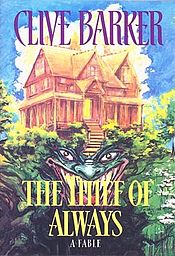 The Thief of Always, by Clive Barker.
A fable of magic, childhood, and the preciousness of time. Written for children, this quick read is also a story for adults, as it recaptures much of what’s fantastic about being a child. There’s danger and wit, even a charmingly chaste love story. And, of course, an unlikely hero who’s every bit magician as he is simple boy.
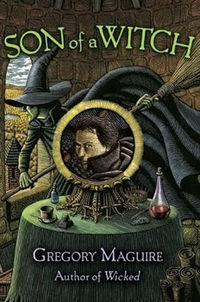 Son of a Witch, by Gregory Maguire.
The sequel to Maguire’s popular retelling of the Oz stories, Wicked. I liked Wicked a lot, but I appreciated the more direct coming-of-age tale central to Son. Full of dragons, intrigue, and romance (of many kinds), Son of a Witch feels more complete, to me. It suffers a bit from being a middle book, but there’s enough about Liir – the main character – to make the world of Oz feel so much more real than it did even in Wicked.
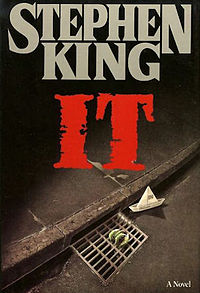 IT, by Stephen King.
There’s something about terror and childhood going hand-in-hand, and King’s IT does so masterfully. Many of us can relate to at least one of the Losers, the children-become-adult protagonists in the book. The main conflict between monster and men (and woman) is terrifying and thrilling…but King’s prose feels strongest when he’s telling the history of the Losers’ lives in rural Maine. I’ve heard the book touted as a great American horror story, but it is, at its core, about characters. And those characters cut, bleed, shine, love, and everything in between.
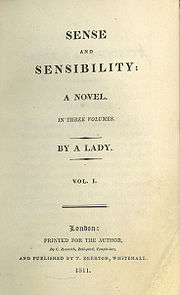 Sense and Sensibility, by Jane Austen.
Like my Sally says, “[That] is one of my favourite stories!” The romantic and dramatic entanglements of the Dashwood sisters are timeless, and their wit and sensitivity are equally biting and tender. Colonel Brandon is one of those great soft-spoken heroes (yes, I call him a hero) you look for in real life. The story is a bit pat for some modern readers, but I’ve always enjoyed its distinctly feminine charms.

The Hitchhiker’s Guide to the Galaxy, by Douglas Adams.
Really, who can’t identify with common-man shlub Arthur Dent, and the (mis-)adventures he has with Ford Prefect, Zaphod Beeblebrox, and Trillian? While the story didn’t start as a novel, Adams’s sometimes-caustic but always-entertaining humor – both in the story proper and the side-notes for the Guide – is one-of-a-kind, and firmly entrenches this book in my list of favorites. The sequels are darn good, too, but this introductory adventure of mice and questions and the destruction of the Earth is a wonderful romp on so many levels. If you haven’t read the Guide, I don’t know what you’re waiting for.
Additional:
“The Unholy Grail,” by Fritz Leiber.
This one is not a book but a novelette, the first story ever written about the sword-and-sorcery anti-hero, the Gray Mouser. Companion Fafhrd doesn’t even show up in this story except as a single line anecdote, but that doesn’t stop this one from being one of my favorite Fafhrd and Gray Mouser stories, ever, mostly for how visceral Mouse’s hatred is for the villain, and how overflowing his love for the villain’s daughter, Ivrian. Fafhrd and the Mouser are notorious womanizers, but, in this short tale, you really get a sense for who Mouse could have been, if he hadn’t succumbed to the allure of dark magic. Ivrian is a great little character, too: frail at the beginning but with a kind of growing strength the more time she spends with her beloved Mouse. Just a great fantasy read, simple in its telling, and I look to this one whenever I think I’m going overboard with the prose.
———
Thanks again to itsjennythewren for the nomination! It was a great excuse for me to comb through my bookshelves, again.
What are your favorite stories?
by Mayumi-H | Oct 31, 2012 | Uncategorized
Wednesdays in this blog’s schedule are reserved for fiction pieces…but National Novel Writing Month is all about writing fiction, so it sort of fits.
To those writers attempting NaNo, whether for the first or fifth time: we’re going to need dedication to the story, support from families and friends, and lots of caffeine, energy drinks, or whatever your wakey-wakey consumption of choice may be.
![Photo by: Andreas Gronski, 2004 [from Wikimedia]](https://mayumi.amorphous.press/wp-content/uploads/sites/4/2012/10/kaffeemaschine.jpg?w=224 "Kaffeemaschine")
The inspiration for HG Wells’ time machine?
And all along the way, we’ll be writing one big pile of crap.
[youtube http://www.youtube.com/watch?v=-JFfN5pKzFU?rel=0&w=420&h=315]
You know what, though? That’s okay. Because all first drafts are crap. (Many second and third drafts are crap, too, but that’s a post for another day.)
NaNo is about helping us see we can meet a deadline, write to (or past) a wordcount, and – in many cases – realize we can, in fact, tell a story. Most likely not a great one by November 30…but one that may just grab us by the shirtsleeves and make us keep going, to dip down into further drafts and deeper edits, and make a better story, one worth sharing with the world.
Or, maybe not. Maybe we’ll be satisfied with what we cranked out in those thirty days, and we’ll be inspired from there to take on another project, knowing now that we can do it. That’s okay, too.
So, let’s grab our pens and get comfortable behind our keyboards. We’ve got writing to do!
Are you participating in NaNo this year? Want to buddy up?
by Mayumi-H | Oct 20, 2012 | Process, Uncategorized
Part of what makes stories so much fun is the drama involved: Will the hero conquer the villain? Will the princess find her true love? Will the puppy make its way home? But, what happens when we find our characters strive more for realism than for drama?
Every story needs some kind of emotional resonance for it to have impact, whether it’s about war or heartbreak or family experience. Sometimes, though, our characters become so much their own people that they end up dictating where their own stories go. I’ve written scenes – necessary ones – for their dramatic effect…but I’ve also had to rewrite other scenes because the characters’ voices had developed so much since my initial plotting that their actions (or reactions) as I’d originally envisioned simply no longer held true to their natures.
What do you do in this situation? Do you let the character take over, possibly sacrificing the drama of the scene? Or, do you follow through with the original idea, possibly sacrificing believability for the character?
It’s okay to play Loosey Goosey in some instances: maybe the hero isn’t in his right mind at the moment and makes a snap judgment against character; maybe the heroine is torn by the conflict facing her and decides on one route over another because her values are confused. Written well, with the associating consequences, those options are totally valid. But, what do you do when your original big conflict becomes significantly less climactic than originally envisioned, because your darned MC has grown up too much over the course of the story?
I’m a big fan of sweeping epics, and last-minute, nerve-wracking climaxes where the audience is led to page after page to see what happens next. But I also believe in, well, believability in a story. The hero shouldn’t overcome the conflict just because the story needs a climax; he should do so because that’s what he has to do, to progress, grow, and change. It may make for less high drama, but it may also make for more realism.
But that’s just my opinion. Which do you prefer: realism or drama?
by Mayumi-H | Sep 21, 2012 | Uncategorized
![By Ardfern (Own work) [CC-BY-SA-3.0 (http://creativecommons.org/licenses/by-sa/3.0) or GFDL (http://www.gnu.org/copyleft/fdl.html)], via Wikimedia Commons](https://mayumi.amorphous.press/wp-content/uploads/sites/4/2012/09/512px-birthday_cake_and_presents_downpatrick_april_2010.jpg "Birthday_cake_and_presents,_Downpatrick,_April_2010")
Taking the weekend off, to celebrate another year of health and happiness with my family.
I’ll be back (probably) on Monday.
Happy writing – and reading – to you all!
by Mayumi-H | Sep 1, 2012 | Uncategorized
Everybody knows how to schedule, right? You don’t? You mean, you sit at your computer and write all your posts “live”? You finish typing and you hit that “Publish” button right away? Well, have I got news for you: Scheduling is your friend.
Scheduling your WordPress posts allows you to coordinate your updates to be published and distributed automatically, at your convenience, without you having to sit there on a sunny Friday afternoon or whatever, just to meet a deadline. You can write up your posts well in advance (you can even keep a stash of posts ready to go), and keep your free time to yourself. Now, who doesn’t want that?
Don’t know how to Schedule? Don’t worry; we’ll go over it in a few very simple steps.
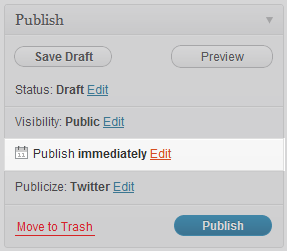
Step 1. Write your post as you normally would – proofread it, make it all nice and pretty, assign it to the right Categories and give it the proper Tags – but don’t hit that nice blue Publish button quite yet. Instead, look where it says “Publish immediately Edit”:
Step 2. Click “Edit.” A box with the current date and time will open up:
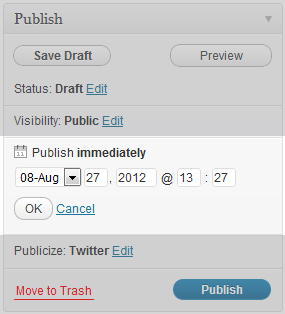
As you can see, the “current” time corresponds to the “Publish immediately” command. If you were to press that “Publish” button right now, your post would be published at the current time (a.k.a., immediately).
But that’s not what we want to do.
Step 3. Change the date and/or time to your preferred Schedule update time. For example, I like to set my posts to publish at 5:00am (my local time, which happens to be Eastern Time, or GMT -4:00), on Mondays, Wednesdays, and Saturdays. For our example, I’ll change this publish Schedule to September 1, 2012, at 5:00 am:
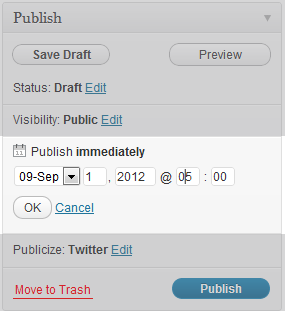
Note: WordPress defaults to 24-hour time (sometimes referred to as “military time”). This won’t affect your scheduling if you want to publish between 1:00am and 12:59pm, but some people aren’t familiar with the 24-hour clock. For a quick reference guide and explanation, check out this simple conversion chart: http://www.mathsisfun.com/time.html
Step 4. Once you’re settled on your Scheduled date and time, click the “OK” button (do not click “Publish”).
Once you click “OK,” you’ll notice that, where the blue button used to say, “Publish”, it now says “Schedule”:
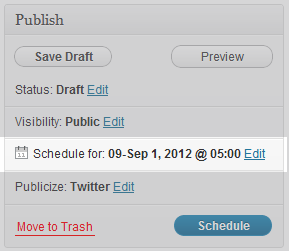
Step 5. Now, you can click “Schedule.” This will move your post from the Draft collection to the Scheduled (or to-be-published) bin.
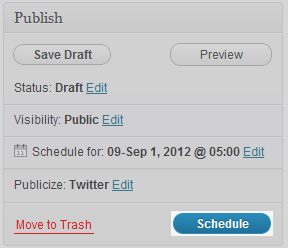
WordPress will take care of the rest: my post is now Scheduled for publishing on 09-Sep 1, 2012 @ 05:00. (Rather, it was published on September 1, 2012, at 5:00am ET. But, since I wrote this in advance, more than a week before its publishing date, I’m talking about it in the future. Timey-wimey, you know.)
[youtube http://www.youtube.com/watch?v=vY_Ry8J_jdw&w=420&h=315]
Hopefully, you’ve found this guide to Scheduling with WordPress helpful. If you weren’t already a master scheduler, consider yourself one, now. 🙂
by Mayumi-H | Aug 11, 2012 | Uncategorized
Linking with WordPress is quite easy…once you know what to do.
If you’re familiar with HTML, you can use the “Text” option in the “Add New Post” window. But, most bloggers are likely just typing in the “Visual” tab. For those of you who don’t want to deal with href tags and the like, just follow these steps to add links to your blog posts. (You can click on any of the following example images to see a larger version in a new tab.)
Step 1: In your New Post window, highlight the text you want to link.
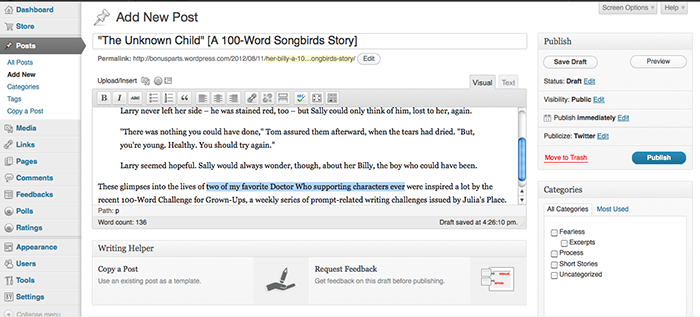
Step 2: Click the link icon in the New Post toolbar.

Clicking the link icon will open up a new dialog box:
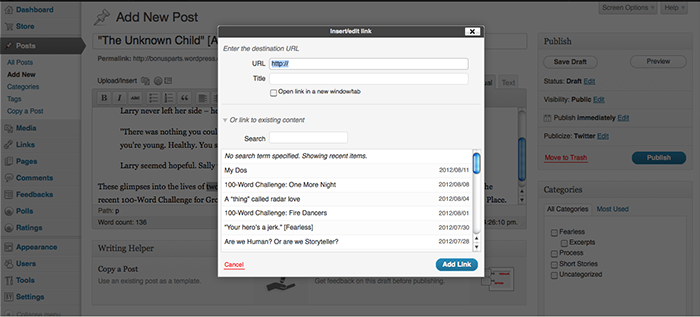
You’ll see that there’s a space to type (or paste) the URL for your link.
Step 3: Insert the URL for your link.
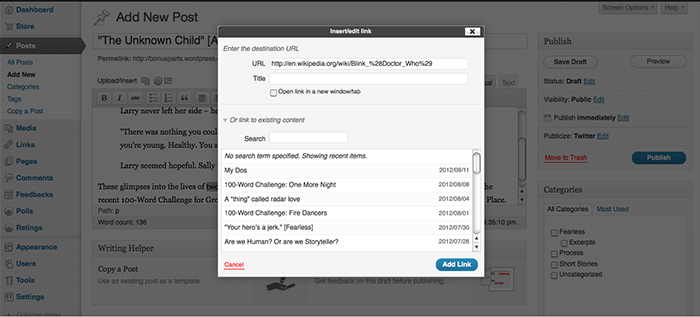
Step 4: (This one is optional.) Click the “Open link in a new window/tab” if you want the new URL to open in a new browser window or tab. (This is the same as using target=”_blank” or target=”new” HTML code.)
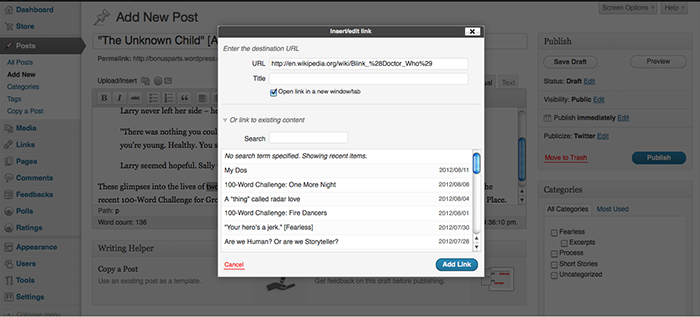
Click “Add Link” – the blue box there at the bottom of the dialog box – to insert the code into your post.
Step 7: Voila! You’ve just made yourself a link! And there it is:
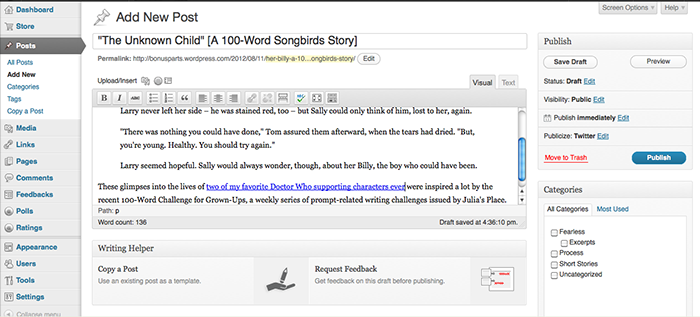
Depending on your Theme and Settings, the visual aesthetic of your link (color, weight) may be different, but the properties remain the same.
Hopefully, this helps you out. If you’d like to see more of these style/code tips, just let me know.
Happy writing!

![Photo by: Andreas Gronski, 2004 [from Wikimedia]](http://mayumi.amorphous.press/wp-content/uploads/sites/4/2012/10/kaffeemaschine.jpg "Kaffeemaschine")
![By Ardfern (Own work) [CC-BY-SA-3.0 (http://creativecommons.org/licenses/by-sa/3.0) or GFDL (http://www.gnu.org/copyleft/fdl.html)], via Wikimedia Commons](http://mayumi.amorphous.press/wp-content/uploads/sites/4/2012/09/512px-birthday_cake_and_presents_downpatrick_april_2010.jpg "Birthday_cake_and_presents,_Downpatrick,_April_2010")
Recent Comments