by Mayumi-H | Jun 5, 2013 | Uncategorized
A few weeks ago, I helped produce the broadcast and webcast of our university’s commencement ceremonies. Our speaker this year was Vice President Joseph Biden, which made for an…interesting production day, to say the least. Just feeling the motorcade approach was rather exciting. Yes, I said “feel” – the rumble of cycle and car motors was like a small earthquake!
[youtube http://www.youtube.com/watch?v=q5LaYKUJ_w8?rel=0&w=640&h=360]
I won’t go into Vice President Biden’s speech, which you can listen to yourself, if you’re so inclined. He was very self-effacing and easygoing, though his security was something of a different story.
Usually, we don’t have to deal with magnetometers when we set up at the production control truck. This year, though, we were warned that safety measures would be similar to an airport security queue.
For those of you who have not traveled through an airport recently, they scan everything, from electronic devices like phones and laptops, to the change in your pockets, to your shoes. I fly fairly regularly – three or four roundtrips per year, on average – so I know what these security queues are like. That said, I don’t know why I didn’t check my work backpack before I left the house that morning. Maybe because I had to get up at four a.m. to be at the truck by six, or maybe because I hadn’t had the opportunity to get in my morning workout routine, or maybe because I didn’t have any peanut butter with my toast. Whatever the reason, I slung my pack over my shoulder and headed to the production field, without giving what was in my bag a second thought.
Until I got into that security queue.
The walkthrough metal detector was for people only. Each backpack, handbag, laptop case, and purse had to go through a manual search. And they didn’t just search. They pulled out everything. Now, Mom always told me to be prepared. So, I make certain to keep preparedness supplies in my bag at all times:
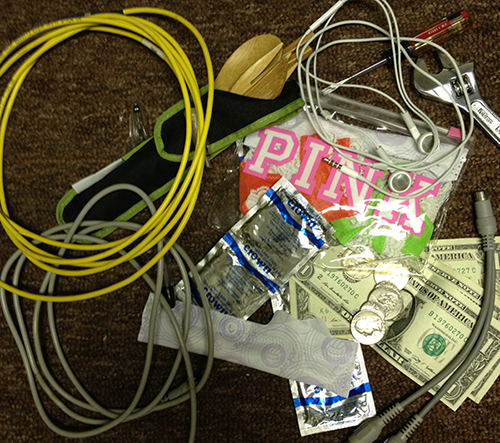
The crap I carry around in my backpack on any given day.
I think it was the string of condoms – or maybe the packet of spare underpants – that made the security guy look at me a little funny. What else could I say, but, “It’s going to be an exciting day.” I suppose I should consider myself lucky he just snickered, put everything back in my pack, and let me on my way.
This has nothing to do with writing. Except, perhaps, to say, always be prepared, for whatever might come at you. And, always be willing to laugh at yourself a little.
by Mayumi-H | Apr 24, 2013 | Uncategorized
Before I get into this post, I need to take a second to apologize to those bloggers whom I follow. I’ve got a backlog of your updates sitting in my inbox, pestering for my attention, but I want to be able to approach your shared words with a clear headspace, and I haven’t had that, in recent days. I promise, I’m getting there, but it may take me a few extra days, yet.
Anyway….
I try to keep this blog to talking about my writing, as that’s been its purpose since its inception. But, sometimes, life intrudes into my work in confounding ways.
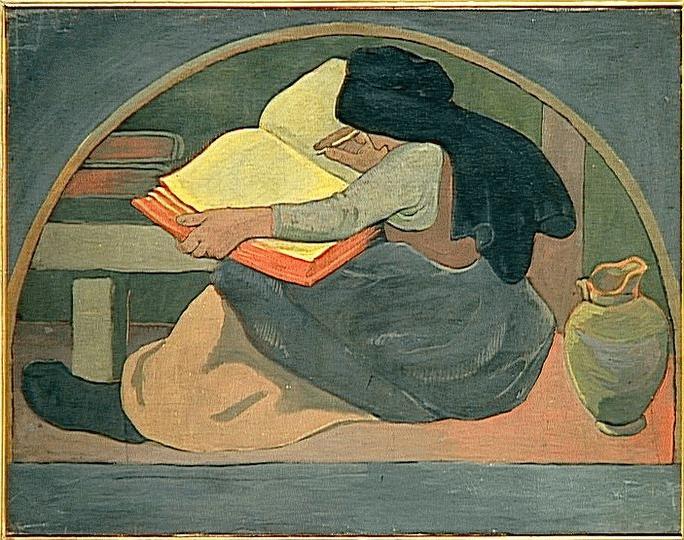
“La Grammaire” (1892) Paul Sérusier [Public domain], via Wikimedia Commons
I don’t hold many feelings of nostalgia for the place itself, perhaps because I haven’t lived “at home” since I went away to university. But, the people still hold significance to me. Understandably so, as they’re my closest relatives. I visit perhaps once or twice a year, and that’s been enough for me, in the past. But, lately, I’ve really come to notice and realize how…well…old my parents are getting.
My mother and father were not typically young parents. My husband’s parents, for example, were married at not much past twenty, and had him when they were still in college. My parents were in their thirties when they had my sister and me. In the pre-Millennial generations, that was old.
Deep down, I’ve always had a concept of mortality. But, faced specifically with my parents‘ mortality has been scary. Especially when discussing wills, deeds, insurance financials, and what happens if one of them “goes” before the other.
Over this last visit, both my mother and father approached the subject rationally with me, and I tried to do the same. Maybe it’s a kind of emotional denial on my part, but I kept thinking, “How would [character X] deal with this situation?” It’s timely and fitting, right now, as I do have a story where this subject – that of a parent’s death – is an integral plot point. It doesn’t really make the issue any easier, though. It just gives me a safe sense of distance.

“Death of Barbara Radziwiłł (detail)” by Józef Simmler [Public domain], via Wikimedia Commons
I’ve written about death in my stories before. I don’t like treating it lightly, because even the most insignificant of deaths – relatively speaking, that is – has an impact on somebody, in fiction just as in real life.
Hmm. Reading over that last sentence just now, I can’t help but think I’m still a bit in denial about the whole process.
Part of the scariness of the prospect is that I’ve always been close to my parents, even though I’ve lived far away. I may not speak to them every week, but I certainly think of them that often, or more. To consider life without them is unsettling. Realistic, and likely unavoidable, but discomfiting nonetheless. Without them, I’d be an orphan.
That sounds silly for an adult woman. The word “orphan” has a connotation of a sooty-faced, Victorian-era street urchin, or a child sitting alone by a window, waiting for a nice couple to come along to adopt them. But, it’s true. Not that I’d be alone if my parents passed away. I have a family of my own, and a sister, cousins, aunts and uncles…. They’re not the same, though.
I’ve always known one of the principle building blocks of good fiction is conflict. It creates tension, builds character. I strive for realistic conflict in my stories. In my life, though? I could do with a little bit less of the stuff.
I’ll try to return this blog to its regularly scheduled programming by next update. Til then, bear with me, okay?
by Mayumi-H | Apr 3, 2013 | Persona 4 Fan Fiction, Uncategorized
I’m a terrible blogger.
In the last several months, I’ve been nominated for some very sweet awards, and it’s taken me forever to post them! Here they are:




I was nominated for these awards by:
- JM McDowell (Dragon’s Loyalty Award), who runs http://jmmcdowell.com/, a blog filled with good humor, advice, and original stories about her archaeologist mystery-cracker, Meghan Bode;
- Jenny the Wren (Liebster Award), who writes up all kinds of different musings, reviews, and personal stories of life and new-mommyhood over at http://itsjennythewren.wordpress.com/;
- Subhan Zein (Versatile Blogger and Tell Me About Yourself Awards), the talented and soulful writer of short stories, poetic observations, and freedom from the mundane at http://subhanzein.wordpress.com/;
- Summer (Wonderful Readership Award), whose inner peace and graciousness always shine through on her blog, http://summer4soul.wordpress.com/.
Some of these awards come with rules for posting: nominate so many bloggers, tell so many facts about yourself, don’t stop the giving chain. Normally, I’m one to adhere to rules. But, for the purpose of blogging awards, I usually let those rules go.

“The rules are, there ain’t no rules!”
But, for those of you interested, some “facts” about me:
- I like saying I’m an artist, but, really, I’m a jock. I have to exercise every day, or I don’t feel like myself. At school, I competed in Track and Field; the 100-meter dash was my main event, and I anchored our team for the 400-meter relay. I love swimming, and surfing is a relatively new passion. Aside from the sprints, I’m not a great runner, though I often find it centers me. When I’m feeling troubled, there’s not much that can’t be cured by a good, sweaty run!
- I’m Miss Middle-of-the-Road. Maybe it comes from being a Libra, but I’ve always had to look at both sides of a situation. Sometimes, that’s helpful, like when I have to mediate an argument between family or friends. Other times, not so much, as it can cause me to vacillate too long, and opportunities can pass me by!
- I’m not the brightest bulb…but I’m not the dimmest, either. Sports are, by their very nature, competitive, and that competitiveness found its way into other parts of my life. I was always comparing myself to other people: their strengths, their successes, the accolades and adulation. But, for every winner, there has to be a loser. It took a long time for me to understand that losing gracefully can be just as worthwhile as winning graciously. A good thing, since winning is so rare!
- I play favorites. Not among my family (my sister), or for my girls (the older one), but with my characters. Whoever is foremost in my story-writing brain naturally gets privileged child status, of course, but I’ll always have my perennial favorites, too, especially in my fan works.
- Speaking of fan works, there’s nothing wrong with writing what you want, whatever that may be. Fan fiction, open poetry, stream of consciousness diary, historical biography, children’s, drama, sci-fi, horror, terror, thriller, romance, research, religion, comics, smut, slice of life, short fiction, long fiction – it’s all good. Certainly, some of those genres relate more easily to publishing, but always write first for your own passion.
- Lastly, I can only be myself, just like you can only be yourself. Every person has their own conflicts, their own burdens, their own triumphs. The world is a big place; we only ever see a sliver of it. But, just because we don’t see it, doesn’t mean it isn’t there. So, be excellent to each other.
[youtube http://www.youtube.com/watch?v=J7532GXPnO8]
Would you like to pick up one of the above awards? Please, feel free to grab the icon!
If you’re looking for some great bloggers to follow, I advocate the talented ladies and gent above – JM McDowell, Jenny the Wren, Subhan Zein, and Summer – as well as some other blogs and bloggers I always make certain to keep up with:
Many thanks go out to everyone who’s ever followed, liked, or commented on my words and musings.
Happy blogging, everyone!
by Mayumi-H | Feb 27, 2013 | Process, Uncategorized
One of the great aspects of sharing our work on the Internet is the tremendous community of people available to see it. Many of these folks can provide valuable feedback, insight, and advice, and they do it for free.
But, just because something comes free doesn’t always make it good. Good critique comes with a price. Often, it’s a monetary price. Make no mistake: that monetary price is worth it, if you’re genuinely interested in getting sharp, honest critique of your work, especially with an eye toward eventual publishing. Not all of us are looking for that, though. Some of us just want to get some more in-depth feedback than, “This is great!” or, “Post more soon!”
For those of you just getting into the tricky business of giving free feedback, here are a few (hopefully helpful) tips.
El editor enmascarado! (public domain image)
- Check your ego at the door.
Whether critiquing someone else’s work or having your work critiqued by another, you must swallow your pride.
For the critic, ego-checking should be pretty easy to do. You’ve been asked to do a job, and your goal should be to complete it to the best of your ability. However, try to rein in any impulses to create a mini-You. Each artist has his own style and story, and trying to rewrite that to fit your own won’t help him become a better craftsman.
For the artist, ego-checking can be slightly more difficult, as our stories often feel like part of us. We’ve invested time, effort, sweat, and tears in them, and to hand them over to another person may induce fear and anxiety. But, whomever we trust with critique, we should listen with open ears to their feedback.
Read that last sentence again. Feedback. Listen. Trust. These are not given – or received – easily, which is why you should also remember point number 2…
- Critique unto others as you would like to be critiqued.
If the critique is genuine, there’s no reason to fear the red pen. Any artist who asks for your help will want you to point out what works and what doesn’t. Because learning where we make mistakes should make us more aware of them in the future, and help us hone our craft.
That being said, remember this is a person who has asked for your help. By nature, people are fragile things, artists often more times so.
When you strike with your red pen, do so honestly. But, be helpful, too. If it’s an error you’re marking, illustrate a corrected example. Issues with the plot, characterization, or pacing? Define them for the artist: let him know where you thought the story slowed down and how he might compensate for that. Tell her why you found the plot meandering and what she might consider changing to pick up the pace. If you don’t like a character but you’re supposed to do, tell the author what traits or scenes counteracted their intentions.
The Golden Rule applies to all interactions, though. Work your red pen as you’d want others to do to you. We all come from different walks of life, and we’ve all got different styles. Which brings me to point number 3…
- Assume nothing.
There’s an old saying that goes, When you assume, you make an “ass” out of “u” and “me”.
Avoid assuming anything before you go into a situation or story. Your artist probably comes from a different background from you, so her story will be different from any perceptions you may have at the outset. Which is why you should try to keep those perceptions under control.
Certain aspects of storytelling will hold true unilaterally, across the board: solid plot, good characterization, proper grammar and formatting. Beyond that, though, you need to let an artist find her own way.
Now, an author should do their own research into the subject about which they’re writing, at least to the point of it being reasonable. I wouldn’t expect someone to get a degree in astrophysics just to write a few lines of dialogue, after all. If something doesn’t seem right, mention it. But keep in mind the geographical, societal, even temporal boundaries of the author’s story. Coffee may be the most popular drink where you are, but if in the story it’s tea, then it’s tea. Live with it. If, on the other hand, the author mentions how Kansas is in South America, you need to correct that. An author looking for guidance will thank you for your attention…or, he’ll have an opportunity to explain his choice. Either way, you’re doing your job as a critic.
So far, I’ve been blessed to have readers who have been equally honest, straightforward, and supportive with their critique when I’ve asked for it. I hope you’ll be so blessed, too, either on the sharp end of the pen or not.
What are your tips for critiquing others’ work? Or, for having your own work ready for critique?
by Mayumi-H | Jan 12, 2013 | Fearless, Uncategorized
In the year I’ve had this little blog space, I’ve tried to keep to an update schedule of three times per week: I reserved Mondays for talking about and posting some pages from the Fearless novel, I kept Wednesdays for creative writing prompts (usually 100-Word Challenges for Grown-Ups or Five Sentence Fictions), and on Saturdays, I’ve been posting about my writing process in general. In going over my annual statistics report, though (and looking at the hits and comments I get), I’m wondering if three regular topics is too many.

The (overwhelming?) power of 3
I don’t always have time for them they don’t always interest me. I like giving readers insight into Fearless (which I’ve taken to calling my beautiful mess), but I often use it as an example for my Saturday process posts…and, most readers around here have their own stories they want to tell, so I’m thinking my posting parts of the novel on Mondays is just plain old boring for them. Plus, many of us have made new year resolutions to buckle down with our own writing this year (I know I’ve done), so maybe three times a week is simply too much to take in.
In light of these considerations, I’ve decided to try updates twice a week, instead of three times per week (at least for the next six months). Since my photo/art blog already posts on Mondays, starting this week, Process posts (about writing and the current work in progress/WIP) will occur on Wednesdays, and writing prompt responses/original short fiction posts will occur on Saturdays.
Hopefully, this will help me write better posts, read/comment on more of your posts, and let me concentrate a bit more on my storytelling.
[polldaddy poll=6823403]
What schedule do you keep for your blogging? Do you keep a schedule? How many updates do you consider not enough, too many, or just right?
by Mayumi-H | Dec 29, 2012 | Uncategorized
I’ve kept blogs for a few years, now, but this marks the first year I’ve been with WordPress. I have to say, it’s been the most rewarding blogging experience I’ve had, yet. Not that Blogger didn’t make me feel welcome, but it didn’t exactly allow for the free and lush exchange of ideas that WP has done.
A year into starting this writing blog, I’ve accumulated a bit over 4200 hits, 81 followers, and 886 comments (though about half of those are my replies). There are many professionals who likely say I should thus consider this a failure, because my hits and followers haven’t grown exponentially over the time I’ve been posting. My blog doesn’t do or say or inform about anything unique, aside from it being uniquely my own.
But, it’s been a place where I’ve stretched my writing boundaries with the 100-word and five sentence fiction challenges, and the annual rush of yet another NaNoWriMo. I found a welcoming audience for not just my fan fiction stories, but my original ones, as well. It’s also been the place where I’ve gotten to know so many new, wonderful writer friends for the first time, and gotten to know a few old mates a bit better. And, it’s been the place where I’ve laughed and been driven to deeper thought, where I’ve learned about others and myself equally as much.
So, I think I’ll keep doing this little experiment. I might not be the most popular blog around here, but then, I’ve never been the most popular anywhere. And I might not be the most talented, but I’ve never been ashamed to share a stage with folks of greater talent.
Here’s to another year full of new faces, new places, and new ideas. I hope you’ll join me.


.jpg)


Recent Comments