by Mayumi-H | Jun 4, 2012 | Fearless, Persona 4 Fan Fiction, Process
I read somewhere that it can be helpful to take a step back and just look at your work. Not from an artistic perspective or a storytelling or an editing one, but from a visual one. The idea is that, if every page looks the same (whether it’s big blocks of text or lots of lines of dialogue), you may need to switch up your storytelling style a bit. It’s just another subtle way of keeping your readers’ attention, I guess.
So, on a recent revision of my manuscript, that’s what I did. I took a step back, and looked at the first page and a half of a chapter.
I have to point out, here, that the reason I did this was because I was leery about starting another chapter with a lot of textual explanation, as I’d done the last chapter. Anyway, here’s what the initial draft looked like:
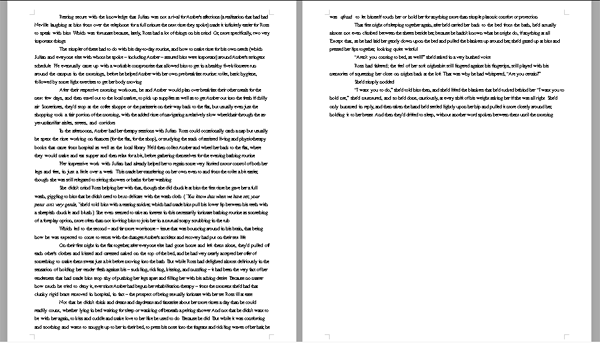
The original start to Chapter 15.
Whoa. What a wall of text. It’s necessary text, though. There’s a fair amount of explanation that happens, to set up the minor conflict of this chapter. But there’s already a lot of description and setup that happens in the surrounding chapters, and I didn’t want to subject the reader to having to read these huge intros every time.
So, here’s the second draft:
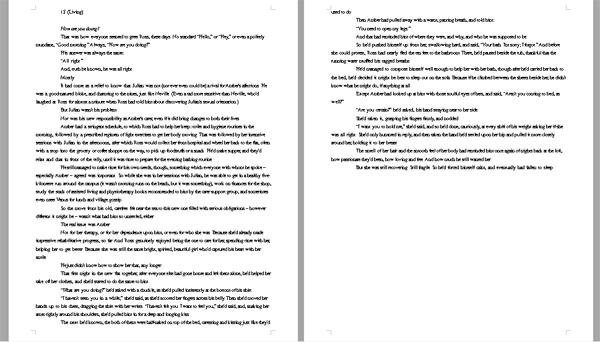
The revised Chapter 15 start. Looks nicer, yes?
All I did differently was break up the blocks of description and explanation with some more personal insight from my main character, answering questions from other people. The same information is offered, but it’s broken up into what I consider more manageable pieces.
And, doesn’t it look a little nicer to read, too?
I’m not afraid to read lush description, but sometimes you just need to change it up, for sake of your reader’s eyes. What about you? Would that wall of text have scared you off? Do you find it helpful to look at your stories in a visual way?
by Mayumi-H | Jun 2, 2012 | Process
My sister runs an online RPG (role-playing game). One of her players writes his group interactions – including combat – with a wall of text: probably about thirty different actions in one response.
This isn’t how you run a game in person, let alone one played over the Internet, where everyone has to read everything.
When I played these games (usually around a table with a half-dozen similar geeks), we were told that our “actions” – what we did in the game, usually as a reaction to a stimulus (such as a club being swung at our heads) – would be about ten seconds. If it takes you longer than ten seconds to describe what you’re doing, that’s too long, and it requires more than one action. (And we’d get smacked by our Game Master for such a transgression. This is likely why my default answer for most conflicts was, “Uh…I fire another arrow, I guess.”)
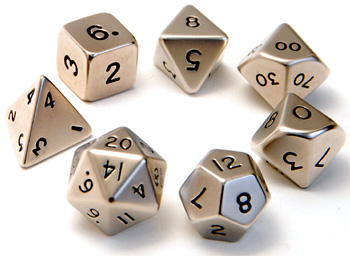
Rolling the dice for a fight
This short-but-sweet technique can help with writing, too, especially when it comes to fights.
My first “real” fight scene – a thankfully brief tussle between a spearman and a cavalryman – read like Kirk fighting the Gorn captain. I described everything in detail, which slowed everything down. Then I remembered the 10-second rule. Any action in a fight scene should be able to be read in at most the same amount of time it would take to perform such an action. Time to read description =< action itself.
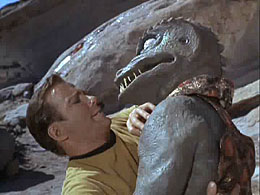
Rrg. Arg.
Kirk “fights” the Gorn in the episode “Arena”
Of course, you can vary it a bit, depending on the situation. I wrote one fight scene that was supposed to be very balletic, so I described a lot of it. I thought that was warranted (even if maybe it wasn’t; that’s my story, and I’m sticking to it). But most of my fight scenes, I prefer to keep short. Hack, slash, fall, run. I’ve also found that writing fight scenes with a quicker tempo works better for creating tension.
If a sensei and a gakusei (teacher and student) are having a sparring match, they might be talking and explaining during the moves. A slower, more descriptive block of text might be warranted. But in a life-or-death situation, the curses, punches, and kicks should be flying. One of the best ways I’ve found to keeping this excitement up is not to dwell on any one action for more than ten seconds. Really, more than two seconds is probably too long. But I’ll grant ten seconds, to start.
[youtube http://www.youtube.com/watch?v=rcoVryJmCX0?rel=0&w=560&h=315]
This isn’t homework, necessarily, but take a look at the video above, from the excellent Fist of Legend. Now, decide how you’d write it. (I can tell you how I wrote it…but that would be cheating.) Remember that stylish action should be quick and to the point. You can drop some elaborate moves in there once in a while, but a fight scene is not a dinner party; don’t waste your reader’s time with a lot of unnecessary detail.
So, what’s your technique for writing fight and battle scenes?
by Mayumi-H | May 30, 2012 | Excerpts, Fearless, Process
What is it about us writers, that we put our beloved characters through an emotional wringer?
Ross has his share of lucky, happy moments, but he’s got to deal with a lot of heavy seriousness, too. Here’s an excerpt from (the recently-rewritten) Chapter 11, that always touches me a little:
Ross walked into her room, to find Amber still asleep, just as Sam had said. Still propped up by the thick, confining torso brace moulded around her, to keep her back in position. Still hooked up to those tubes and monitors he hated. And yet, despite all of that, still so lovely, like the faery tale sleeping beauty whose story she’d once told him was her favourite.
He blinked; the thought was ridiculous. But that didn’t stop him from bending close, to press a kiss to the ridge of her cool brow, his heart pattering with anxious hope.
She didn’t wake.
Not that he’d really thought she would, because that would have been mad. But it brought a low smile to his lips anyway, and he kissed her again, leaving her with a promise for tomorrow.
I’ve always enjoyed writing parallels in my stories. In my last big story, one of my favorite moments was a retelling of the Orihime/Hikoboshi myth, as it related to my two protagonists. For this story, there’s a throwback to Brier-Rose, or Sleeping Beauty.
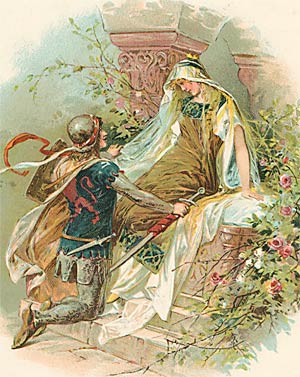
I think faery tales and folklore are a charming way to draw parallels to situations in modern tales. Do you use classical stories references in your own work? How? Why?
by Mayumi-H | May 26, 2012 | Process
For four solid years at university (okay, three-and-a-half; I had a lot of Advanced Placement credits), I studied the art of understanding and writing the English language. I love reading, and I love writing. And I take a lot of pride in my knowledge of both.
But is that a good thing?
English major; writer; theatre tech: You name it, I nerded it.
(Panda necklace available from http://www.etsy.com/shop/panduhmonium)
I’ve read publishers and professionals who say that a good editor will take care of any grammar or punctuation issues you may have, and that you – the storyteller – should concentrate on all of the things that will make your story sell: plot, characters, conflict, dynamics. That’s great to hear, especially for those writers who have more skill with story than they do with pesky matters like proper capitalization and use of commas or quotation marks.
But I’m the type of person who lives and breathes that stuff. Before I send any manuscript off to a beta reader or an editor, I want it to already look its best. I want to be proud of it. If I send off a manuscript that is half-assed in its grammar or spelling, that’s going to make me look like an idiot to my editor. At least, I think so.

Idiot: when Captain Picard can’t even look at you.
I know that any editor is going to return my manuscript with lots of notes and corrections; I’m preparing myself for an ocean of red mark-ups. But I think I’m doing that poor person a favor by at least making the manuscript as clean as it can be, the first time around.
For all of you experienced writers out there: Am I worrying too much about the rules of my language? Should I leave all of that to the beta readers and editors? Or am I right to be muscling up on my words and punctuation as well as my plots and characters?
by Mayumi-H | May 26, 2012 | Process
I’m a fan of DVD extra features, but this one kind of blew my mind.
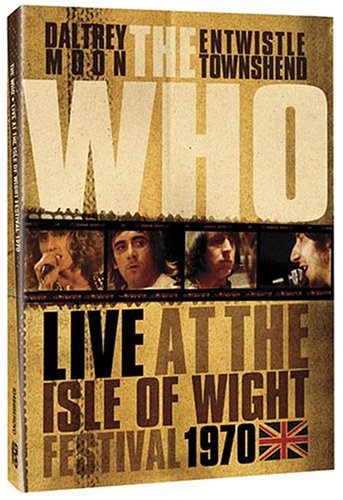
Come for the music. Stay for the insight.
I’ve always enjoyed the music and songs of The Who, and that has a lot to do with Pete Townshend’s storytelling. Yes, that’s right: the lyricist as a storyteller, just like a novelist or poet (or any of the fancy-schmancy names we dream up for ourselves as people who just want to tell stories).
Watch the Isle of Wight Festival concert footage, because it’s amazing to see an honest-to-God rock band in their prime kicking out hit after hit for the better part of 100 minutes. But then click on over to the Special Features, and watch the interview with Townshend. About 2/3 of the way through, he describes the difference between an Artist and a Craftsperson.
The Artist, he says, tells a story from inside, a story made for the Artist, first. The Craftsperson, on the other hand, tells a story to meet demand, a story made for selling. He likens a Craftsperson to a Hollywood screenwriter, who can churn out blockbuster hits, what audiences and studios want. An Artist, meanwhile, can’t do that; an Artist is too engaged with his own story to let it be compromised by anyone else.
There is nothing wrong with being either an Artist or a Craftsperson, in my opinion. (Townshend seems to agree; he says with some admiration about the Hollywood blockbuster writer, “I don’t know how they do it.”) And, I think that a storyteller can be both, at the same time. But one side will have dominance over the other.
I don’t know whether I can call myself an Artist. I definitely prefer to tell stories that are personal to me, though. And I admire real Craftspeople, who can sacrifice parts of their stories to give them more mass appeal, to succeed with a wider audience. I think that’s necessary, if a storyteller wants to be monetarily successful. But there’s a part of me that considers it a Faustian bargain, too: What part of my soul will I have to give up, to give my stories the success I think they deserve?

“Just sign on the line, Miss….”
Not having reached that point of decision-making, yet, I can’t say for certain my answer.
I’m willing to edit my stories, if I think they’re worthy of the effort (some aren’t). But I don’t know if I could, say, change an ending to make the story more widely accessible, or change a character’s sexual orientation to appeal to a different audience. I think I’d rather just print up the story on my printer, in that case, make myself a personal cover, and call it a day.
What do you think? Are you an Artist or a Craftsperson? Both, or neither?
by Mayumi-H | May 21, 2012 | Excerpts, Fearless, Process
I came across this writing meme a while ago, but only recently did it come back to me.
The rules are:
Go to page 7 or 77 in your work-in-progress.
Go to line 7.
Copy the next 7 lines (or 7 sentences), and paste them into your blog. (No cheating!)
Tag 7 authors to do the same.
Now, I don’t particularly care to get tagged in these things, so I didn’t do the last step. But I did like this idea, especially since the way this worked out, it highlights a piece of the story and character/romantic development that comes back into play later in the story (and which I recently felt the need to rewrite).
So, here’s my 7 lines from page 77:
But Amber just stepped over to him and lifted the book from his hands.
“That’s all right,” she said, as she sat down beside him. She flipped open to what seemed a random page, but the way she touched her fingers to the picture of a pretty princess laid out upon a bed of spiralling thorns told him differently.
“This one’s my favourite,” she said. “Brier-Rose.” She looked up from the pages and faced him with a tiny smile. “Sleeping Beauty.”
He smiled back, easing close to her on one arm. “You are quite the romantic,” he said.
She shrugged. “Faery tales are simple. The villain is always defeated; the hero always wins. The princess always finds true love.” She paused, her gaze falling once more to the half-coloured illustration beneath her fingertips. “And the father never forgets his children.”

Prince Florimund finds the Sleeping Beauty [Public domain image via Project Gutenberg]
Ross is right: Amber’s an incurable romantic. But I really like the way that she’s telling him a lot, here, even though she’s not spelling things out for him. That’s the way I like to tell stories, too: letting the reader decide how dialogue, action, or interactions can be interpreted beyond a surface level.
This excerpt happens all the way back in Chapter 5 (which feels like a lifetime of writing ago, though really just November 2011)…but it has repercussions throughout the rest of the story.
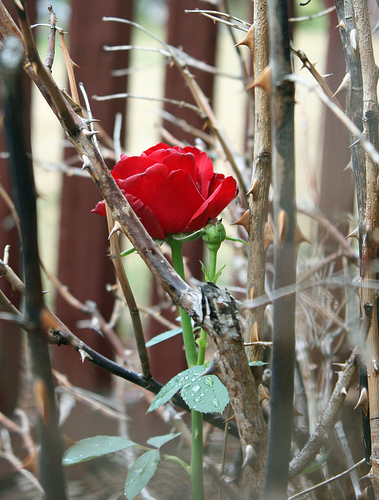
If you decide to participate in the Lucky 7 Writing Meme, let me know in the comments. I’ll happily link over to you!



Recent Comments