by Mayumi-H | Jun 4, 2012 | Fearless, Persona 4 Fan Fiction, Process
I read somewhere that it can be helpful to take a step back and just look at your work. Not from an artistic perspective or a storytelling or an editing one, but from a visual one. The idea is that, if every page looks the same (whether it’s big blocks of text or lots of lines of dialogue), you may need to switch up your storytelling style a bit. It’s just another subtle way of keeping your readers’ attention, I guess.
So, on a recent revision of my manuscript, that’s what I did. I took a step back, and looked at the first page and a half of a chapter.
I have to point out, here, that the reason I did this was because I was leery about starting another chapter with a lot of textual explanation, as I’d done the last chapter. Anyway, here’s what the initial draft looked like:
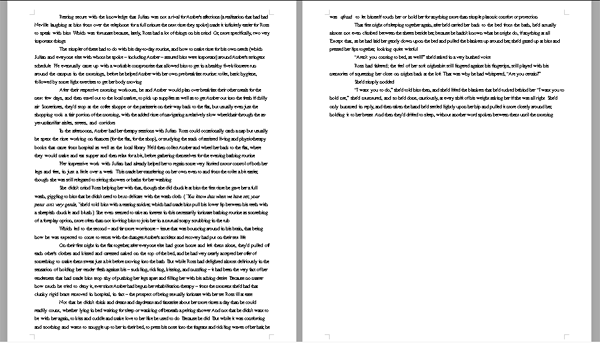
The original start to Chapter 15.
Whoa. What a wall of text. It’s necessary text, though. There’s a fair amount of explanation that happens, to set up the minor conflict of this chapter. But there’s already a lot of description and setup that happens in the surrounding chapters, and I didn’t want to subject the reader to having to read these huge intros every time.
So, here’s the second draft:
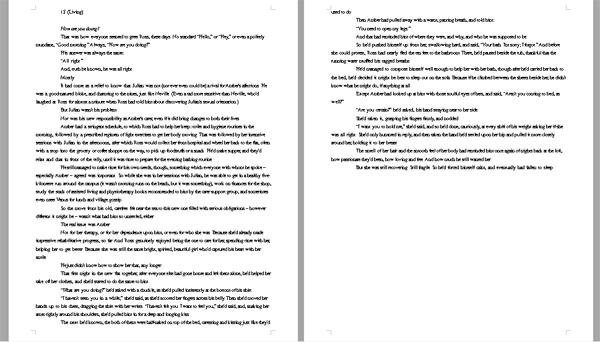
The revised Chapter 15 start. Looks nicer, yes?
All I did differently was break up the blocks of description and explanation with some more personal insight from my main character, answering questions from other people. The same information is offered, but it’s broken up into what I consider more manageable pieces.
And, doesn’t it look a little nicer to read, too?
I’m not afraid to read lush description, but sometimes you just need to change it up, for sake of your reader’s eyes. What about you? Would that wall of text have scared you off? Do you find it helpful to look at your stories in a visual way?
by Mayumi-H | May 30, 2012 | Excerpts, Fearless, Process
What is it about us writers, that we put our beloved characters through an emotional wringer?
Ross has his share of lucky, happy moments, but he’s got to deal with a lot of heavy seriousness, too. Here’s an excerpt from (the recently-rewritten) Chapter 11, that always touches me a little:
Ross walked into her room, to find Amber still asleep, just as Sam had said. Still propped up by the thick, confining torso brace moulded around her, to keep her back in position. Still hooked up to those tubes and monitors he hated. And yet, despite all of that, still so lovely, like the faery tale sleeping beauty whose story she’d once told him was her favourite.
He blinked; the thought was ridiculous. But that didn’t stop him from bending close, to press a kiss to the ridge of her cool brow, his heart pattering with anxious hope.
She didn’t wake.
Not that he’d really thought she would, because that would have been mad. But it brought a low smile to his lips anyway, and he kissed her again, leaving her with a promise for tomorrow.
I’ve always enjoyed writing parallels in my stories. In my last big story, one of my favorite moments was a retelling of the Orihime/Hikoboshi myth, as it related to my two protagonists. For this story, there’s a throwback to Brier-Rose, or Sleeping Beauty.
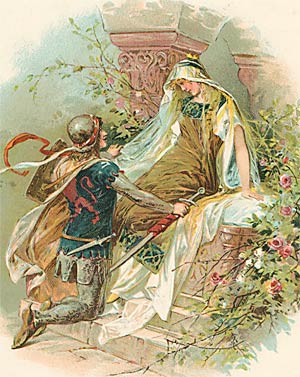
I think faery tales and folklore are a charming way to draw parallels to situations in modern tales. Do you use classical stories references in your own work? How? Why?
by Mayumi-H | May 21, 2012 | Excerpts, Fearless, Process
I came across this writing meme a while ago, but only recently did it come back to me.
The rules are:
Go to page 7 or 77 in your work-in-progress.
Go to line 7.
Copy the next 7 lines (or 7 sentences), and paste them into your blog. (No cheating!)
Tag 7 authors to do the same.
Now, I don’t particularly care to get tagged in these things, so I didn’t do the last step. But I did like this idea, especially since the way this worked out, it highlights a piece of the story and character/romantic development that comes back into play later in the story (and which I recently felt the need to rewrite).
So, here’s my 7 lines from page 77:
But Amber just stepped over to him and lifted the book from his hands.
“That’s all right,” she said, as she sat down beside him. She flipped open to what seemed a random page, but the way she touched her fingers to the picture of a pretty princess laid out upon a bed of spiralling thorns told him differently.
“This one’s my favourite,” she said. “Brier-Rose.” She looked up from the pages and faced him with a tiny smile. “Sleeping Beauty.”
He smiled back, easing close to her on one arm. “You are quite the romantic,” he said.
She shrugged. “Faery tales are simple. The villain is always defeated; the hero always wins. The princess always finds true love.” She paused, her gaze falling once more to the half-coloured illustration beneath her fingertips. “And the father never forgets his children.”

Prince Florimund finds the Sleeping Beauty [Public domain image via Project Gutenberg]
Ross is right: Amber’s an incurable romantic. But I really like the way that she’s telling him a lot, here, even though she’s not spelling things out for him. That’s the way I like to tell stories, too: letting the reader decide how dialogue, action, or interactions can be interpreted beyond a surface level.
This excerpt happens all the way back in Chapter 5 (which feels like a lifetime of writing ago, though really just November 2011)…but it has repercussions throughout the rest of the story.
If you decide to participate in the Lucky 7 Writing Meme, let me know in the comments. I’ll happily link over to you!
by Mayumi-H | May 14, 2012 | Fearless, From Hell (A Love Story), Process
It’s my belief that any story is, at its core, about relationships. Relationships between people or groups of people, usually: families, friends, lovers, enemies, warring countries/planets/galaxies, spies trying to outdo each other, whatever. A story about a boy and his dog making their way through the post-apocalyptic countryside is about a relationship. Or a story about a female fighter pilot and the only thing in the world she trusts – her plane – is about a relationship. Even a story about the last surviving scientist looking for a cure to a world-spread disease is about a relationship.

Perhaps the greatest unconsummated love affair of them all?
Now, my stories tend to examine relationships on a smaller scale, usually between two people, along with a supporting cast of eccentrics around them. Love stories. But it’s never just a love story. I like some kind of conflict (often external) that will rear its ugly head, and which my characters need to face together to overcome. Or die trying in the process.
My question, though, is – when you have an external conflict that the lovers must face – how much time can you spend building the relationship, first?
I like building relationships, myself, but in this age of short attention spans, if a storyteller spends a lot of time forging that alliance between the characters, will the reader get bored before the big ol’ conflict hits? What’s a reasonable amount of time to spend getting a couple together? What if I’m telling this story all wrong?!

(image by Michelle Burnette)
Have you ever read a story and thought, “They would never get together that quickly!” Or, conversely, “Why is this truce taking so long?” What are your thoughts about this topic? I’d love to know!
by Mayumi-H | May 13, 2012 | Fearless, Short Stories
Not prompted by any challenge, but I wanted to write something in honor of Mother’s Day over here.
Her Motherly Reason
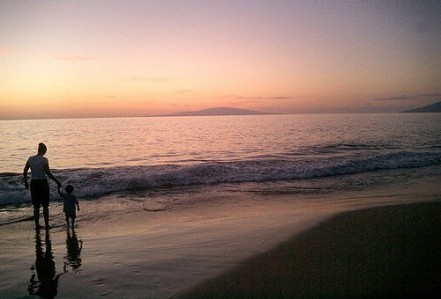
Maggie stared at the clock. Six sixteen, three hours since the shot had sounded, calling Jim away. She knew it was selfish (the crew needed their coxswain), but today was Mother’s Day!
She sighed. Mother’s Day without her husband. Rubbish.
The door creaked; she sat up. “Jimmy?”
“…Mummy?”
Maggie blinked. “Ross? What are you doing up?”
Carrying the tea tray, he padded in, his grin showing off a gap of lost baby teeth. “I made you breakfatht!”
Cold cereal and water wasn’t quite the scrumptious breakfast she’d imagined for today. But she smiled anyway, and hugged him, her motherly reason.
A childhood friend’s mother told us this story. One Saturday, when Jenny was a little girl, she brought Mommy breakfast in bed: dry Boo Berry cereal and water. Mommy thanked Jenny for being so thoughtful, gave her a hug, and then sent her on her way to watch her cartoons. Then Mommy put the cereal and water under the bed, to clean up later.
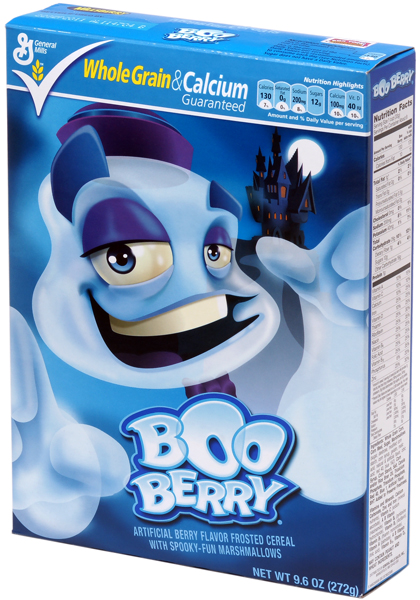
Boo Berry Cereal. The type of breakfast only a child could love.
That story’s stuck with me for many years. There’s something very pure and charming about a child being so selfless and kind, to go to the trouble of making his or her mom breakfast in bed. Of course, a kid’s idea of a great breakfast is not necessarily the same as an adult’s, not to mention that a young’un usually can’t make much more than cold cereal. But the sweetness is there.
I decided to translate this little true story into backstory for my hero.
In my novel, the main character starts out the story being pretty selfish. His impetus for doing things in the first few chapters is to satisfy his own ego, or to get a modicum of revenge on a woman who spurned him. But, over the course of the story, he comes to understand that the world – and its wonders – are greater than himself. I didn’t think he could do that very well if he was a complete prick through and through; there has to be some compassion and selflessness already in him, even if it takes a trauma to make him remember that it’s there.
What about you? Do you like writing backstory for your characters?



Recent Comments