by Mayumi-H | Oct 22, 2012 | Fearless, Short Stories
 I’m returning to Julia’s 100-Word Challenge for Grown-Ups this week, where the prompt is:
“…it can’t be that time…”
For those of you unfamiliar with this challenge, we’re to write a 100-word story using Julia’s prompt (in this particular case, we’re allowed to go to 105 words, since we have to incorporate the specific prompt phrase). Here’s mine:
“Let Go”
Tears came, despite her willing, and a rough scratching stifled the words from her throat:
“It can’t be that time,” she told him, as her hand hovered above the faint stubble of his cheek. How round it used to be, how full, when tickled laughter had been his only language. No longer, though: his face had grown so long, so narrow, like the rest of him, the very reflection of his father long past.
Now, she had to let him go, too.
She sniffed. “I’m not ready to say goodbye!”
A quiet sigh escaped him. Then, he chuckled. “Mum, I’m going to miss the bus…!”
I recently read a post over at Itsjennythewren’s blog about researching publishers. One point Jenny mentioned was that each character should “feel like they are the main focus in the book.” I have quite a few characters to deal with, so I don’t know how successful I’ve done at that bit. But, I do like thinking about each character’s life, no matter how little page time that character might get. Hopefully, this little vignette – about Maggie, Ross’s mum – manages her perspective successfully.
What did time take away from your characters, this week?
by Mayumi-H | Oct 15, 2012 | Fearless, Process
I’m back from Japan, where I had a lovely time with both my intimate and my extended family. We ate, drank, walked the touristy route I always walk whenever I visit (the mountain trails at Arashiyama; the shopping maze at Kawaramachi dori; the delectable tempura at Yoshikawa Inn), as well as our usual visits to friends in Tsu (where, this year, we saw the Ama divers at Toba) and Sanda (where we always get treated to the most scrumptious home barbecue). While I did all this, though, in the back of my mind, I was still thinking about the men and women of Fearless.
The story takes place mostly in the fictional village of Harbram, based loosely on lovely Porthtowan, along the north Cornwall coast, where I have extended family on the other side. It’s more than a stone’s throw from Kyoto, of course, but the principles of writing it are the same ones I took for writing characters in Japan.
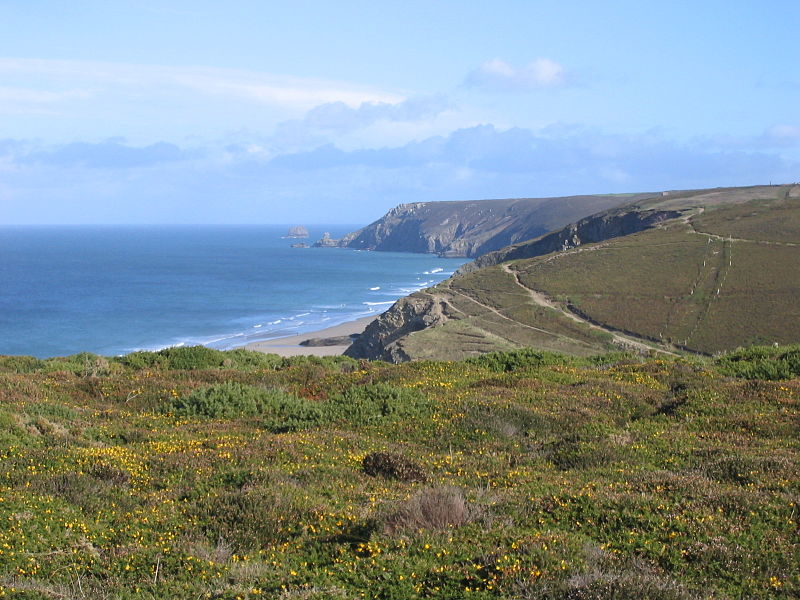
The cliffs at Porthtowan, inspiration for Harbram
First, there’s nothing quite like immersing yourself in the culture of your characters, especially your main character. Not everyone can indulge in a two-week vacation in their MC’s culture or experience it firsthand, but there are ways around that. Read up on your subject: history, lifestyle, idiosyncrasies; the Internet is a bountiful and endless source of information about this sort of thing (also many times erroneous, so do be certain to double-check your resources). Talk to people who live the lives of your characters, in experience, background, even outlook. With so much programming out there, it’s likely you can even find some television shows or movies about your subject! (Be mindful of artistic license with this one, though.)
All this is to say, you don’t have to rely solely on your imagination to create the world in which your characters live. Many times, you shouldn’t rely only on your own brain, because you will probably be missing out on a lot of important facts or details that can end up making or breaking your story. (I cringe every time I read a story set in Japan where characters do not take off their shoes before entering the house!)
There’s a lot of information available at your fingertips. Use it to build a full, lush, beautiful world in which your characters will play, dream, cry, and live.
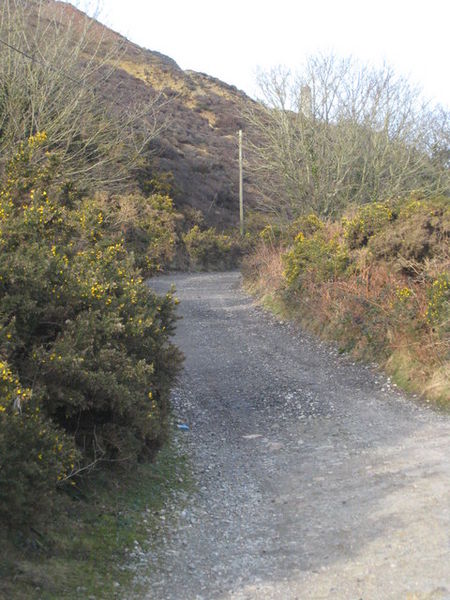
Porthtowan’s Mount Hawke footpath, the inspiration for my Crow’s Point path.
What techniques do you use to create your characters’ world?
by Mayumi-H | Oct 1, 2012 | Fearless, Short Stories
Contributed to the Five Sentence Fiction prompt DEVOTION, from Lillie McFerrin’s blog.
My Fearless story may be about Ross and Amber, but their supporting cast is just as important. In some ways, I think supporting casts offer some of the real meat of a story. They can provide back story where necessary; they can offer contrasting views of a situation; they can help create necessary conflict – or resolution – for or between the main characters.
Neville is, without a doubt, my favorite of the Fearless supporting characters, but I’ve enjoyed creating the back stories for the others, as well….
“Onward”
She loved this tiny village by the sea, with its cool, breezy nights and crisp, sunny days; she loved the way her husband had stories to go with its every old name and hidden corner, and the way her daughter was making stories of her own, to go with every new face and open break of beach and field.
But, as much as she loved the odd eccentrics and familiar friends of this village, she loved more who she was, the purpose she knew she had. Which was why it almost broke her heart to broach the subject she’d kept secret for too long, and told her husband she had to move on, to where she could do the most good, away from here.
He paused for but a moment. Then, as though he’d only been waiting for this, he smiled, and said, “So, when do we leave?”
Which of your supporting characters do you love – or hate? Why?
by Mayumi-H | Sep 17, 2012 | Fearless, Short Stories
It’s a double-whammy this week, as I’m incorporating both Julia’s 100-Word Challenge for Grown Ups (week 57) prompt of “…returning to the routine…” and Lillie McFerrin’s Five Sentence Fiction prompt “AWKWARD” into the same post. Actually, it’s a triple whammy, since I’m also using Monday’s Fearless post to coincide.
To catch you up, Julia’s 100-Word Challenge for Grown-Ups gives writers a phrase or picture prompt, and we have 100 words (give or take; see the link for details) to write a story around it. Lillie’s Five-Sentence Fiction gives a one-word prompt, and we’re to write a flash fiction piece, consisting of only five sentences, that corresponds to said prompt.
I didn’t think I’d be able to participate at all this time around, as my schedule has been so hectic…but the pieces just fell together right, for me. (Maybe you disagree.)
“Hope In You”
![By Zelda F. Scott (Own work) [GFDL (http://www.gnu.org/copyleft/fdl.html) or CC-BY-SA-3.0-2.5-2.0-1.0 (http://creativecommons.org/licenses/by-sa/3.0)], via Wikimedia Commons](https://mayumi.amorphous.press/wp-content/uploads/sites/4/2012/09/256px-ballet_flat_in_the_westpark_in_bochum.jpg "Ballet_flat_in_the_Westpark_in_Bochum")
The bar turned slick beneath her hands, and her arms quivered all the way to her shoulders as her foot slid over the mat. It wasn’t from any thought or impulse, though, but mere weight, and that more than any pain or effort made the tears well.
Graceful, darling dancer: she’d never be that again, not if simply returning to the routine of standing on her dumb, labouring legs was this hard.
Spitting a plea for rest (and hating herself for it), she transferred to the chair, feeling weak, broken, hopeless.
Until she thought of him, and his smile, and pushed herself up again.
Julia’s prompt is a bit easier to recognize, here, than Lillie’s is, but hopefully you can see how I related this to both.
What awkwardness – or return to routine – did you describe, this time around?
by Mayumi-H | Sep 15, 2012 | Fearless, Process
I was going to talk about how it’s important to stay healthy while you’re working on any project (even a writing project), but I’ll save that for another time. Because I seem to be coming down with something, and because, earlier this week, my thought processes were waylaid by a few different posts about what it means to be a woman, and how society views women. I’m not taking a stance on whether one or both of these posts is right or wrong. They simply made me think. About myself, and specifically about my female characters.
I’ve talked about this conundrum before: how important (or not) it is for a character to be likable. It’s the same for women characters as it is for men. Whether they’re likable is often irrelevant, so long as they’re realistic. Likability should come – or not – based on how “real” they are: their sympathies, their reactions, their thoughts and feelings. My current main character is a man, and his big starting flaws are that he’s vain, distrustful, and driven by his biology, to put it nicely. He’s been an absolute blast for me to write, because – particularly early on – he’s free to be so one-dimensional in a lot of his interactions (“Let’s have fun!” “Let’s surf!” “Let’s f–k!”). Since it’s a romance story, he has to face and overcome (or run away from) certain obstacles introduced by the main female character.
This is where it gets tricky.
Women expect other women in stories – especially romances – to be intelligent, powerful, strong. But, not all women are powerful or strong in the same way.
Don’t get me wrong: I love women who kick ass. When I was a kid, I wanted so badly to be Vasquez from ALIENS: she was no-nonsense, stood toe-to-toe with any of her fellow (male) Marines, and went out in a blaze of glory. I loved that! My opinions of strong women haven’t changed as I’ve gotten older…but I have realised a woman doesn’t necessarily have to be a stoic smartgunner in order to be “strong.”

said kickass smartgunner
As I’ve become a woman, myself, I find I appreciate other women – fictional or real – who can embrace their femininity as a kind of strength. My last heroine was a woman who had a hard time reconciling being a fierce warrior but also a young woman who wanted to be loved by her man. That was a fun, enlightening journey to take with her, but I wanted to do something different for my next heroine.
Perhaps it’s because this current story is from a man’s point of view, but I don’t have a problem with my new heroine being girly, sassy, and sexy. (That’s what my hero likes about her!) That doesn’t mean she’s a wimp, though, and I don’t think I’m dismissing The Sisterhood by making her not be a fighter; her strength ends up manifesting in more subtle ways. Simply because she’s a nurturer rather than a hunter shouldn’t mean she’s any less valid as a strong woman character than a ball-busting CEO or tough-as-nails starship captain.
Of course, no one will ever be another USCMC PFC Vasquez, J. (Sidenote: Jenette Goldstein, who played Vasquez, is just as kick-ass as her breakout role. Just check out her shop at http://www.jenettebras.com/ – this is a lady who understands how great it is to be sexy!)
What does a “strong” woman character mean to you?
by Mayumi-H | Sep 10, 2012 | Fearless, Short Stories
The prompt for this week’s Five Sentence Fiction from Lillie McFerrin is MEMORIES.
Once again (and keeping with my posting schedule), I’m using it to tackle some backstory for Fearless. Part of this is an effort to get back on-track…and part of it is because I think the conflict is an interesting one to examine.
“What It’s Not”
At four, he simply hadn’t known; “love” was but the smell of Christmas roast filling the kitchen, or cold ice cream sliding down his throat, or the rush of seawater between his toes.
By the time he was twelve, he’d come to understand it a bit more, though still not very much: Mum’s warm embrace, and his sisters’ gentle teasing; the joy of rolling waves to ride, and the blow of ocean air against his face.
By sixteen, though, he knew, he understood, even if he wished he didn’t. Because love like in stories was glorious and loud, full of honesty and trust, not hushed and hidden and kept secret in his breast, whispered only to the wind and the soft goose feathers stuffed in his pillow; it wasn’t a wicked laugh and a crooked smile, nor the shine of golden hair and sun-drenched flesh stretched beside him in the sand day after day. It was Antony and Cleopatra, Tristan and Isolde, Paolo and Francesca…not this, not them, not him: Neville, and the beautiful, oblivious boy who filled his dreams.
A bit of a tortured Neville, here, but teenagers tend to be filled with angst.
What MEMORIES did you take a look at, this week?

 I’m returning to Julia’s 100-Word Challenge for Grown-Ups this week, where the prompt is:


![By Zelda F. Scott (Own work) [GFDL (http://www.gnu.org/copyleft/fdl.html) or CC-BY-SA-3.0-2.5-2.0-1.0 (http://creativecommons.org/licenses/by-sa/3.0)], via Wikimedia Commons](http://mayumi.amorphous.press/wp-content/uploads/sites/4/2012/09/256px-ballet_flat_in_the_westpark_in_bochum.jpg "Ballet_flat_in_the_Westpark_in_Bochum")
Recent Comments