by Mayumi-H | Dec 17, 2012 | Fearless, Process
I’ve seen in circulation a list of character personality traits, that, on one side, lists strengths – what people typically consider “good” traits – and, on the other corresponding side, faults – what people typically consider “bad” traits. The interesting thing is realizing that these traits often represent the same personality quality. For example, “decisive” was on one side, but the characteristics also identified this trait as “single-minded.” “Commanding” was on one side, while “aggressive” was on the other. “Adaptable,” and “fickle.” You get the idea.
Independence is one of those traits we usually consider good in people. But, there are times when independence manifests as stubbornness. The trait itself remains the same; it’s how we deal with that trait that affects events in a story (or in our lives).
We’re all human; we all have strengths and faults. Sometimes, our strengths manifest as faults, and sometimes it’s the other way around.
Writing a bold (headstrong) yet sensitive (flighty) young woman in Fearless has made me realize all too clearly how character traits can be good, bad, and everything in between. This is especially true as she and the people around her have to deal with the conflicts that arise.
He’d thought her pretty from the start, but she was more than that. Vibrant, audacious, exciting, and adventuresome. Girlish and petulant, too, and huffy when she didn’t get her way. But, before her, he’d never thought there could be a woman so sweet and pure and brave as people had only ever been in make-believe stories.
Having the main character make these realizations has been a great joy for me, too. Because, as I look around at the people around me – even the ones I’m with every day – I’ve come to understand a bit better that everyone has multiple sides to them.
What character traits stand out to you, with your characters? Do you consider them strengths or faults?
by Mayumi-H | Nov 26, 2012 | Excerpts, Fearless, Process
Breathless, sweaty, and dizzy of a sudden, Ross tumbled to the bed beside her, one arm still draped loosely around her. They would need to clean up and wash before bed, but, for the moment, he just wanted to lie with her in the drowsy quiet. So, settling his head next to hers, he blinked, and swallowed, and asked:
“Can we cuddle a bit?”
No mincing words, here: I think sex is an important part of any adult, loving relationship. It’s fun to write, too…though what’s more interesting is examining what happens around the main act. Pillow talk in these situations can offer a unique perspective on your character.
Trailer title from the 1959 movie; public domain image.
Lovers (and this includes men, here) are often much more honest with each other when they’re naked and relaxed, coming down from a sexual high. Just something about that situation, I guess, that opens people up. 😉
If you’re so inclined to write a sex scene, I’d suggest at least considering that opportunity of after-sex pillow talk, to broach some of your more sensitive topics. Perhaps your woman has body image issues, or your man has trouble with intimacy. You can potentially use this time to explore those, in a natural, conversational way.
Because honest communication is what truly makes sex sexy.
If you write sex, on what part do you like to focus: the buildup, the climax, or the denouement? If your story doesn’t include the convention of sex, how do you approach sensitive relationship subjects?
by Mayumi-H | Nov 17, 2012 | Fearless, Process, Short Stories

Though currently embroiled in my NaNoWriMo tale of soldiers and stowaways, I was abruptly struck by Julia’s prompt for this week’s 100-Word Challenge for Grown-Ups:
…the silence was deafening…
WordPress and Twitter friends itsjennythewren and sjbwriting said I should feel free to indulge my pestering inner muse on this one, though, so I’ve done. (Make sure to check out their blogs, too!)
If you don’t like my story, that’s fine. Sometimes, we just have to write for ourselves.
“It should have stayed that way”
The blaring horns, the cawing gulls, even the roar of rolling waves…none of them matched the sounds of Ross’s heartbreak: hitching breaths exploding like dynamite, staccato bursts of emotion spit wet and raw between his teeth.
Yet, still, he was beautiful.
And that beauty pulled, like an undertow, until his sobs became a muffled gasp of surprise from around the briny clasp of his lips.
A heartbeat later, he pulled away, his eyes clear and full. Not of love, though. And even the practised platitudes couldn’t make vanish that look of betrayal.
Wordlessly, he rose, and left. And for Neville, the silence was deafening.
I feel a bit bad that my WordPress readers only get to see this tortured side of poor Neville, when he’s really one of my more well-balanced characters. Love grows in different ways for each of us, though, and this love between him and Ross is integral to the depth of their friendship.
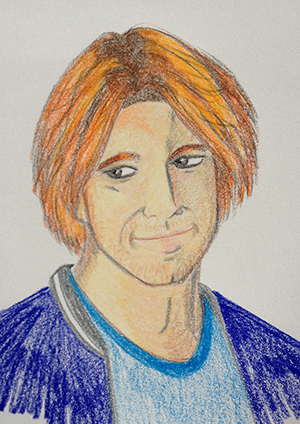
“Good old Nev.”
Others might say I’m pandering with my portrayal of Neville, because his sexual orientation gives no conflict to the main plot. But I always felt that, even if there’s no sexual affair between them, his love for Ross made him more honest than virtually any other character in the story. The story (and Ross) needs that. I don’t think I could make Neville straight and have him be the same character or give his perspective equal weight than it has with him being gay…and still a little bit in love with Ross.
How did you answer this week’s prompt? And/Or: What are your feelings about a character’s identity affecting (or not affecting) the plot of a story?
by Mayumi-H | Nov 10, 2012 | From Hell (A Love Story), Process
A few weeks ago, the fine folks over at Limebird Writers celebrated their first anniversary. To commemorate, they had a contest with a bunch of fantabulous prizes that would make any aspiring writer’s quill quiver with eager excitement, mine included. My video didn’t win, but the process was such fun – and so easy – I thought I’d share a few of my production steps.
1. Text.
Every story starts with text. (Well, every story starts with an idea, but you need to put the idea on paper if you want to be able to share it.) I wrote a (very loose and very silly) poem, which you can read below:
“Happy birthday, Limebirds!”
Just one short year ago today
The Web was graced with an idea so bright
A place for writers to tell their stories
To craft and let their words take flight
Safe harbor from the fright’ning storm
Of jealous trolls and arbalests
Where artists could be free and nurtured
‘Til they’re ready to leave their nests.
The word rang out to authors round
And the name came to be known.
Storytellers settled in
And so the family’s grown.
No matter what your pen may favor –
Poetry, horror, SF, YA –
You’ll always have a friend with
The Limebirds UK.
Yes, I know the meter is inconsistent, and the sentiment is a bit heavy-handed…but I wanted to do something fun, especially since it was going to be sung.
2. Audio.
Despite it being called a “video,” audio is perhaps the most important part of any video project. You can cover up crappy video, but you can’t cover up crappy audio. I recorded my audio using Audacity, a great piece of cross-platform shareware available from Sourceforge. I recommend Audacity mostly because it’s easy to use and free to download, and exports to MP3 with very little issue.
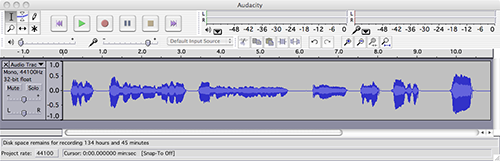
An example Audacity window.
(As for the tune, B came up with that herself. I was trying to find some music to go with the cadence, but she just ran with it, so that’s what I kept.)
3. Video/Images.
This isn’t really a video, per se, since it’s just static images sewn together with Final Cut Pro.
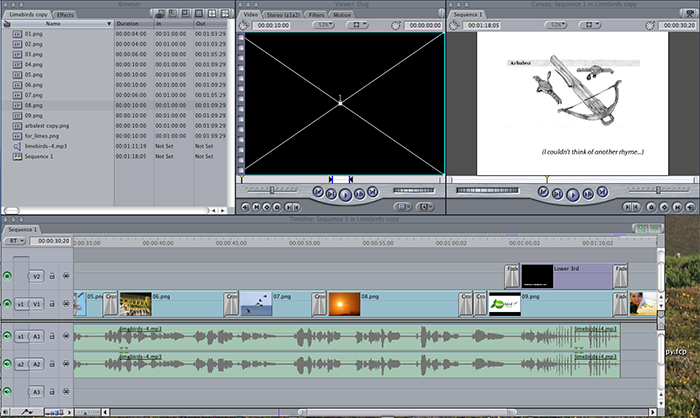
My Limebirds anniversary project, in process
I use FCP because it’s what I’m used to, but Adobe’s Premiere product is very good, too. (For those of you who are students or work at a college or university, make sure to ask for the educator’s discount!) If you’re not interested in shelling out lots of money for either of these programs, Apple’s iMovie and Windows Movie Maker are adequate – if not very powerful – substitutes.
I sized and cropped each of the images for video (720×480) in Adobe Photoshop (again, because that’s what I’m used to). If you don’t want to spend a lot of money on Photoshop, though, check out a nice little freeware program called GIMP, which is, frankly, a great alternative. (GIMP does not have quite as many bells and whistles as Adobe’s products, but it is a powerful little program.)
I did make sure to use public domain images so I wouldn’t infringe on anyone’s creative art. Wikimedia Commons is a great place to get royalty-free, open-access imagery. Just make sure to pay attention to the usage rights attached to each image, as these are specified by the original artist, and we don’t want to exploit anyone else’s work. 🙂
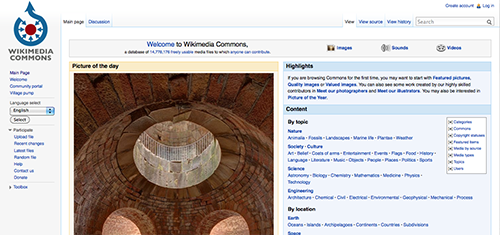
The Wikimedia Commons front page. All you need for royalty-free.
So! Here’s the full video. At 01:19, it’s a bit long for what it is, but it’s difficult to tell a kid to hurry it up. 😉
[youtube http://www.youtube.com/watch?v=Y6IGm6GucXs?rel=0&w=420&h=315]
Have you ever experimented with video? What kind of video did you make…or would you like to make? Let me know! Oh, and do make sure to stop by the Limebird Writers. They’ve always got great things to say!
by Mayumi-H | Nov 3, 2012 | Fearless, Process
When you look at yourself in the mirror, what do you see? Take a moment, and think about how you’d describe yourself. If I were going for strict facts, I’d say I’m an Asian female, five-foot-one, brown eyes, dark hair, slight build, no visible distinguishing marks. That sounds a bit boring, doesn’t it? But, describing me as “a quirky techie with a rippling laugh and lopsided smile” doesn’t exactly help in forming a physical image for a reader’s eye.
The first physical description I have for my (current) MC comes about 3000 words in [first draft], and it only consists of him “[running] his fingers through his jagged, shower-damp hair [and checking] the closeness of his shave.” Aside from that, I wanted to let the characters speak for me: a local girl giggles at his attention, his best friend describes him as “a vain bastard bordering on narcissistic”, and the love interest calls him “the finest thing [she’d] ever seen.” He’s a surfer and a runner, so he’s got an athletic build, and he looks down at people a lot, so he’s tall (and something of a jerk, but that’s not relevant to this post).
Conversely, the MC describes the woman he loves in all kinds of detail, most of it physical and visual.
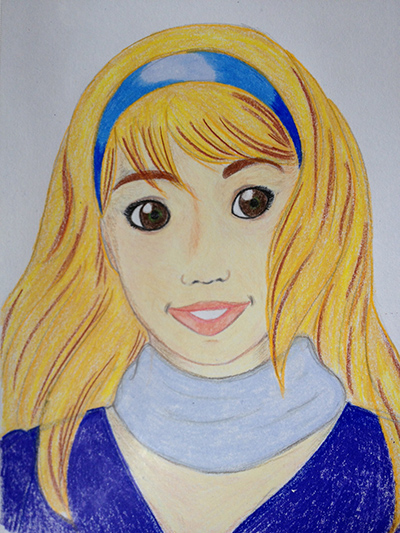
I admit, I’m a little bit in love with Amber, myself.
Some folks say the mirror is an overused (bad) convention and shouldn’t be used for describing your main character. But what’s a good middle ground between overused and imprecise? What conventions do you use to describe your MC?
by Mayumi-H | Oct 20, 2012 | Process, Uncategorized
Part of what makes stories so much fun is the drama involved: Will the hero conquer the villain? Will the princess find her true love? Will the puppy make its way home? But, what happens when we find our characters strive more for realism than for drama?
Every story needs some kind of emotional resonance for it to have impact, whether it’s about war or heartbreak or family experience. Sometimes, though, our characters become so much their own people that they end up dictating where their own stories go. I’ve written scenes – necessary ones – for their dramatic effect…but I’ve also had to rewrite other scenes because the characters’ voices had developed so much since my initial plotting that their actions (or reactions) as I’d originally envisioned simply no longer held true to their natures.
What do you do in this situation? Do you let the character take over, possibly sacrificing the drama of the scene? Or, do you follow through with the original idea, possibly sacrificing believability for the character?
It’s okay to play Loosey Goosey in some instances: maybe the hero isn’t in his right mind at the moment and makes a snap judgment against character; maybe the heroine is torn by the conflict facing her and decides on one route over another because her values are confused. Written well, with the associating consequences, those options are totally valid. But, what do you do when your original big conflict becomes significantly less climactic than originally envisioned, because your darned MC has grown up too much over the course of the story?
I’m a big fan of sweeping epics, and last-minute, nerve-wracking climaxes where the audience is led to page after page to see what happens next. But I also believe in, well, believability in a story. The hero shouldn’t overcome the conflict just because the story needs a climax; he should do so because that’s what he has to do, to progress, grow, and change. It may make for less high drama, but it may also make for more realism.
But that’s just my opinion. Which do you prefer: realism or drama?



Recent Comments