by Mayumi-H | Apr 17, 2013 | Persona 4 Fan Fiction, Process
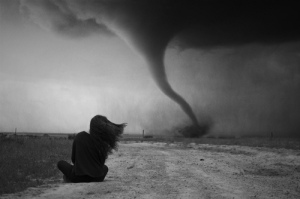
Last Friday’s Free Write Friday prompt from Kellie Elmore was the below photo:
What struck me about the photo was not so much the twister itself or the girl in the foreground, but the way people’s lives can often feel like they’re caught in a storm. And, how lonely that girl’s silhouette is. From nowhere – truly, nowhere, as I am, at the moment, working on three very different stories with nothing to do with the prompt – a scene popped into my head, bright as a bolt of lightning: a young man and young woman hiding together, to be together. It was very conversational but still mostly descriptive of their clandestine affair, which is why I chose not to submit it to the prompt.
The odd part about this story snippet was not the flash of inspiring imagery, or the way these characters felt like familiar ones to me, or even the main conflict fashioned by my brain for why the two of them should meet in secret. Rather, it was the smaller conflict of their histories. Specifically, how religion related to their interaction.
If you think violence or sex are hot-button issues, they’re nothing compared to religion. I don’t even feel very comfortable talking about it, here, because… I don’t know. Because I’m scared, I guess.
Not many readers take issue with crime or violence in stories. It’s part of real life, after all. Sex is a slightly touchier subject, probably because it’s associated with prurience or deviance (which is not always the case, but I think I’ve belabored that point already). Faith, though, is unique to each individual person. Nonetheless, it often feels like we’re treated only to religious extremes, in fiction: fanatics like Margaret White (the mom in Stephen King’s Carrie) or the Republic of Gilead in Margaret Atwood’s The Handmaid’s Tale. Given such examples, it’s hardly a wonder that religion often does not play a role in many stories, at least, not a prominent one.
So, why did I take a religious angle for that scene? Mostly, it came from the dialogue. Evidence of their faith sprang, fully formed, from these characters’ mouths. They didn’t preach to me or to each other. They simply were who they were: a mid-western society girl and her working-class, ex-Army boyfriend. Not even their different racial backgrounds featured so prominently in their characterizations as their religious upbringing.
It was weird. Because my own faith is very personal, and I’d never inject those feelings into a story. Not consciously, any way. Sure, religion has had its part. I’ve examined Shinto, but only for the burial rituals and a wedding ceremony; two of my earlier protagonists were Catholic versus Protestant just for a few low-level jabs; I’ve looked at Anglicanism in a broader sense from a social perspective, mostly to counterbalance the dourness of one of my scientific empiricists. But having characters mouth off to each other about church and faith? That was new.

Shrine to World Religions, by Helen (Flickr: Shrine To World Religions) [CC-BY-2.0], via Wikimedia Commons
Have you ever had your characters take you by surprise, about their personal agendas or perspectives?
by Mayumi-H | Apr 10, 2013 | Process
Knowing how to write dialogue is an important tool for a writer. Even more important, though, I’d wager, is being able to write believable dialogue. Countless articles and books have been written on the subject, but the same advice always crops up: Pay attention and listen.

By David Benbennick [GFDL (http://www.gnu.org/copyleft/fdl.html), CC-BY-SA-3.0 or CC-BY-SA-2.0], via Wikimedia Commons
What we hear in daily conversation doesn’t always work for the written word, of course. Slang, for example, can be problematic to explain to someone unfamiliar with its roots, just as dialect speech can be nightmarish for a reader to slog through. (Joseph, I’m looking at you.) Generally speaking, though, even these examples don’t have to be make-or-break issues with dialogue. If your characters are strong enough in their own voices, the little tweaks and twinges shouldn’t matter so much. Quirky speech patterns can even help identify characters to the audience, often a good thing.
But, those are generalities. I’m talking about specifics, here.
The other day, while sitting with some friends, we were talking about the transience and flow of language across generations. The discussion went pretty deep as we argued our opinions and went back and forth with pros and cons to each perspective. Then, from nowhere, one friend piped up, “I’m gonna bring back ‘rad’ to the common lexicon.”
I burst out laughing…and I knew I’d have to use it in a story.
My friends learned a long time ago that almost nothing said in my presence is sacred. Not to say I can’t keep a secret, because I can do that. But, the words themselves become free to my pen, the second they’ve left anyone’s mouth. I don’t make any excuses for myself in this regard. If I hear it with my ears, it instantly becomes reality – and believable – to me. And, that makes for great dialogue.
Some of my favorite conversations in real life I’ve decided to preserve in my stories. Many of them were simply jotted down in 100-word shorts or random snippets tucked into the pages of a notebook, for use – or not – at some later date. But, others have found their way actively woven into the larger tales, adding a sense of deeper realism and stronger truth to the story that may not have been so deep or so strong without them.
Other writers (ones better than me) say to listen to the world and words around you. Pay attention to the details. Keep your eyes and ears open. And, that inspiration can be sitting right in front of you. Or just to the left, spouting pearls of beautiful dialogue between peanuts and sips of beer.
Some among you may consider my technique of stealing borrowing words from such conversations cheating at my art. As for me, I prefer to consider it art imitating life. For real.
How do you create believable dialogue? Have you ever used real conversations in your stories? Were you able to read Joseph’s dialogue from Wuthering Heights without looking at a translation sheet?
by Mayumi-H | Apr 6, 2013 | Fearless, Short Stories
This week, Lillie McFerrin’s prompt for her Five Sentence Fiction challenge is “WORDS.”
I went a few different ways with this prompt, at first…though, my initial flash fiction idea – while based on a true story – pushed the vulgarity a bit too much than I like to do for a public challenge. So, this little vignette, taken from the early days of Fearless:
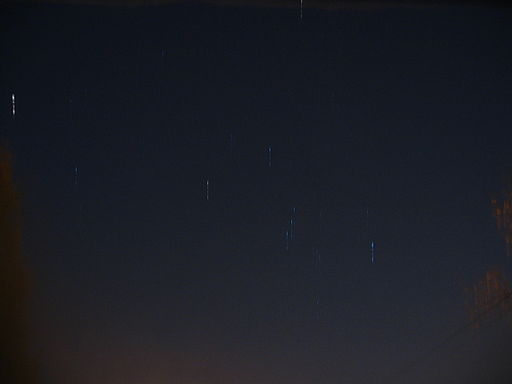
By AstroHurricane001 at en.wikipedia [Public domain], via Wikimedia Commons
“The loss of artful conversation”
Stretched upon the sand, beneath a canopy of stars, with the rhythm of the rolling current nearby, the lads often turned reflective.
“I think,” Neville mused softly, “with all this technology, and the culture of instant messaging, mankind’s lost the skill of artful conversation, like the poetry that used to exist in the days of Shakespeare, or Milton: what happened to that, where’s all that gone?”
With his head laid in the pillow of Amber’s lap and soothed by both the sound of waves and the gentle drift of her fingers through his hair, Ross hummed, and murmured, “There might be something to that. But,” he added, his gaze finding Amber’s as he opened his eyes again, “for some things, I don’t think you need conversation.”
That settled the lads for a long minute, until Niall sniffed, and declared:
“I’m gonna bring back ‘rad.’”
I’ve spoken on this blog about making art with words before, so I don’t think it needs repeating. I do often wonder, as Neville does, if the immediacy of communication hasn’t taken away some power of words, though. When was the last time we made efforts to write real letters, rather than emails, or instant messages on a phone?
Or, perhaps, I’m just waxing nostalgic, and that old power of lyricism in dialogue has been replaced by something else. What do you think? How do WORDS speak to you?
by Mayumi-H | Apr 3, 2013 | Persona 4 Fan Fiction, Uncategorized
I’m a terrible blogger.
In the last several months, I’ve been nominated for some very sweet awards, and it’s taken me forever to post them! Here they are:




I was nominated for these awards by:
- JM McDowell (Dragon’s Loyalty Award), who runs http://jmmcdowell.com/, a blog filled with good humor, advice, and original stories about her archaeologist mystery-cracker, Meghan Bode;
- Jenny the Wren (Liebster Award), who writes up all kinds of different musings, reviews, and personal stories of life and new-mommyhood over at http://itsjennythewren.wordpress.com/;
- Subhan Zein (Versatile Blogger and Tell Me About Yourself Awards), the talented and soulful writer of short stories, poetic observations, and freedom from the mundane at http://subhanzein.wordpress.com/;
- Summer (Wonderful Readership Award), whose inner peace and graciousness always shine through on her blog, http://summer4soul.wordpress.com/.
Some of these awards come with rules for posting: nominate so many bloggers, tell so many facts about yourself, don’t stop the giving chain. Normally, I’m one to adhere to rules. But, for the purpose of blogging awards, I usually let those rules go.

“The rules are, there ain’t no rules!”
But, for those of you interested, some “facts” about me:
- I like saying I’m an artist, but, really, I’m a jock. I have to exercise every day, or I don’t feel like myself. At school, I competed in Track and Field; the 100-meter dash was my main event, and I anchored our team for the 400-meter relay. I love swimming, and surfing is a relatively new passion. Aside from the sprints, I’m not a great runner, though I often find it centers me. When I’m feeling troubled, there’s not much that can’t be cured by a good, sweaty run!
- I’m Miss Middle-of-the-Road. Maybe it comes from being a Libra, but I’ve always had to look at both sides of a situation. Sometimes, that’s helpful, like when I have to mediate an argument between family or friends. Other times, not so much, as it can cause me to vacillate too long, and opportunities can pass me by!
- I’m not the brightest bulb…but I’m not the dimmest, either. Sports are, by their very nature, competitive, and that competitiveness found its way into other parts of my life. I was always comparing myself to other people: their strengths, their successes, the accolades and adulation. But, for every winner, there has to be a loser. It took a long time for me to understand that losing gracefully can be just as worthwhile as winning graciously. A good thing, since winning is so rare!
- I play favorites. Not among my family (my sister), or for my girls (the older one), but with my characters. Whoever is foremost in my story-writing brain naturally gets privileged child status, of course, but I’ll always have my perennial favorites, too, especially in my fan works.
- Speaking of fan works, there’s nothing wrong with writing what you want, whatever that may be. Fan fiction, open poetry, stream of consciousness diary, historical biography, children’s, drama, sci-fi, horror, terror, thriller, romance, research, religion, comics, smut, slice of life, short fiction, long fiction – it’s all good. Certainly, some of those genres relate more easily to publishing, but always write first for your own passion.
- Lastly, I can only be myself, just like you can only be yourself. Every person has their own conflicts, their own burdens, their own triumphs. The world is a big place; we only ever see a sliver of it. But, just because we don’t see it, doesn’t mean it isn’t there. So, be excellent to each other.
[youtube http://www.youtube.com/watch?v=J7532GXPnO8]
Would you like to pick up one of the above awards? Please, feel free to grab the icon!
If you’re looking for some great bloggers to follow, I advocate the talented ladies and gent above – JM McDowell, Jenny the Wren, Subhan Zein, and Summer – as well as some other blogs and bloggers I always make certain to keep up with:
Many thanks go out to everyone who’s ever followed, liked, or commented on my words and musings.
Happy blogging, everyone!
by Mayumi-H | Mar 30, 2013 | Short Stories
I’m back to Julia’s 100-Word Challenges for Grown-Ups. This week, the prompt has a bit of an Easter theme to it:
…looking at all of that chocolate….
We’re not required to incorporate the exact phrase in this challenge’s 100 words, but I did, because it evokes such a vivid image. Maybe a bit too vivid, though?

Public domain image
“Relief and Shame”
The gift basket was a lovely gesture…but just looking at all of that chocolate made a tide of sick rumble up from her belly to the top of her throat, threatening with a rancid belch she barely caught in her palm in time.
She didn’t notice Wennie crouching beside her in the toilet, not until it was all over. “You want some water?”
Easing back against the wall, she nodded.
Wennie returned a moment later, glass in hand.
She sipped, the cold taste of relief sliding down her throat. And shame.
Wennie gave a tsk. “Have you told him, yet?”
I can’t be the only one who’s felt queasy in this situation. 😉
Did you partake in the chocolate challenge, this week? How did that taste to you?
by Mayumi-H | Mar 27, 2013 | Process
Most folks likely didn’t notice, but I was away last week, “away” meaning cramped into an editing suite, poring over timecode and doing frame extraction. I’m back again, but last week’s work has stayed with me. Mostly, because editing video always makes me think of this scene: the Warriors gang fighting off the Baseball Furies, from the 1979 film, The Warriors.
[youtube http://www.youtube.com/watch?v=zL0ipXUD-uU?rel=0]
Oh, Ajax, you pithy pugilist, you!
A fight scene without a soundtrack instantly feels much more violent than a fight scene set to music of any kind. That silence can often work in a filmmaker’s favor. Director Walter Hill says he wanted to preserve a cartooniness with this scene from The Warriors, so he kept the music in. That’s not a critique, for musical sound and rhythm can also do a fine job of adding tension, excitement, and drama, just as well as silence. It all depends on how it’s used.
When we write, we’re not given the luxury of pumping music at our readers. So, how do we create the same level of tension with words alone?
One idea? Choose your words carefully for more than just their meaning.
Writers often think they work in silence, because words are static on a page. But the rhythm of words can be just as important as what they mean. Poets and lyricists understand this better than most other writers, because their space, time, or meter is often limited. But even the self-proclaimed short story writer or novelist shouldn’t ignore that poetic ear.
Try speaking your scene aloud. You’ll hear how the choice and cadence of each word interacts with the ones to follow, and how those interactions affect the way your story is told.
Have you ever read a story that was just he said after she said, all the way down the page? There’s nothing wrong with that approach – it’s certainly serviceable to a story. But, words can move people by more than just their definitions. Why not let them do that?
Now, lots of writers and editors will tell you that prose and poetry are two different styles for a reason. That’s not incorrect. And, it may not be the best idea to turn your action thriller into a garden of flowery prose. That’s not what I’m saying, though. I’m saying, words should fit the moment, theme, and emotion of the story being told. Even readers advanced enough not to have to read aloud will still hear those words in their heads.
Study a good action scene. The words and ideas come quick, like lightning, one after the other. No time to describe in minute detail. Why? Because it slows the reader down. On the opposite hand, study a moving scene of gentle emotion. Words move more slowly, here, like leaves drifting on the wind, spiralling to a quiet settling on the ground. An argument will crackle, snap, and finally flare up like a paper bag thrown on a fire; a sex scene will start small and grow, mounting higher and higher until it crashes like a wave against a beach, where it eases down to foam again.

Brian Robert Marshall [CC-BY-SA-2.0], via Wikimedia Commons
Do you have any such rhythm techniques when you write? Which are your favorite types of scenes to write? Why?
by Mayumi-H | Mar 16, 2013 | Short Stories, Songbirds
No new original fiction, this week. Instead, an older 100-word post I did on my own, for my Songbirds.
“Alternate Realities”
Armed with an arsenal of books, pamphlets, and websites, Larry thought himself ready for anything Katie might throw at him: from the logistics of gender possibilities and a tidy explanation of where babies come from, to gentle assurances that nothing or no one could ever usurp the love and devotion he and Sally felt for their soon-to-be elder child.
Throughout his entire rambling explanation, Katie sat quietly in his lap, until he paused, smiled, and asked, “Do you have any questions, about the new baby?”
To which his daughter thought, and blinked, and said, “Can I have a puppy, instead?”

By Sam, Photos8.com [CC-BY-2.0 (http://creativecommons.org/licenses/by/2.0)]
I adore the relationship between parents Larry and Sally…but I also really enjoy examining the relationship between their girls, Katie and Billie. I think because the Nightingale family gives me an opportunity to reflect on and remember my own life, while still keeping a touch of fantastic silliness and adventure so integral to their universe.
I’ve been lax with picking up prompts these last few weeks. I think they must be designed more for writers who want to write but don’t necessarily have any larger projects on which they need to concentrate. But, I’ve got two Works in Progress which I want to complete/edit/perfect. I don’t necessarily feel bad neglecting the prompts to work on my larger projects, but I do want to keep some semblance of regularity to this blog.
So, for any of you out there looking for a writing challenge, below are a few good ones I follow. I’m sure there are more out there, too, if you just poke around a bit.
And, for those of you busy concentrating on your own long projects, here’s to a good wordy weekend!
by Mayumi-H | Mar 13, 2013 | Process
I hadn’t meant to kill her.
I certainly didn’t start out the day planning for it to happen. I didn’t even know it was happening, until I looked at what I’d wrought, and realized she was dead.
Somewhere deep down, though, I knew: it had to happen. I’d been waiting for it to happen.
That knowledge didn’t make it any easier to do. It didn’t make the squeeze of the trigger any less jerky, or the thunder of the shot any less loud. Or the pain I felt watching the once-bright light in her eyes go out any less acute.
One moment, she was there: fighting, struggling, strong. And the next, she simply…wasn’t. She wasn’t there. She wasn’t anything. She was just gone, like she’d never existed in the first.
I cried when I killed her. I honestly and truly did.
Sitting back, I had to stop. Everything. And let her have that one moment of my reflection. Because I hadn’t given her the chance to have anything else. Not the happiness she’d sought, or the love she’d desired. Not even the fleeting freedom for which she’d run and fought so hard.
I’d never killed anyone before. Not anyone who’d mattered. Flitting bystanders with no histories, random casualties of war: they didn’t make a difference. They had no stories.
This one, though. She’d had a story. A story I’d cut short, for a split-second of excitement. For the sake of mere plot.
“Acceptable losses,” I called her, the next day, after I’d had the time to reflect. A phrase to describe her and her ilk, the ones I’d left soulless and smoking along the way. Because in love and war, sacrifices must be made.
I knew it was for the best. I knew it had to be done.
But, I’d still cried.
I’ve been thinking about this topic ever since a recent blog post about what heroes can do, by Vanessa-Jane Chapman.
I’ve always thought death in stories should be warranted. Many of them are. They’re often valuable for completion of a story. But, when it came time to do the deed, myself, with one of my own…it got to me.
Let your story go where it needs to go, even if it’s someplace terrible. You may end up stronger for it. Or, you may end up realizing you’re not as nice a person as you’d always thought you were.
Death in your stories: how do you react?
by Mayumi-H | Mar 9, 2013 | Short Stories
“Enough to Last”
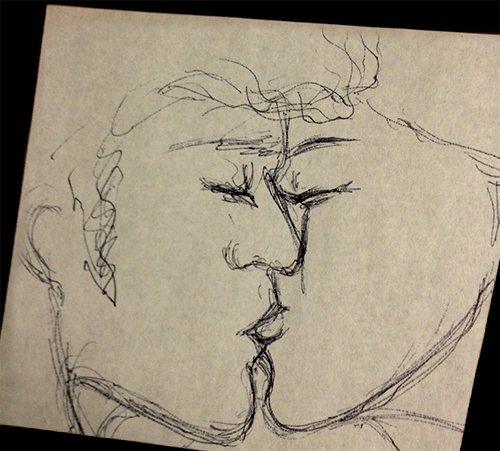
doodling Aral leads to this….
The high-pitched strains of concerto violins singing from the stereo in the corner. The slow-motion flutter of gossamer chiffon to the floor. The muted patter of raindrops against the window, tapping as though to be let in as witnesses to their dance.
He remembered them all, but, more than any other, the words breathed in his ear as she came and took him in her arms for the first time as had and held: “It’s always been you.”
He didn’t totally believe her, but the shine of love when he looked in her eyes could be enough to last him.
I hadn’t planned on participating in any challenges this week, but last week’s free write must have jump-started something in my writing brain, because, after taking one look at Lillie McFerrin’s Five Sentence Fiction prompt this week – “WHISPER” – this vignette came to me almost instantly, with only minuscule changes from the initial drafting.
I hope you, too, are enjoying freedom in your writing, as it’s a glorious feeling to have.
Did you participate in any writing challenges this week? What whisper was blown into your ear? Or, did you whisper something, yourself?
by Mayumi-H | Mar 6, 2013 | Process

Writers’ Museum in Edinburgh. In Lady Stair’s House. Photo by Jeremy Keith.
Now, I’ve shared my stories with others before: friends, writing buddies, family (once in a while), even strangers. I don’t stress about feedback from any of those folks. They receive my stories as a chunk of text to absorb, and, for the most part, their feedback is a simple, “I liked it,” or “I didn’t.” We may go into slightly more detail than that, but it’s often conversational, with comments painted in pretty broad strokes.
A professional edit, though, picks a story apart scene by scene, line by line, word by word. That’s good. It helps a writer step outside the confines of their little self-imposed world, to have someone examine that world with a sharp, precise knife and cut where necessary. They may do a little triage, too, to keep the story pumping. I’d trust an editor – especially a good one, like I was lucky enough to get – to do that.
When I received the pages back and finished reading through all the comments, I wanted to scuttle back into my NaNo hole and tear the whole story apart again. Not because I was crushed or demoralized by those red marks. Because those red marks showed me there was something there. And I wanted to fight for it. I wanted to dig deeper into myself and that world and those characters, and make the story better. Because, with those fixes and suggestions, I knew it could be so.
I didn’t think I’d pick up that story again. It was a first draft, and first drafts always need work. But, when I crossed the NaNo finish line last year, I thought, Good enough. Now, I know how wrong I was. The best bit? The editor never came out and told me I could do better. It was everything between the lines: all the little ticks and tacks that – when I saw them – I knew were right.
In hindsight, I shouldn’t have worried. The editor’s feedback was great. Not to say it was all glowing praise, because it wasn’t that. Rather, it was observant, critical, and helpful, what a proper edit should be. And, just reading through the comments for that one scene made me realize the story wasn’t all it could be.
I wasn’t all I could be.
So, I decided to take the pages back and start over. Not from scratch, because I do like a lot of the story already. But the suggestions and observations are with me every time I start to play in that world again. And when I play in all my other worlds, too.
The story may never be great, or a bestseller, or even publishable. But I can make it better than it was before.
Better. Stronger. Faster. Dah-na-na-naa! Dah-na-na-na-na Na-na-na-naa!
[youtube http://www.youtube.com/watch?v=HofoK_QQxGc?rel=0]
What words of wisdom do you have for a hopeful aspirant? Got stories of your own to share? Want to trade? Let me know!



Recent Comments