by Mayumi-H | Jul 26, 2014 | Process
No deep thoughts this week. I’m working hard on the ending of my sci-fi western, so I’ll offer this recent conversation with Twitter buddy George McNeese:
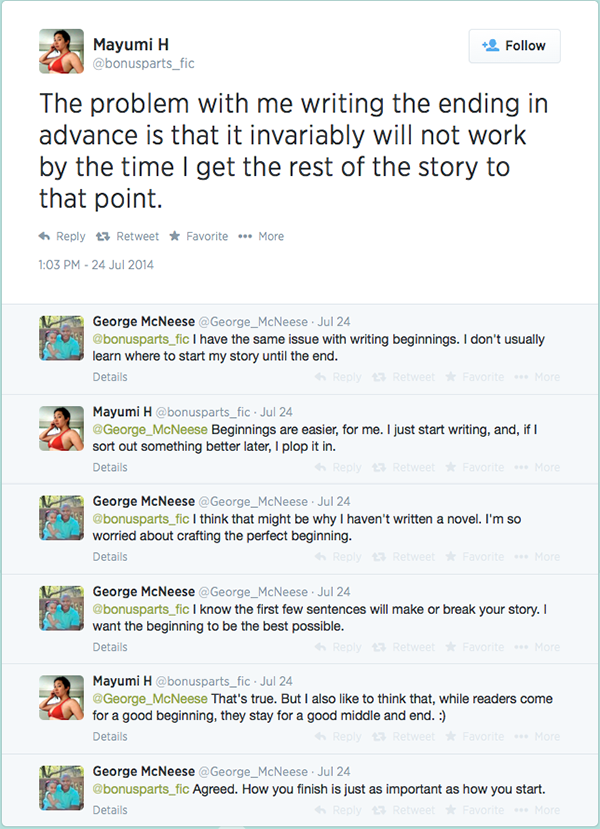
(click to enlarge)
George is one of my favorite Twitter users because he always has thoughtful things to say, often about his own writing journey. That usually leads me to think more deeply about my journey, too, even when I’m in a tough place, as I am right now, re-crafting the ending of my current story. Especially when I’m in a tough place.
I write sequentially, which I enjoy doing because the story feels like it has more natural rises and dips that way. It also pre-empts issues like my current one, where the ending I wrote a year ago – the initial impetus for the story entire – doesn’t fit with the story that’s been built to come before it. It’s not the worst place to be, of course: the characters have grown a lot from that initial writing, too far into themselves to make that ending work. I think that’s a good thing. But it also means creating an almost entirely new ending moment that has the same emotional resonance as the one I first wrote 400 days or so ago.
A story needs to be strong on all counts: beginning, middle, and end. Finding that right (write?) balance for us is the tricky bit. What’s your favorite part of the story to write?
by Mayumi-H | Jul 5, 2014 | Finding Mister Wright, Uncategorized
I did manage one post for June (my flipping the coin villain backstory post), but the rest of the month was a wash, blog-wise. But, I did have some excitement. Drumroll, please….
My husband read one of my stories!
Some of you out there are likely thinking, Big f***in’ deal, but this was a huge deal for me. My husband hadn’t read anything of mine since university, which is…well, let’s just say it’s a long time ago, now.
I’d left my original story “Finding Mister Wright” in a file folder on the dressing table a few months back, inviting him to take a look whenever he felt like doing so. I left it up to him because I don’t like when other people force their writing on me. But, as the months went by, seeing that folder left untouched rankled me. So, when he messaged me one evening and mentioned he’d read it, I was walking on clouds!
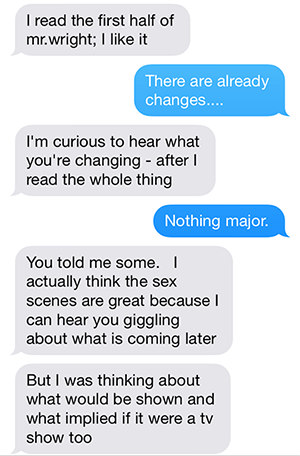
I know it doesn’t look like I’m excited, but I was.
We spoke about it in some more detail, and I’ve gotten to bounce some ideas off of him, for how to make the third act come together with more punch. One thing he said that made me nearly burst with glee was, “I like how you keep writing these characters after their main story is done. It gives them a much ‘fuller world’ feeling. Like they’re real.”
Honestly, a lot of my characters are real to me, even the fantastic ones. That’s what makes writing so joyous for me. It’s also why I get sad whenever I come to the end of a story. The characters and their relationships grow on me after all that time and effort of pulling their world and all of their conflicts together.
So, as of today, two people have read that first draft of “Finding Mister Wright” (Hi, JM!). Each of those people, with their timely feedback, has made me think about not just this story but all of my writing in a more focused way. I’m still undecided on the best way for me to get my stories out there – querying and sucking up to agents and houses, or hiring an editor and publishing on my own – but I feel like this little boost has fanned the flames of my spirit to be even stronger than before. Brighter, if you will. And each little bit of extra brightness makes the darkness of defeat seem not so foreboding.
I hope everyone out there is having a great summer (or whatever your local season may be). I’m looking forward to sharing more stories and steps forward in the months to come!
by Mayumi-H | Jun 8, 2014 | From Hell (A Love Story), Persona 4 Fan Fiction, Process
Last time, I talked about writing villains. Everybody had great comments, but Vanessa’s sparked a new idea in me. In my head (sometimes on paper), I have backstories for every character who walks onto my pages for any more than a sentence or two. Most of these backstories are rather simple, because I don’t see the point in spending too much time on a character who is basically just a spaceholder. But for anyone with any significance to the story, they have their own story. But Vanessa’s insight offered me a different perspective: basically, that we storytellers should remember that every good villain is the hero of his or her own story.
Now, this doesn’t necessarily mean that your villain needs to have heroic traits. But, their motivations and characterization should come from a place of realism. The best villains are often ones with whom a reader can personally identify. I don’t know if I managed that with the villains illustrated in last week’s post (actually, I doubt it), but it’s a good characterization technique to remember. So, this morning, I drafted up a couple of would-be storylines for each of those principal antagonists, posted below. If nothing else, it was fun to look at them from a new angle. I’d recommend doing something similar for your own antagonists – you never know when you might be struck with new inspiration.
The Red Widow
It’s a man’s galaxy. That’s what they say. Certainly, it seems that way to a girl sold into slavery for men’s pleasure. But this is no ordinary slave girl. This is one who learns from her so-called “masters”: how greedy, vain, and susceptible men are. Especially to a woman’s charms. Justiciar, pirate, or politician: no matter the insignia on their collar or the banner on their ship, men have their weaknesses, and she knows them all. Her marks have called her many names: Anya, Elsbeth, Illia, Una. But the galaxy knows her better as a woman as smart as any justiciar, as savvy as any pirate, as sly as any politician. It knows her as Red Widow. And she’s going to turn this man’s galaxy upside-down.
Into the Light (Lohengrin, the Swan Knight)
Abram had a son, once. A bright, beautiful boy full of possibilities. A gentle boy cherished for his kindness and skill with a tanner’s knife. The air would sing with the strokes of that knife, and wealthy women and men would come from across all districts to watch and buy his work. Abram loved his boy. But the Darkness loved him, too.
One day, that Darkness came for him, in the form of another smooth-faced boy, and lured Abram’s son away. Away, into the Darkness. What choice for a father but to save his only son? And the only way to save him from the dark was to lead him back into the light. With fire.
The Darkness has taken other boys. The Lost Boys, they are. But he will save them. He will take up arms and become their knight, to set them free, body and soul. He will be Lohengrin, the Swan Knight, their savior.
The Body Electric (Reilly)
The Dahl Army gave Reilly everything: a job, a purpose, even something like a family. For twelve fine years, he fought, laughed, caroused, and conquered by the sides of his fellow commandoes and their skilful sergeant. But on what is supposed to be a routine grab-and-go mission on Artemisia, the unthinkable happens: the op goes sour. An explosion and fire burns away half his soldierly body. And what does Dahl do? They dump him like scrap.
When the Hyperion salvage team finds him rotting in an Artemisian infirmary, they see his potential, and make him an offer: Become part of the Body Electric, a soldier enhanced for the technological wars. Of course, a soldier with potential needs a purpose, but Reilly has a purpose: hunt down his old teammates who left him to die, starting with his glory-hungry sergeant, the man responsible for it all.
Every Shot a Kill (Strenk)
Walking around the galaxy with the S&S munitions manufacturer family name stenciled on his uniform has never meant much to Lukas Strenk. Guns are just tools, only as good as the man who holds ‘em. And he is a great man, the best in the Inner Ring. Every shot from Strenk’s Orion rifle is a kill. But even the simplest kills can go wrong. When Galactic Defense redacts his latest target assignment after knowing the job’s already been done, they blame Strenk, of course, never mind his 100% success rate and the value of his name. “Get yourself gone or get yourself dead,” the GD Justiciar tells him. Strenk’s only answer is a bullet.
To hell with the shifting, shifty so-called rules of the Inner Ring. When the galaxy gives you lemons, you shove ‘em straight up its gaping *** and lick the residue from your fingers.
Once again, I think Strenk came out on top as my favorite of these, though I enjoyed the exercise for all. Have you ever flipped the coin on your antagonists? Have you ever found you identify more with a villain than a hero in a story? Let me know!
by Mayumi-H | May 31, 2014 | Persona 4 Fan Fiction, Process
Recently, I had an interesting dialogue with a writer friend on Twitter. He’d looked through my sci-fi/western/drama/romance and mentioned how “graphic” it is. I agreed that it’s probably “the most gleefully graphic I’ve let myself get in a long time.” Our conversation became more about writing side stories, but I kept thinking about why I’ve enjoyed working with this particular story so much these past few months. Part of that reason is that personal allowance to be graphic, an allowance I haven’t given for my more recent original fiction. There’s a lot of sex, because that’s a big part of the main character’s personal journey, but I’ve also loaded it with more action and violence than I’ve done in a while. Following that thought, I came to realize that it’s the villains who have made this story so much rollicking fun, for me.
I’ve read analyses that say the villain is the most important part of the story. I don’t exactly agree with that wording, because not every story will have a “villain.” In more precise – and also more amorphous – terms, I think it’s conflict that drives a story. I’ve talked about this a bit before, but I want to go into some more detail, here.
Every story needs some conflict, whether it’s external or internal. It’s nice to see characters get a breather or spend some happy time together, but a whole book about that would be rather boring. My drama stories tend to lack a villain in the traditional sense because the conflict usually arises from the hero himself. One of the common characterizations in my stories is that each main character is the principal architect of his or her own happiness…or their own misery. The decisions they make determine how they move forward or backward. Of course, I like development, so they usually set themselves – or get themselves set – on the right path, but the journey’s the fun part, anyway. That said, I hadn’t written a real villain in a long time.
Then, I decided to write a western.
I spent a lot of days reading old westerns, especially the serial stories of Elmore Leonard. The villains in those short stories were varied, violent, cunning bastards. And, even if they only made themselves known for a few pages, they had presence. I wanted my sci-fi shoot-em-up western to have that. Because, while the main character’s internal conflict was perhaps the most important part of the story, he would never be able to make that journey of self-discovery without someone pushing him on. Or shooting at him, as the case came to be.
I love writing my heroes. But, I’ve loved writing these villains, too, each one of them, for their own reasons. Red Widow because she’s a smart, sexy grifter, and deadly for that:
She’d saved her head with her hands, and pushed back against the wall to shove him off. One leg flew out behind her, connecting with Hal’s gut. He staggered with an oof! and she spun, another kick catching him in the ear.
Lohengrin, the Swan Knight, is insane. But his insanity is full of such self-righteous zealotry, his every line full of such grandeur, he makes a formidable foe:
Lohengrin swung his flame toward the popping drehlafette, and licking fire met stoic metal as the autocannon’s barrel slid into place. The muzzle spit its first round, and its second, when the Swan Knight gave a sudden strangled gasp.
Reilly is driven by a simple desire for revenge, but it’s changed him to the point of being unrecognizable even to his old sergeant:
Ax froze at the sight: a gleaming, golden horror of a man, almost seven feet tall with pylons for limbs and black enhancement goggles pressed deep into the puckered flesh of his face. In front of his left eye glowed a red targeting reticle, blazing in the dark. His chest was pockmarked with sparking holes and indentations from the drehlafette, but none of them slowed him down.
And Strenk, who’s probably my favorite of the lot, simply because he has no overarching goal or reason for his grittiness. He’s just plain ol’ nasty:
Strenk’s gaze filled his focus, cold and damning. “Open those pretty petals, tulip.” He dropped his free hand to his crotch. “I want to see if I’ll fit.”
All of these villains do horrible things, and I occasionally feel a bit scared at how easily some of their actions and dialogue have come to me. At the same time, though, I believe in art as a catharsis and unhindered outlay of our personalities, both the dark and light parts of it. Art is also a relatively safe way to explore the more dangerous demons within each of us. I don’t think I could ever pick up a flamethrower and point it at someone, but it definitely gets my senses tingling to imagine that and create it on the page. I suppose what this exercise has truly shown me is that my villains have as much to say about me as they do about my hero. Their danger, their brutality, the sheer ugliness they represent have made this story a crazy-fun ride, because for every dark, twisted action they throw at him, my hero grows a little bit stronger, a little bit wiser, a little more…heroic. But then, isn’t that what a villain is supposed to do?
What is it about your villains that you love? (Come on, admit it: there’s a part of you that loves ’em!)
by Mayumi-H | May 24, 2014 | Finding Mister Wright, Persona 4 Fan Fiction, Short Stories
I’ll be honest: religion does not often feature prominently in my stories. I suppose because my own faith is very personal to me, something I don’t always feel comfortable voicing in public. That makes me something of a coward, I guess, but I neither want to invite criticism for my beliefs nor have to engage others in why I believe x or y (but not z). But, as I’ve delved more deeply into the humanity of my characters, I’ve come to realize that they can’t all be just like me. That goes for their ability to be close to the divine as much as it does for their attraction to the darkness.
I’ve always been able to separate myself from my darker characters, the antagonists and villains. Because, while they can be enormous fun to write, I don’t consider myself capable of some of the despicable things they do. Or, I don’t like to consider myself capable. But even my “good” characters have maintained a distance from religion and faith that I think isn’t necessarily indicative of who they can or should be.
Religion is complicated, though. For me, more so than sex, violence, or any other characterization point. Why? Is it because I don’t want to dictate my beliefs to readers? Because I don’t want to be “outed” as being religious in a community where intellect is valued more highly than faith? I don’t want either of those things, to be honest. But I also can’t deny the power of prayer in my own life, so why should I deny it in my stories?
The link below will take you to another “Finding Mister Wright” free-write I did yesterday (~1400 words, 5 pages). I didn’t mean for it to preach anything to anybody. I simply had a notion about the Marshall-that-was that I felt deserved a bit of exploration.
“Namesake” – Another “Finding Mister Wright” free-write
I’ve been putting these in PDF form because I think it should be your choice whether you want to read or not. Not for any sensitive material, but because I know so many of my blogger buddies are on hiatus or simply don’t have the time (or inclination) to read a longish short story that probably doesn’t help them keep to their schedule. 🙂
Do you find your characters represent you, most of the time? Or, do you use them to investigate differences in opinion? Something in between?
by Mayumi-H | May 17, 2014 | From Hell (A Love Story), Process
The knocks burst a staccato beat through the flat, startling on the first and annoying on every one to follow.
Findlay Raske lurched up from the bed, snapping one drooping side of his pyjama bottoms back into proper place above his hip. “All right, all right,” he called. “The hell is this, now?” he muttered to himself, laying one hand on the door for balance. He pressed his face close to the peephole, blinked against the light from the corridor, and groaned.
“For ***** sake,” he said, unlocking and swinging open the door regardless. “Kris, you can’t keep coming round like this! Do you even know what time it is?”
“Three-eighteen,” Kris replied. Not with his typical clipped delivery, though. He actually slurred.
“Christ,” Finn said, wrinkling his nose. “You’re drunk!” He gripped the door handle and started to swing it back. “You know what? Forget it. I’m done picking up your pieces-”
“Hanne’s dead.”
Finn stopped, the door forgotten. The discourteous wake-up call, too. Even the smell of cheap whisky blown on the air between them. Everything except those words…and the red film across Kris’s should-have-been blue eyes.
“Come on,” Finn murmured, settling one hand on Kris’s shoulder and leading him inside. “I’ll make us some coffee.”
Kris nodded and shuffled over the threshold into the flat. He made his way to the kitchen on his own, Finn following at a three-pace distance to gauge.
The years since his unceremonious resignation from the police department – a detective sergeant’s career and pension made worthless because of a few too many unsolicited opinions of proper procedure and conduct – had made Kristoff Stenhall hard-edged and skeptical, but nothing to plunge him into this sort of self-destructive depth.
With a low-blown sigh, Finn stepped around him and moved to the counter and sink. He filled the kettle, pulled out the press, and brought out the coffee tin, all in silence. He scooped one, two spoonfuls into the carafe but froze on the third, for the feel of Kris’s arms around him.
The metal zip of the jacket chilled the small of his back, causing Finn to suck a breath that straightened his spine. He let it go a moment after, though, for the warm, wet blow of Kris’s voice over his neck:
“I need you.”
Finn set the spoon on the counter and turned, pushing an excuse to his lips. But he got only as far as saying Kris’s name when the other man silenced him with a kiss.
The next time Finn spoke, the clock next to the bed read three fifty-seven. He’d had to glance over Kris’s head, resting on his chest, to see it.
“I’m sorry about Hanne.” He stroked his fingers through Kris’s coarse fringe, sweeping it back behind his ear with little success. It drifted loose a second after, falling once more into his eyes. Finn did it again, undiscouraged. That was Stenhall, after all: never anything easy. “I know you were fond of her.”
Kris kept the point of his focus on a space of wall past Finn’s shoulder, blowing a series of slow, steady breaths across his chest. It cooled the fine layer of sweat there, making his nipples harden.
Finn watched him blink a minute before venturing, “Do you know…how…?” He craned his head down for the lack of answer, prompting, “Kris?”
“Murder.”
Finn frowned, not least for Kris’s plain, hard tone. He’d never particularly liked Hanne Rolig – she’d always been able to exert too much influence over Stenhall, even after his resignation – but no one deserved to have their life snuffed out with such callous disregard for their future possibilities. And, despite any conflicts they may have had over their personal choices, Rolig had been a good detective: fair, clever, and concerned with the truth. Finn couldn’t help but admire that.
“I’m sorry,” he said again. “Whatever you need-”
“I need you,” Kris repeated, as the muscles in his arms and back went taut. He pushed himself up from Finn’s chest and looked straight at him. The same redness as before still darkened his eyes, but the blue beneath shone clear and hard as crystal. “I need you to help me find out who did this.”
Many folks say we should write outside our boundaries. If we’re comfortable writing action, try romance. If we always write romance, jump into sci-fi. If sci-fi is our gig, go back in time for some historical biography. As for me, I love reading crime and heist stories, especially adventure-y ones, but I can never pull them off. My mind simply isn’t clever enough to create a mystery or conflict suitable for a detective story.
Above is yesterday’s free-write. I’d hoped to see where a spark for a detective story might take me. As you can see, not very far afield of where my usual interests lie: the human drama. I couldn’t help my brain: I’m drawn more to passionate conflicts and conflicted passions than I am to procedural plot. Still, I like Kris and Finn (and Annie, who wasn’t intro’ed here but who’s been jumping around in my head as I’ve gotten these two gentlemen sorted). I just wish I were smarter, so I could give them a strong story worthy of the affection I already feel for them.
How do you push yourself into new territory?
by Mayumi-H | May 10, 2014 | Fearless, Process
On Friday, May 9, 2014, I finished the last chapter of Fearless. 167,000+ words, two-and-a-half years, and countless dreams, tears, and laughs later, it’s done. The first draft, that is. Which means it’s really just the beginning. Now, the manuscript (holy $%*&, I can really call it a manuscript!) can go to beta, then to editing, then to revision. Then, it goes to beta, editing, and revision again. I’m not sure how many passes this story will require to make it the best it can be before I die. For the moment, though, I think I’m going to take a deep breath, sit back, and let Ross and Amber rest a while. They deserve it.
I always get this happy-sad feeling when I finish a story, especially a big one. Fearless was my 2011 NaNoWriMo project, and it went through plenty of ups and downs before I typed those final words. I rather love that part of writing, though: the adventure of the first draft. It’s often imprecise and messy, but it’s full of such raw, untamed emotion! Revision requires analysis and skill, and it’s a necessary part of building a better story. It’s nothing like that rush of first draft, though. Not for me, anyway.
As an online reader, my experience is with works in progress. Friends and fellow storycrafters will post scenes or chapters as they’re made, and there’s a real sense of accomplishment to seeing a story come together organically in that way. But so many times, potential authors lose steam in their stories, and plots and characters are simply abandoned. It’s trite to say, but that makes me sad.

Clip Art by Ericlemerdy, shared via Clker
A story that is given time to grow and evolve becomes like a thing alive. When we let a story fall by the wayside, its world dies. I completely sympathize with writers or artists who start a project but then quickly realize this won’t work or that isn’t what it should be. But I really can’t understand artists who can devote huge chunks of their lives – like, years! – to a project, only to let it wither and fade when the going gets too rough or, heaven forfend, they move on to newer, shinier worlds.
I had a writer friend who told me, “Always finish the story, even if the ending is crap. You can always go back and fix it. But a finished story, no matter how crappy it is, is a real story, with a beginning, middle, and end. If you can finish, that puts you above at least half of all the other writers out there.” Now, I don’t know if his numbers were accurate, but his words have always stuck with me. And, every time I’ve started a story, I’ve wanted to make it “real”. Yes, some of the endings are crap. Some of the endings I wrote simply to get to the ending, so I wouldn’t have to look at that world any longer. But for every story I’ve written since I got that advice oh-so many years ago, I’ve given an ending. And, honestly, I think it has made me a better writer.
Now, if you’ll excuse me, I’m due for a break…at least until the next story comes calling.
What do you do when you finish a story? Do you celebrate or put your nose back to the grindstone? And, would you like to join me for a celebratory beer? (Sure, I’ll buy!)
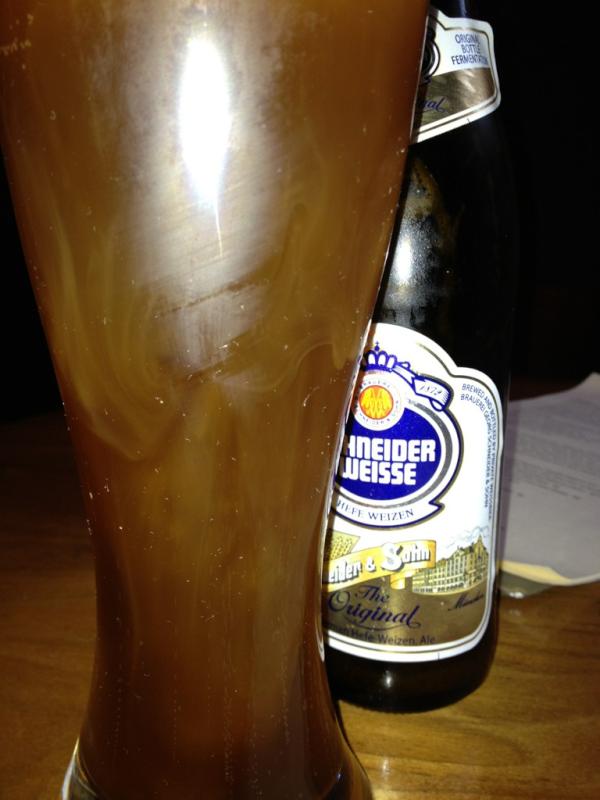
A Schneider Aventinus poured right. Photo by bonusparts
by Mayumi-H | May 3, 2014 | Finding Mister Wright, Persona 4 Fan Fiction, Short Stories
No one has told me to stop, so I’m still writing these extensions of my “Finding Mister Wright” story from this past winter break. Here’s another one: “Stupid, Macho, and Wicked” (opens as a PDF in a new window; ~2600 words/10 pages long).
Writing Marshall and the gang has been cathartic. I started writing them when we thought my dad was getting better, wrote some more when he was dying, and I’m still writing them after he’s gone. They’re not my most conflicted characters nor my most adventurous, nor even my most publish-worthy. But they comfort me. Maybe because I get to see, through them, the joy of love and family with fresh eyes. I like to think a lot of my dad’s wisdom comes through in these characters. Certainly, many story elements are drawn from personal experience, but their slow growth and evolution over all of these stories has offered me a lot of personal succor, too. A confirmation that life goes on, and can be good. And, that my writing can still be full of silliness and simplicity even when I think a lot about growing older and change and death.
This particular story doesn’t touch so seriously on any of those subjects, but it does flit around one or two a bit. I wonder sometimes if that’s the nature of Marshall and his story, or the way of all things. Take a look, if it please you. If not, I’m pretty sure I’ll be back next time with a more serious discussion of writing in general.
‘Til then: happy writing!
by Mayumi-H | Apr 25, 2014 | Finding Mister Wright, Persona 4 Fan Fiction, Short Stories
A recent post by fellow blogger Vanessa J. Chapman about coriander/cilantro brought back this memory of cultural differences. Now, I like the leafy stuff, especially over curry or in guacamole, but head on over to Vanessa’s post to get an opposing view. Whether you like it or not, though, a standing argument is what to call the darn stuff. At least around my house, anyway. That led me down memory lane and got me to put together this free-write short story (if you can call ~2300 words “short”), set in my “Finding Mister Wright” original fiction continuity.
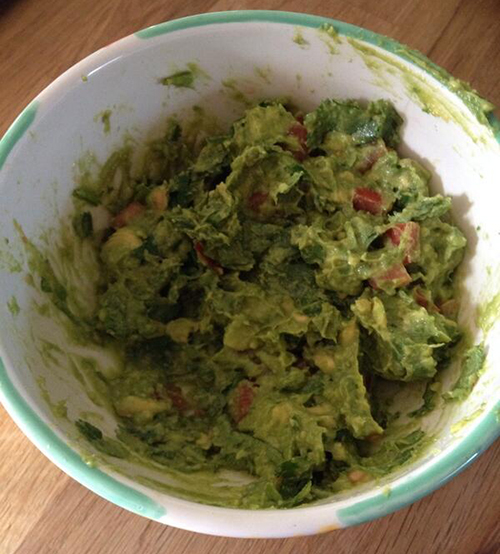
Homemade guacamole, heavily laden with cilantro (sorry, Vanessa!)
Apologies to folks who’d rather read a (potentially) more interesting article about my writing process than my fiction. But, the FMW universe of characters and situations is too much fun for me to let go. Click here to read the PDF (it will open in a new tab). Or, don’t. I will say it was fun switching to another character perspective for this one…especially since I’m more used to writing Rob in his intergalactic gunslinger persona, and not as a rather soft-hearted dad. 😉 WARNING: Because this is Rob, there are a few four-letter words in there. Nothing nasty, though. All colloquial.
On a semi-related note, please join me in sending your best writing concentration mojo to JM McDowell, who’s working her darnedest on her manuscript even as I post this. JM was the only one gracious enough to bite on the original “Finding Mister Wright” story draft (not even my husband’s bothered to read it!), and, without her thoughtful feedback, I probably would have left Marshall and the rest to languish in a drawer. Instead, I’m letting them flourish. Maybe they’ll never see a bookshelf, but they’ve given me a lot of joy these past few months. If only for that, I have to say, thanks, JM! Good luck with your latest version!
by Mayumi-H | Apr 12, 2014 | Finding Mister Wright, Short Stories
I’ve been writing a lot of dark stuff, recently. So, at the end of a sunny, productive week at work, I just didn’t want to venture back into that ugly universe of gunslingers and death-dealers. I wanted to do something light. As it turned out, something sappy, too, but we have to take the respites when they come as they come. Thankfully, one of my Twitter buddies – George McNeese – gave me the push I needed to see the following short story brainworm through. It’s a free write I pulled together between 4:30pm yesterday and 9:00am this morning, so it’s quite rough. But, I had fun writing it. Hopefully, you have fun reading it, should you so choose.
Click the link below to read the story in PDF format. It follows the characters and situations introduced in my “Finding Mister Wright” series. It’s also fluffy and silly (and quite non-traditional), but all the stories told are true, albeit taken from different sources.
All Yours – A Finding Mister Wright Free-Write
‘Til next time, happy writing!


Recent Comments