
[Previously: London]
MAY 1925: CAIRO
The only time I’ve been out of English-speaking countries was during the war, and even then, I was in France. A well-placed mare-see bo coop or see-voo-plate with a couple of evocative hand gestures was enough to get me some food or coffee. Or bullets, but that’s another story. By contrast, my only knowledge of the Middle East is from The Arabian Nights…which I read in-between trading shots with the Germans near Albert, funnily enough. I wasn’t expecting to see genies or mermaids while in Egypt, but I was hoping for some level of normalcy compared to what I’d seen so far in New York and London.
No such luck.
It was the merry month of May, 1925, when we landed in Cairo. We spent another week getting our land legs in the so-called mother of the world. Our goal was to find Faraz Najjar, an antiquities dealer referenced in Elias’s notes. To do that, we employed a man named Saleem Naziz as our dragoman (an Arabic translator and guide; will do pretty much whatever we pay him to do). Saleem came with his son, Mahmoud. Mahmoud was a cute kid, easy on the ears if quick with his palms. He took a shine to Doc Frome, who kept him happy with money for fruits and sweets and whatever else he needed.
Money talks all over the world, but especially so in a city like Cairo, where the affluent walk among the indigent, and there’s always someone begging you for cash.
It didn’t take long for Saleem and Mahmoud to find Faraz Najjar’s shop in the Street of Jackals. Just before we were about to enter the shop, a trio of men wearing black robes, black turbans, and lanyards with upside-down ankhs showed up. They went into the shop ahead of us, slamming the door behind them. Unless the bargaining process in Cairo was a lot more violent than I’d seen so far, the shouts and sounds of a fight from beyond the door proved they weren’t interested in Najjar’s curios.
I’d lost too many informants – and one too many friends – by letting some thugs get their time in ahead of me. I charged the door to the shop, trusting the others would follow.
Inside, Najjar was in the middle of a dueling blades act with the trio in black. One of them was already on the floor with a bloody chest. Najjar got a good swipe into a second one, and I went for the third.
We brawled. Neptune whacked him with one of his trusty flashlights, and I followed with a crack of my fist in the back of his head. I got my arms around him, opening him for Najjar, who ran him through with his blade. Unfortunately, his stab went a little too far through and punctured me in the side. It stung but wasn’t that bad. Certainly, not as bad as the guy I let fall to the floor in a dead heap next to his buddy.
Molly had tussled with the second thug, keeping him occupied while Najjar ran him through, too. She came away with a sliced hand, but Doc Frome could take care of that later. Najjar was in worse shape. He said to take him to the mosque for aid, and that the thugs had come courtesy of Omar Al-Shakti, the main villain in these parts. Al-Shakti was a buddy of Edward Gavigan, the crazy cult leader we’d driven over back in England.
Saleem and I carried Najjar back to the car. There wasn’t room enough for all of us, so while the rest of the crew took Najjar to the mosque, I stayed and looked around the shop.
With three dead bodies rapidly deteriorating in the sweltering heat, the place started to stink. I did manage to find among Najjar’s things a ledger. The Arabic records might as well have been hieroglyphs to me. Though, there was one entry I could read: BESART, it said, with some numbers and the word POTTERS.
At last: a clue I could work with.
I closed up the shop and headed outside. I made a conspicuous sight in my suit with its bloodstained shirt and the swiped knife tucked in my belt, but folks seemed to give me a wide berth. At any rate, I didn’t see any black robes or turbans following me.
I hailed a cab and asked them to take me to the mosque.
Don’t ask me why it hadn’t occurred to me that there might be more than one goddamned mosque in all of goddamned Cairo. Needless to say, the one the cabbie dropped me off at was not the right one. The US Embassy was close by, though, so I went there and got some first aid for myself.
I asked the folks at the embassy if they’d ever heard of a potter named Besart. One of the staff there, name of Dave Tillman, said there are a lot of potters in Cairo, and he didn’t know of anyone named Besart. The secretary, Margaret, suggested that I was probably looking for the Street of Potters.
“Like the Street of Jackals?” I asked.
“That’s not a good place for you to be,” Tillman replied.
Yeah. No kidding.
The Street of Potters was a good halfway across the city again. It was dingy, filled with street vendors and beggars alike. It reminded me a lot of the more destitute areas of Los Angeles. So, you know. I fit in fine.
To my surprise, the car and the crew were there, too! Hallelujah. We exchanged notes. All I had was the name Besart from the ledger. Doc Frome informed me that Warren Besart was a French fence who lived in the Street of Potters. He’d arranged transport of some goods, through Najjar’s shop, for Roger Carlyle, of the famed and doomed Carlyle Expedition. Najjar, sadly, had died at the mosque, but not before sharing some dying wishes. The living take precedence, though, and we went in search of Besart.
Saleem and Mahmoud found Besart’s hovel. We didn’t get an answer to a knock, so Neptune picked the lock. Around the inside of the doorway, we found a series of ankhs carved into the wood. Besart we found in the back of his room, stinking of unwashed skin and burnt hashish. It took a couple – well, four – hearty slaps to get him to come to. When he did, he told us a story that I still don’t want to believe is true…but probably is.
Several years earlier, Besart had accompanied the Carlyle Expedition to Dahshur, near the ruins of the Bent Pyramid. His story was that the expedition members had entered the pyramid and vanished. While Jack Brady suspected foul play, neither he nor Besart did anything about it except get drunk. The next morning, the expedition members reappeared, full of excitement over some discovery they’d made. They didn’t go into details, though, and Besart was left in the dark.
That same night, Besart said an old Egyptian woman visited him. She was the mother of one of the expedition’s diggers who’d been killed. She warned Besart that the expedition members’ souls had been lost because they’d consorted with some kind of ancient evil inside the Bent Pyramid. I’m not sure if Besart believed her, but he did secretly follow the expedition party to the dig site at Meidum, where he witnessed them and a hundred madmen take part in some perverse ritual. According to him, a creature the size of an elephant but with five shaggy heads came up out of the sand and devoured everyone except the expedition party. The next thing he recalls is being nursed back to health by the old Egyptian woman and her son. Her name, he told us, was Nuri, and she was in Dahshur. She also held in her possession a stone from the Bent Pyramid.
Besart was obviously insane. But if I’ve learned anything since dipping my toes into Elias’s world, it’s that insanity often carries its own truth.
We left Besart to his drugs. Even if his story about the Bent Pyramid was a hashish nightmare, Nuri and the stone was too mighty a morsel to ignore.
It took Saleem most of a day to prepare for the journey to find Nuri. In the meantime, we fulfilled Najjar’s dying wish and burned down his shop with the bodies of the assassins inside.
That night, I dreamt of a giant pyramid whose creeping shadow I couldn’t escape no matter how fast I ran. I chalked it up to Besart’s influence, though I couldn’t help but think we were on our way to the very pyramid that haunted his mind, too.
It was only a few hours’ drive from Cairo to Dahshur, but we were six crammed into a Tin Lizzie crossing the desert. Even with Neptune being a stick and Mahmoud small enough to ride in Doc Frome’s lap, we had to take several breaks to cool the engine. It didn’t help that it took another half-day of searching before we found Nuri and her son, in a little town on the outskirts of Dahshur.
We weren’t their first visitors. Omar Al-Shakti’s men had cut off both of Nuri’s hands and one of her son’s, violent reprisals for some transgression. I figured it had to do with the stone from the Bent Pyramid. The unexpected guests to our impromptu party confirmed it.
They came in a car, two men in black robes and turbans, just like Najjar’s assassins. Molly blew the face off of one of them, but the second managed to escape in the car.
At least we’d kept Saleem and Mahmoud safe, as well as Nuri and her son. Though, I didn’t need to know Arabic to understand that Nuri wanted us gone, on the double. She let us take the stone with us.
After our most recent altercation, I decided someone needed to keep watch. So, while the others slept, I kept my shotgun in my lap and scanned the horizon in all directions. At dawn, the sun rose in the east as it always did and always would until the end of the world, and for a moment, it felt like we would all be all right.
Then we started for the Bent Pyramid.
The Bent Pyramid is…different from other pyramids. The structure rises uniformly to the halfway mark of its full height, at which point the rise takes a shallower angle. From a distance, it looks almost as if the top of the pyramid has been squashed toward the base. An architectural accommodation, maybe. Or maybe something more sinister was the cause.
Doc Frome, Molly, and I didn’t like the look of the thing. Neptune couldn’t be dissuaded, though; he was determined to investigate. Mahmoud, too, was excitedly curious.
Neptune had more strange adventures under his narrow belt than I did. Those flashlights of his were okay in a brawl, and while he was a terrible shot with a revolver, at least he carried one. Mahmoud was another matter. There was no way the rest of us were going to let this little kid anywhere near that pyramid. We watched Neptune make his way toward the climb and made sure Mahmoud stayed behind, as much as he wanted otherwise.
That climb felt like an eternity to us watching from the sand. Eventually, Neptune made it to the top. He waved, a speck against the searing Egypt sky. Then he just…disappeared.
The doc, Molly, and I ran for the pyramid.
I got there first and started climbing, retracing Neptune’s steps to the top. There was a narrow entrance into the pyramid about halfway up, but I kept going for the top. Once there, I looked around. There was no sign of Neptune. He wasn’t sitting there; he hadn’t fallen off and tumbled down another side. He’d simply vanished. There was only a broken carved capstone, the other half of Nuri’s precious rock.
Molly and Doc Frome reached the top with me. The doc explained she’d sent Saleem and Mahmoud away, to return for us at nightfall with fresh supplies, mostly to keep them safe. We set Nuri’s stone next to its other half. I’m not sure what I expected, but we got nothing for the effort.
We still needed to find Neptune.
Doc Frome was willing to go inside with me, but Molly was firm about staying put. She did give me her lighter, though.
I climbed down to the entrance and squeezed my way inside. The tunnel was narrow and short, making for slow going for the first several dozen steps. It also wasn’t an easy trek holding the lighter in one hand and my shotgun in the other. But I wasn’t about to go looking for Neptune without a weapon. And at least it was cooler in here than under the blazing Egyptian sun.
After a while, the tunnel widened, allowing me to walk upright. I came to a square chamber with a mural decorating the far wall: a giant black pharaoh with a face like death seated on a throne and surrounded by worshippers or slaves. Gavigan had been involved with a Cult of the Black Pharaoh. The same? That could explain the connection between him and Omar Al-Shakti.
On closer inspection of the mural, I noticed an indentation in the wall. It was shaped like a door. I pushed. It gave. There was darkness beyond…broken by the swing of a beam of light. Light from a flashlight.
“Neptune!” I called into that darkness.
“Come see this!” Neptune called back.
Part of me wanted to strangle him, but the part that wanted to get his scrawny behind out of there in one piece won out. I gave the door another push and made my way into the next chamber.
The door slid shut behind me.
Dammit.
Neptune’s flashlights picked out a brazier, which I lit with Molly’s lighter. I used what was probably the last of the lighter’s fuel to light the rest of the braziers, giving us a full view of the chamber. Like its cousin on the other side of the door, the room was made up of four smooth walls and was mostly empty, save for a black throne at the far end. From it came a tinkling of laughter that made the top of my spine itch.
The laughter got louder. In the throne’s seat I could almost make out the form of a man in a white suit.
I tucked the lighter away and racked the shotgun, ready to blast him when there was a scraping sound. The door!
The doc called from the other side: “Hello?”
Neptune and I scrambled toward her voice, shouting at her to stay where she was, not to let the door close. She stayed where she was, holding the door open, and we hustled through to the outer chamber. We couldn’t slam that door shut fast enough.
We ran back through the tunnel, and when sunlight kissed us again, I was ready to drop to the ground in praise of it. Molly sat waiting for us, sucking on a cigarette.
“Where’s my lighter?” she asked, oblivious to the horror we’d left inside the pyramid.
Saleem collected us at nightfall. The four of us had agreed we’d send a telegraph to Colton Ramsey in the States, arranging for safe passage out of Cairo for Saleem and Mahmoud if they wanted it, as well as for Besart if he could be found. We needed to leave, too. Egypt held no more mysteries for us.
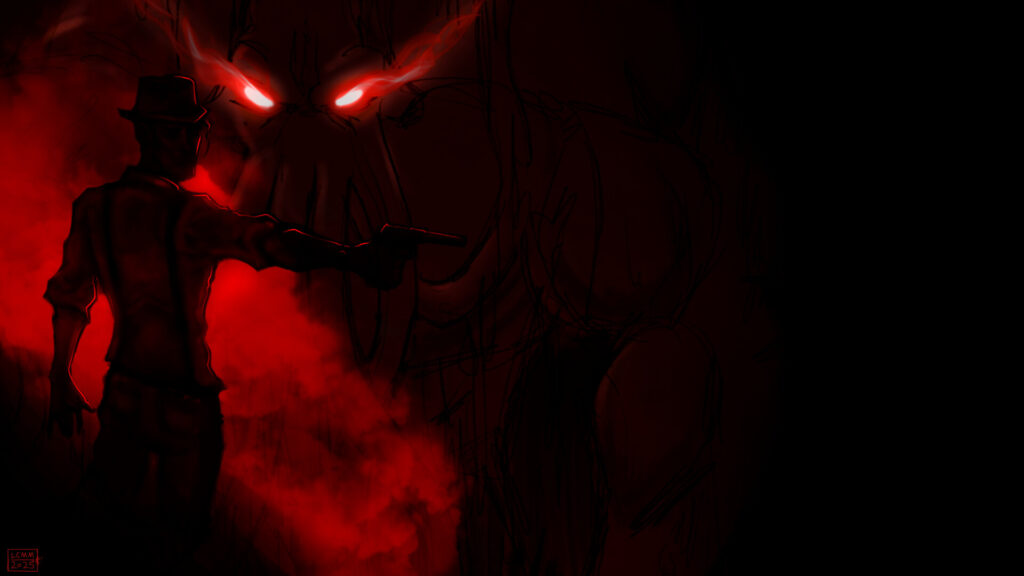
As we drove, I thought of the pyramid and its obsidian throne. How the man in the white suit sitting in the throne had seemed to change his shape from a person to a black pharaoh with a face like death to a looming shadow rising from the chair, filling the chamber with its darkness. And how its laughter became a word that felt like a name that set my mind on fire: Nyarlathotep.
I wonder what Scheherazade would have said about that.
Recent Comments