by Mayumi-H | Mar 3, 2016 | Fearless, Persona 4 Fan Fiction, Short Stories
…but, for some reason, many of my characters have difficult relationships with their own fathers. It’s the reverse of the Disney Princess situation, where it’s the mothers who are missing (seriously: many Disney Princesses just seem to not have had mothers at all!). In the majority of my stories, main characters challenge their fathers, are estranged from their fathers, their fathers are dead, or some semblance of all three. I honestly don’t know where this particular character detail comes from, since I had a pretty good relationship with my own father, and I honestly did love him. I think the admission of that love is what I’ve enjoyed exploring through these stories of children challenging and reconciling with the patriarchs of their families. Or, maybe it has something to do with the idea of The Patriarch being emotionally removed from his children, so he doesn’t show a lot of love to them. Whatever the reason, the fathers of my characters tend to get the short end of the stick. That must be the reason why, when my characters grow up and have children of their own, they are so determined to be openly loving men to their kids.
Chie, from 1 More Chance!, which I wrote between 2009-2011, rebelled against her father in her choice of boyfriend, but that was a tame conflict compared to the stark animosity Amber showed to her father in Fearless, whose first draft I wrote for NaNoWriMo 2011. Daniel’s conflict with his father, written over the last few weeks and linked to below, is somewhere in the middle between those two perspectives…and, I have to admit, related to some of my own feelings about my dad, which I haven’t examined too closely since he died in 2014.
“Butterfly”
[~13K words / 51 pages Calibri DS- PDF opens in a new window]
This story plays with time in a way I haven’t attempted before, but I’d recently read a novel that jumped back and forth in time in a similar fashion, to share story details between scenes, that I found interesting. I don’t know if I was completely successful in my attempt – I wondered if I should have done more jumping, just to break things up – but I always enjoy writing these characters, and the opportunity felt right.
Two of the guest characters in this story are returns for me, while another is based on a university colleague, and another is an homage to a writer friend’s adventuring archaeologist. I really enjoyed bringing back my own characters into this fold, and I do hope my friends don’t take offense to me envisioning them and their creations in a way that fit into my story. But, that’s the beauty of relationships, right? You never know where they’re going to take you.
On thinking more about it, the challenge of writing this story that I really enjoyed wasn’t so much the technical aspect of skipping around in time or between worlds of my making, but the Daniel character’s uniqueness in this situation, in that he is both a child and a parent, struggling to find the balance between both aspects of himself.
How do your personal relationships with family or friends affect your characters and their stories? Do you ever find yourself writing a little bit about yourself in your stories? From a technical perspective, what are your thoughts on time-jumps in storytelling? I’m happy to hear your answers to any of these questions! (And, if you’re hearty enough to actually read the story, I’m interested to hear your thoughts about that, too!)
by Mayumi-H | Jan 16, 2016 | From Hell (A Love Story), Persona 4 Fan Fiction, Process
Since the first flash of a projectile from a barrel around 1000 CE, the gun has had a rich and varied history across most all avenues of life: social, economical, political, and creative. It also has the power to divide people and opinions like no other tool before or since. Let’s be clear: a gun is a tool. It is specifically designed to make easier the task of killing, of human or other animal. Now, one can certainly use a gun to accomplish goals besides killing – say, destruction of a barn wall, for those not well-versed in the skill of shooting a target – but their primary function is to kill, with more power, speed, and accuracy than any other weapon (assuming said gun is in the hands of an expert).
Politics aside, I have always found guns fascinating, especially their varied designs, and how beautiful they can be. Take a look at the craftsmanship in the Colt below:

I didn’t grow up around guns, but I had my share of toys for games of ranchers and rustlers with the boys next door, and I talked about them a lot with my father, who’d been an Army sergeant in Vietnam and who’d had an intense respect for firearms and war weaponry in general throughout history. He’d impressed upon me at a young age that guns are dangerous, doubly so if they’re not handled with respect. As I got older, we delved into the specifics of them: “I would much rather you know how to properly use a gun and never have to,” he’d say to me time and again, “than find yourself in a situation where you had to use one but didn’t know how.” He never squelched my interest in them, but he always made sure I understood the inherent danger in them, and the enormous responsibility a person has whenever they pick one up.
I’d written stories with characters who’d used guns since I was a kid: Han Solo’s DL-44 heavy blaster pistol, the Enterprise crew’s type 2 phasers, my D&D-inspired thief’s flintlock pistol. In those early forays, guns were simply weapons of convenience that often made a cool noise or shot a bright laser beam, and I didn’t think much about their impact (pun not intended). It wasn’t until a few years ago, when I wrote the gunsmith in From Hell (A Love Story), that I really thought about what I was saying about guns through my stories when my characters squeezed a trigger. There’s a semi-pivotal moment in the story where this gunsmith and the main character argue about throwing blind cover fire into a crowd of civilians. The gunsmith’s argument is that they’re surrounded by people, while the main character points out, “Yeah, and at least one of them is shooting at us.” The ramifications of their choices follow them through the rest of the book, but it was important to me that both of them realize: odds are good that when you pull out your gun, people will die.
Because I’d grown up being taught to respect – not fear – guns, I wanted that respect to come through in this story. Even in the books and stories I was reading to get a feel for a dirtier galaxy based on the Old West, the characters treated their guns like the closest partners they’d ever have, which was probably pretty close to the case in those wilder frontier times.

Stories are not soapboxes, though, and it can be difficult for a writer to separate their personal views from those presented within their prose. Firefights offer great opportunity for excitement, high action, and conflict. But a quick-trigger topic like gun use (ha ha) requires at least some responsibility on the writer’s part. Like any weapon, they’re dangerous, and our stories would lose a measure of realism without addressing just how dangerous they can be. We can do this through the actions, reactions, thoughts, and dialogue of our characters, as well as offering realistic depictions of what happens when those characters use their firearms without awareness, caution, or respect.
Have you ever written a gunslinger? What do you think about guns – or any weapons – in stories? While realism is important, how much do you think a story requires to be seen as effective in its telling?
by Mayumi-H | Jan 2, 2016 | It's My Life, Writing Projects
Here’s my list of posted story words for the year 2015:
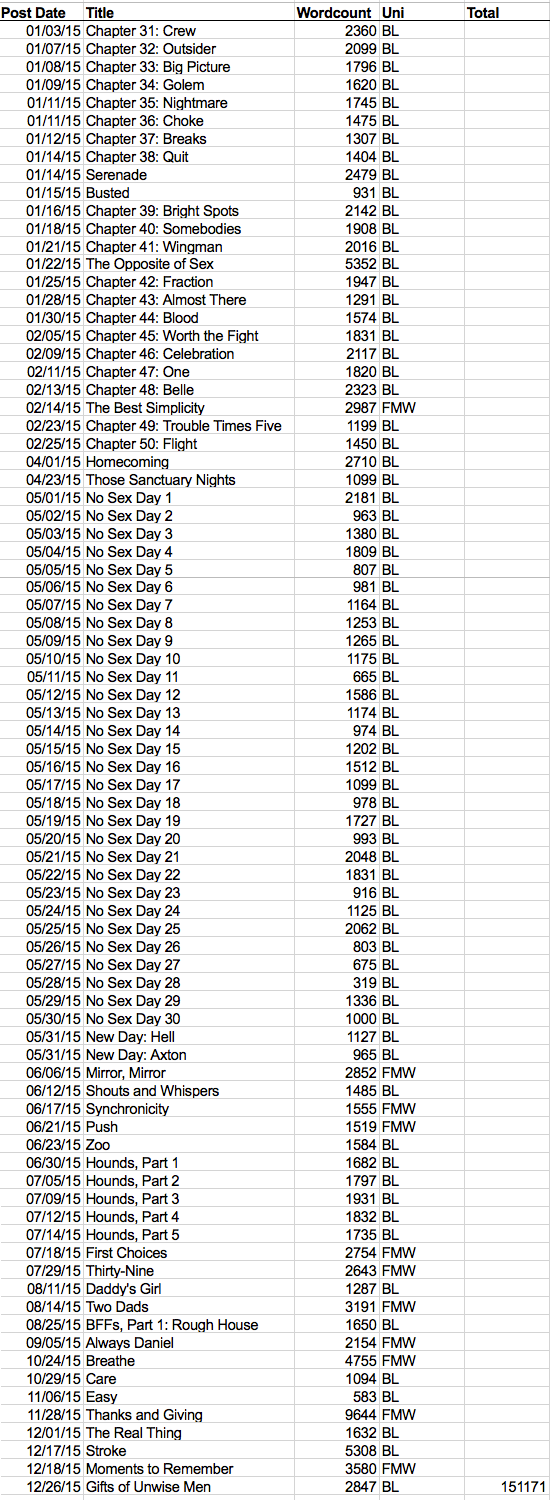
The majority of my story writing through January and February was finishing up my 2014 NaNoWriMo endeavor, Highs, Lows, and In-Betweens, which I’m currently editing for another free book. March was a bad month, so we won’t go there. April brought a return to form a little bit, but I made a concerted effort in May to focus on getting back into my game, by writing and posting a vignette per day, which definitely went a long way toward restoring my good feelings about writing. I managed to keep on through the second half of the year despite very little feedback, proof that I don’t need an audience to keep me interested in my characters and universes, a trait I’m finding increasingly more valuable the more I go back and edit my work. Make no mistake: I love feedback, but my stories don’t generate much of it. Despite that, I wrote and posted just over 150,000 story words in 2015. Not bad for a no-talent hack.
While I know that the numbers truly don’t mean anything, they do represent my honest effort over time to craft words into theme, plot, and dialogue that resonates. And posting them is a public prod for me to keep developing my skills, in a way that keeping these stories in a desk drawer could never do. Not every story will resonate to the same degree, of course, not even for me…but every single one of them is a tiny piece of myself that I’ve put out there for folks to read and – just maybe – enjoy.
Sharing stories is one of the biggest reasons why I write. I take a lot of comfort and joy in thinking them up and writing them down, but when I hear that someone else has read and found joy in one of my stories, that’s a feeling like no other. That’s why I think it’s so important for us to share our stories, whether we publish our books for a global audience or we just click the “Add attachment” button to send it along to a friend.
Everyone’s writing goals are different, and everybody’s stories are going to be different. But every story made with honesty, care, and love is worth sharing. We might not think so because we see our own writing all of the time, and it can often start to look the same. But what makes our stories unique is that they’re ours, and no one else can craft that story in the exact same way that we can do.
For the coming year, I wish for you many words of the good and precious kind, and, if you haven’t yet done so, the courage to press Publish or Send on a story of your making.
What was your 2015 Year of Writing like?
by Mayumi-H | Dec 19, 2015 | Finding Mister Wright, Short Stories
Last year, I talked about how my sister and I used to swap stories on Christmas morning. I won’t be spending Christmas morning with my sister this year, but I’ve taken to writing holiday stories even without a swap. The holiday season is about sharing and joy, and writing has always given me great joy, that I like to share.
This year’s holiday story, like last year’s, is with the Wrights and McAllisters, the two families from my “Finding Mister Wright” series of free writes. Only a few folks read the 2015 Thanksgiving holiday story with Rob’s family, but this Christmas-themed one – at Marshall and Caitlin’s new family home – is a shorter, simpler tale. In some ways, anyway. It deals with memories, kids, and keeping the important things in mind during the holidays, which I’m trying to do more every day.
“Moments to Remember” [~3580 words / 15 pages DS]
PDF will open in a new window
Next time, I’ll talk about my writing year in review. In the meantime, happy writing, happy reading, and happy holidays to you all!
by Mayumi-H | Oct 24, 2015 | Finding Mister Wright, Process, Short Stories
These last several weeks, I’ve felt mostly horrid. It’s been a rather hectic fall semester, with new projects to complete as well as new fires to put out. My students are either going through Senior-itis or studying abroad, so all the work they would ordinarily do falls to me, too. This isn’t actually that awful – what takes my students twelve hours to do, I can do in half that time – but it does mean tasks pile on through the week. Add to that my sleeping schedule is wonky due to changing weather and light, and I’ve felt sluggish and unmotivated.
I’ve also been working on a story edit.
When I edit, I try my best to concentrate on that story. It helps me keep overall voice and continuity better than notecards or Scrivener can do. I still read while I edit, because I learn more by example from my favorite authors on what’s important in a story, how to keep plot threads moving, and when to dangle, when to pull up, and when to trim loose. But the only writing I’ve done for the last month or so has been rewrites of an already-finished draft. Rewrites are good: I changed two whole chapters, cleaned up more than a half-dozen more, and had one character do a near-180 flip on me. It’s all better for the story as a whole, but it was sucking me dry.
I discussed this with my husband, who reminded me that “[r]ewriting is still writing.” But, he is much more comfortable working from what’s already on the page. The blank page doesn’t bother me; I just start writing words off the top of my head. In fact, it’s hard for me to find blank pages in my notebook when I need one, because so many of them are filled with first lines, initial ideas, or jots of dialogue. For some people, that’s all the writing they need to keep going. For me, all of those little notes and ideas are merely warm-up, like stretching before a workout. Have you ever just stretched and not followed up with the real workout? My body reacts poorly to that. It wants to work hard and make a sweat. Why couldn’t I see what that stretching-and-not-working was doing to my writer’s brain?
On my Thursday morning commute, I decided to open up a blank document. I just couldn’t face again one of the annoying scenes in the edit I was trying to make work. I began typing off the top of the head…and, over the next two days, I typed out over 4700 words of a new free write.
I haven’t felt this good in a long time.
Friends and colleagues – real writers – supported this, with cheers like, “Writing is therapy!” and “Writing is the best medicine.” I had apparently forgotten how sapped I get when I don’t allow myself the freedom to write something new and for fun.
Editing strengthens a story. It’s an integral part of making the story the best it can be. And, I do enjoy it, especially to see the finished product. But, sometimes, I have to let myself just write, for the pure joy of the story, the characters, and the process itself.
“Breathe, another ‘Finding Mister Wright’ short-fic”
[~4750 words/16 pages; PDF]
Clicking the link above will take you to the latest chapter in my “Finding Mister Wright” slice-of-life series. It’s about love and family, fatherhood and brotherhood, and the big and little changes those things cause in us. It’s a free-write, so it’s choppy in parts and rambling in others, but I decided not to edit it despite that. Part of what brings me back to these characters time and again is how much joy and love they have for each other, and how much of the same I have for them. I doubt they’d be so therapeutic otherwise.
How is your writing journey progressing? What do you do when you find yourself in a writing or editing funk?


Recent Comments