by Mayumi-H | Feb 29, 2012 | Excerpts, Fearless, Process
The prelude to a bit of smuffy sex for my hero, in Chapter 6. What would a romance be, without it?
Ross took her hand with a rippling chuckle, pulling himself to his feet with her as anchor. He stood above her then, their hips and chests touching, and he dropped his head, his mouth seeking and finding hers for a kiss that began as just a delicate brush of lips but then, inevitably, became a heated exchange of passions as they wrapped their arms around each other once more. And while they must have made their way back to the shop, and they must have told Neville something when they arrived, and they must have walked up the rear steps to the eaves loft above the showroom, Ross couldn’t have said later how they did any of it. All he knew was Amber: the eager clutch of her slender fingers, the wanting clasp of her supple lips, and the raring flare of his desire as he held her to him.
Many thanks to those of you who have given these excerpts or the posted draft chapters a read (notably zer0-damage, Shade the Raven, fivereflections, thespooneytoaster, and Electric Monk); your support has been thoughtful, inspiring, and engaging, and I couldn’t have made it even this far without it.
by Mayumi-H | Feb 27, 2012 | Fearless, Process, Uncategorized
I’ve been told that one of the qualifying rules of a good romance is that it has to have a happy ending, where the hero (or heroine) gets the guy/girl (or whatever couples permutation the romance takes) in the end. But who decides what makes an ending happy or not?
I enjoy a fine romance, myself. Or, at least, I enjoy examining the relationships that exist between people, whether they be family, friends, or lovers. (Enemies count here, too, I suppose, but they don’t exactly fit into my topic of romantic relationships.) Just as relationships come in many forms, though, so, too, does what constitutes the “happy ending.”
Disney-fied romances tend to happy-end with the heroine (it’s usually the heroine on the quest) marrying the hero, the man of her dreams. Tragic romances, of course, end with the hero and heroine falling in love but then losing each other in some way, usually death. (Here it could be said that death ends all love affairs, whether successful or not, but that’s a topic for another day.) For my own tastes, I like seeing the hero and heroine finding happiness…but what brings happiness to one couple might be very different for another.
Ross, the hero of my (first? real?) novel, Fearless, starts out a rather typical self-centered young man, who finds himself falling completely in love with a girl, for whom he’d overcome damn near anything. (And he’s got to overcome a lot, over the course of the story. But then, that’s where the title comes in.) But sometimes the happy ending for which many of us long just…isn’t what’s meant to be. Life gets in the way; events interrupt. And people change. A hero should change for the better, through his story, and whatever his quest may be: a challenge from the heavens, a challenge from a rival, a challenge from without or even within. But even a changed hero sometimes just doesn’t fit into the stereotypical happy ending.
For the characters in this book, being fearless is about more than just facing up to the challenges that block your path to the happiness you seek. It’s also about letting go, even when it hurts you more than anything.
by Mayumi-H | Feb 24, 2012 | Fearless, Short Stories
 Julia’s Place has a 100-Word Challenge going. These are always fun opportunities to write, especially for someone like me, who has a tendency to be verbose.
This week’s challenge theme is “The Flip Side.” Here’s my entry:
One of his students, a girl, lingers at his side, batting her lashes. “Thanks for the lesson, Neville.” She sucks a breath that makes her chest puff. “If there’s ever anything I can do…?”
“Just practise,” Neville says, before sending her on her way.
Beside him, Ross watches the girl go, too. “How do you do it, mate?” he asks. “Everyone loves you!”
Neville turns and looks at him, his friend with the luscious smile and the eyes so deep and blue he thinks he could drown in them. Then, he sniffs. “Not everyone.”
This little support piece for Fearless has been bouncing around in my head since I started the story’s initial plotting, back in October 2011. You can be the judge if it adheres properly to the “Flip Side” theme. (Hint: It’s not so hard to see.)
Hope you enjoyed it!
by Mayumi-H | Feb 24, 2012 | Process, Uncategorized
This post came from a dialogue I recently had with my husband. I lamented that I didn’t think I was doing things “right” for the romance genre, and that maybe I should change parts of the story (specifically, my heroine’s backstory and the circumstances around her meeting my hero). He didn’t exactly put his foot into my behind and tell me not to start rewriting the beginning, but he did ask what it would accomplish for the story. And he managed to bring up a plot point – a very important one, actually – that would be radically changed if I went back and switched things around. That conversation – and its associated realisations – are what prompted this post.
Most any real writer – whether professional or amateur – would agree that rewrites can lead to doom.
I’m not talking about the necessary editing that occurs with all work: where the writer and his or her editor (or editors) go through the story as a whole, make notes, and decide on changes. Those rewrites are good.
I’m talking about the rewrites that occur in our heads. When we get frustrated with a story and think, “What am I doing wrong?” That’s when we are in danger of stopping our progress and going back to “fix” things that may not even need fixing at all. When we somehow decide (usually in a fit of depression or anxiety) that everybody else is doing this so much better, and if we wrote just like him or just like her, we’d be successful and the masses would love everything we put down on paper.
While that last sentence is a fallacy in and of itself, the real danger here is not really in the changing of a story. Any or all stories can change, over time. Most of them likely will. Some stories are almost living things, metamorphosing from a simple idea to a more complex one (or sometimes vice versa).
No, the danger, here, is the stopping progress part, the going back to fix part. It’s likely not the right thing for me to use this space to yell at you fine readers, but I speak from experience:
Never, ever do this!
When we stop moving forward with a story that isn’t yet finished, that story is in danger of never becoming finished. And a story that isn’t finished won’t get published anywhere. Worse, though, in my opinion, is that that story falls into Limbo. The characters are left hanging, the plot remains unresolved, and there’s another couple hundred hours lost to…what? Nothing?
Switching gears helps a lot of writers to get back on track. There’s nothing wrong with that. Taking a break is also a great idea for many of us. We can’t concentrate 100% on the same thing twenty-four hours a day, seven days a week, and not get brain-strain from it all.
But, for pity’s sake, force yourself to finish your story before you start to go back and change huge chunks of it. A large percentage of want-to-be writers are only want-to-be writers because they never actually finish anything. Be part of the few. Even if the story is crap, at least it will be completed crap. That’s more than most have to their name.
by Mayumi-H | Feb 22, 2012 | Excerpts, Fearless, Persona 4 Fan Fiction, Process
All heroes must remain fearless, yes?
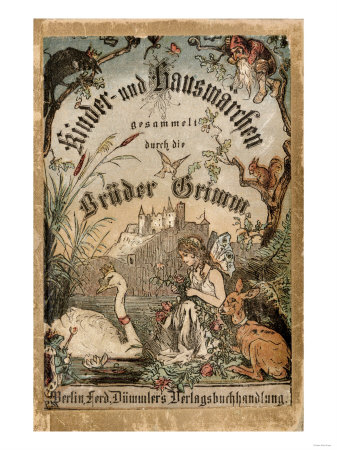
Kinder-und Hausmarchen, 1865 edition.
Image courtesy squidoo.com
Ross nodded, his eyes lingering on her as she padded into the bathroom. Shortly, he heard the sound of shower curtain rings being pulled along a bar, and then the staccato patter of water, and then he turned his attention to the low bookcase beside the chest of drawers, in an effort to distract himself from the thought of Amber naked and wet no more than a section of hallway away.
A closer perusal of the book titles stacked side to side on the shelves didn’t give him any greater insight into the girl who’d placed them there…until he noticed one book – a tall, thick, weathered hardback – that was more worn and more beaten than any of the others, and significantly so. He wasn’t much surprised to realise that it was a book of faery tales (it wasn’t readily evident what “Märchen” meant, but “Grimm” was easy enough for him to recognise). Pulling it from the shelf, he opened it onto one supporting forearm with a creak of stiff binding.
The stories were written in the original German, which – with the exception of a few very simple words (yes, no, sorry) – he couldn’t read, but many of the crudely-coloured pictures were familiar from the bedtime stories from his youth. He wondered a bit absently why this particular book was so much more tattered than the rest; even the most misshapen paperbacks were in better condition than this old tome. And then, while flipping through the pages from back to front, a very familiar word written in black script on the inside front cover caught his eye, and he paused.
For Amber, my darling princess, the message read, and Ross paused, as he felt a sharp if short twinge of jealousy that made him frown. Was there some other bloke, then, for whom she longed more than any other, and for whom he’d now have to silently compete for her attention and affection, just like he’d done with so many other women over the years?
The inscription went on:
You are a more valuable treasure than any of prince or devil. Be brave, even in the darkest forests. With more love than you know, Your Father.
Sitting there on the bed, with the book laid open across his arm, Ross paused again, feeling abruptly stupid for his jealousy. Because of course such a gift from her father would be so tattered and used. He understood well the quiet desperation of a man- or woman-child trying to hold on to something so cherished lost; he’d spent a long time of his youth trying to be like his own father for that reason, like the good-natured husband and all-knowing dad that James Finch had been. But even the years at Torpoint and keeping a lifeboat rescue pager in his pocket wouldn’t bring back a dead man, any more than Amber’s wear and tear of a precious gift of a storybook would make her own father come home.
Staring at the written words on the inside cover for what seemed like a long time, Ross felt both privileged and despicable to have been given this glance into Amber’s secret innocence.
I guess some folks would consider this a lot of pointless detail into the past personal life of a character, but I enjoy these glimpses. I think that people are just as much products of their pasts as they are of the events that happen to them in the present.

Recent Comments