by Mayumi-H | Apr 7, 2012 | Process
In a recent “Media Strategy Saturday” post over at The Red Pen of Doom, Mr. Guy (whose work you should be reading if you are in the creative business at all…and even if you’re not, it’s funny and insightful stuff he’s writing, over there) suggested that everyone play the one-word-to-describe-yourself game. Whether meant facetiously or not, I took it to heart.
So I thought: How would I describe myself, in one word, as an artist/writer/creator?
I reflected on this question for a while, and even bounced some ideas off of my husband. (His suggestions? “Unappreciated” and “misunderstood.” “Tight-ass” was in there, somewhere, too, but I argued that was technically two words, if taken the way I preferred, with all of those early morning workout sessions.)
The issue I started to have was that most of the words I came up with had pretty bad connotations. “Exacting,” for example, creates a picture of a rigid nun…and not the bad-ass, gun-toting kind like Ghost Rider got to pal around with. (I know from whence I speak on this topic, by the way. Sixteen years of Catholic schooling will do that to a person.)
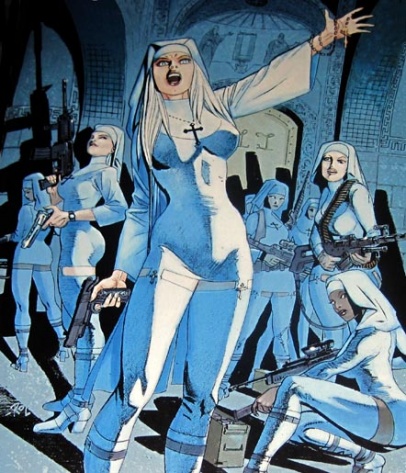
The Gun Nuns from Jason Aaron's recent stint on "Ghost Rider"
Other words that came to mind were equally problematic: “Creative” feels too generic, and it doesn’t properly convey my approach to wordsmithing and research. “Observant” might be accurate, but it says nothing about my skills as a writer. And “indelible” just makes me sound like a pompous jackass.
But there was one word – my first choice, funnily enough – that kept coming back to me: Diligent.
It’s not a bad word, certainly. Not as exciting or engaging as I would like it to be, as a word for people to think of when they remember me. But not bad, as the squirrels can attest.
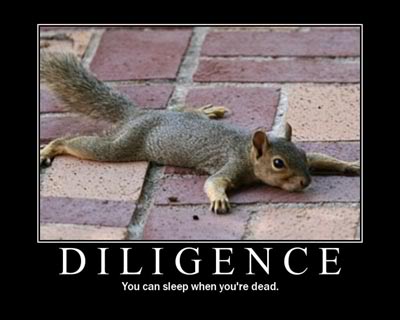
"I'll sleep when I'm dead."
I may not be the brightest star in the sky, or the swiftest wave on the beach. But I always see a project through to its end. And while my writing may never catch on (or catch up) to the masses, I love making stories, and I’ll never give up. Not ’til I’m dead, anyway. And then, I suppose all of this self-interested stuff won’t really matter.
So! What’s your one word?
by Mayumi-H | Apr 2, 2012 | Excerpts, Fearless, Persona 4 Fan Fiction, Process
Neville scowled at the doctor’s back. “Twat,” he muttered.
Venus snorted in mild amusement. “All doctors are twats,” she told him. “It comes with the territory. But he’s good,” she murmured, now. “Very good. And well-respected around here. And Amber’s his patient, so they’re more likely to release information to him than to an off-duty nurse,” she added with a shallow shrug.
Ross offered her a smile that he didn’t quite fully feel but managed anyway. “I’d still rather have you here,” he said.
Venus smiled up at him, and reached out to rub her hand over his back. “Thanks, duckie,” she murmured, and he hugged her close for a second in reply. She gave him a returning quick squeeze and sighed. Then she led him back to the chairs against the wall, to sit and sip at their coffee, and wait.
The coffee wasn’t particularly good. It was too bitter and too sweet at the same time, reminding Ross of nothing so much as one morning barely three weeks ago, when Amber had tried her hand at using Freddie’s French press. She’d gotten the balance of grounds to water wrong – or something – and had tried to cover it up with copious amounts of milk and sugar, with less than poor results. The hot mess had ended up tasting so sludgy and so burnt and so utterly terrible that Ross had made her promise never to make coffee again, despite how much she’d protested that she only needed some practice, and if he’d let her try again, she was sure she could do it right.
He would have given anything to be drinking her coffee, now. To have her standing next to him with that cautiously inquiring smile she would use when she was seeking his favour, the one that made one side of her mouth curl up hopefully, pressing one dimple into her cheek. And to feel her cuddle guardedly close, tucked almost under his shoulder, with her hair smelling so clean and her arms already wound mostly around him, itching to hug him when he finally smiled at her.
He pressed his face into the palm of one hand, focusing firmly on his breathing because anything else was simply too difficult to do.
I admit it: I enjoy writing stories in arcs. I like seeing characters through one adventure or crisis for a few chapters, lead them to a resolution, give them a little bit of downtime, and then slap them in the face with a new crisis. I like my videogames and movies and books to do the same thing, for the most part.
Naughty Dog’s “Uncharted” series of games is a good example of what I’m talking about. (There are others, of course. I just like looking at Nate Drake, the protagonist of the series, best.)
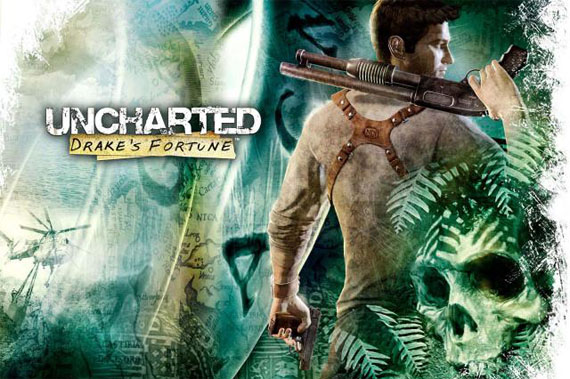
Nate's back!
...and, oh, what a back it is!
The hero (Nate Drake, whom the player controls through the game) bounces from one location to the next, finding clues to the over-arching mystery adventure, which usually involves shoot-outs, corporate thievery, hanging from ledges, and the occasional romantic entanglement. Each point on the adventure map has its own little story, mystery, and climax, but they all contribute to the whole. You can set down the game after each mini-adventure, as it were, and take a breather, before you jump headlong into the next one. (Nate always jumps headlong into everything. It’s a character trait.)
I – and this is just me, personally – like stories structured the same way. If it’s a constant uphill rise or battle toward one grandiose climax, I get tired reading that (or watching it, or playing it). There’s no time for me to relax. For some genres, of course, that can be a good thing, I suppose. In a thriller, you might want to never let up on the tension. (I can’t imagine anyone surviving very long in a story like that, but I’m digressing.) But in a romance/drama/relationship story, which is what I’m writing, I think it’s worth it to the reader to see the characters get some happy time before the next bus comes crashing into the building.
And there are buses. Emotional ones and physical. Because all stories need some conflict.
What does all of this have to do with the excerpt above? I guess I just thought that you were seeing a lot of happy-happy, and I wanted to let you know that the story does actually have some meat to it. Emotional meat. Heavy emotional meat. But there’s an end coming for that, too. You just have to see it through.
by Mayumi-H | Mar 31, 2012 | Fearless, Process, Uncategorized
I wonder how many writers out there are like me, and keep relatively close at hand previous drafts of passages, scenes, pages, or even chapters? For every story I write – even those 100 word challenges – I keep a separate document, where I drop all of the phrases, sentences, and paragraphs that don’t end up in the final draft. Some of these “unused” documents are small, of course, but others are hundreds of pages long. When I was writing 1 More Chance!, I put entire scrapped chapters into that standby document…!
Most of the time, what goes into the scrap heap stays in the scrap heap, but, on occasion, I go back to the well. Sometimes I do this just because I’m bored, and it’s interesting to see what I’ve edited out. But sometimes, I’ll pick up some discarded piece of prose and find a new use for it, with a new group of characters or a new situation. (Does this mean I’m plagiarising myself?)
A “draft” of any of my stories will usually undergo a great deal of change from inception to completion. That’s not to say that I don’t know what’s going to happen in beginning, middle, and end. But the plot (especially for the longer stories) will jump from Point A to Point D to Point G, before moving on to the originally-planned Point B. Even Fearless has done that, a little bit, and I’ve known since the first sentence how that one is going to progress.
I suppose that all of this has to do mostly with the fluidity of stories. It’s not an issue for me, despite what you may glean from the above musing. I just wonder if I’m the only one who holds on to everything to come before. Not that I’m going to change the way that I write. I mean, I like letting the characters and situations take over, for a while. After all, doesn’t that help to make the writing true?
by Mayumi-H | Mar 28, 2012 | Short Stories
Doc says she can hear. So, he reads.
The book labeled “Grimm” is her favourite, but the German is gibberish to him. Instead, he chooses another story: about a little girl lost, trying to find her way home. That’s the one he reads to her, in the hope that she’ll hear him, and find her way home, too.
But hours turn to days among the tubes, pumps, and beeping monitors, and the time comes when the words on the page – ‘What was the rabbit late for,’ wondered Alice – dim, waver, and run.
The book falls, forgotten.
And he falls, too: down, down, into the lonely dark.
This was my original entry to the 100 Word Challenge for Grown-Ups for Week 36, where the prompt was to include the phrase, ‘What was the rabbit late for,’ wondered Alice … and also to hook the end of the story with ten words from which another author could write a new entry.
I like this entry, certainly. There’s a lot of what I think is pretty fun wordplay and description. But it’s also so depressing and dark. Plus, the end hook doesn’t allow for a lot of variation in theme for the next person. It’s like I’d be sticking someone with a depressing story! So, in the end, I went with something more lighthearted, instead. I’ll leave it up to you which one you prefer.
by Mayumi-H | Mar 26, 2012 | Excerpts, Fearless, Process
“This is for you,” he said, clicking open the small velvet-covered jewellery box with a flick of his thumb, to show her the fragile silver necklace with its moonstone briolette and the tiny pearls wrapped around it.
Amber’s delicately made-up lips broke into a wide smile. “Oh, Ross…!” she breathed as she looked from the box to him. “You shouldn’t have done!”
He wrinkled his nose dismissively. “It’s a Christmas present,” he muttered.
She giggled. “That’s still almost two weeks away!”
He shrugged one shoulder. “I know,” he said, and then grinned. “But, I couldn’t wait.”
Even the bright lustre of the chain couldn’t outshine the smile she graced on him. “Well, thank you,” she whispered. “It’s lovely.”
He smiled again, and plucked the necklace from its black bed with his fingers. “Here,” he said, passing her the box as he shifted around behind her. He pushed the blonde curtain of her hair over one shoulder, then lowered the chain in front of her, settling the dangling pearl onto her chest, not far above her cleavage. He fastened the catch and smoothed it down upon the back of her neck, then paused very briefly, to lay a light kiss just above it, between the scooping collar of her coat and her hairline.
“Thank you,” she whispered again, pressing back into his hands, which he’d settled on her shoulders. Then she turned about on her toes in a graceful little pirouette, and wound her arms around his neck. She didn’t say another word, just rose up and kissed him, while the rain came down upon the awning above their heads.
Recently, I’ve had several conversations about the value and necessity of depth of description in stories. Personally, I’ve always been something of a word-hound, and I like setting scene and offering details. I have been known to go overboard with my details, though. (That’s one of the reasons why I’m really enjoying the 100-Word Challenges; they really make me think about the words I’m putting down on paper.) However, I think that – especially in a genre such as romance – details are quite important.
Even though women tend to be the main readership of romance, writing from a man’s perspective has made me consider how visual men are, as a gender. They’re stimulated by what they see. Not that women don’t have that visual stimulation, too, but with men it seems to be so much more acute. The male voice also tends to be a lot more immediate than the female voice, at least for my men. So, with this story, I’ve tried to concentrate on offering details mostly when they’re warranted, and when they’re in relation to what Ross would notice in the world around him: such as the way Amber looks, feels, smells, and moves.
It’s been very interesting to find a voice for Ross. I hope that readers can sympathise (or even empathise) with him along the way. But, even if they don’t, even if I don’t find readers for this story, it’s still been a fun and enlightening experience for me.

Recent Comments