by Mayumi-H | Oct 31, 2012 | Uncategorized
Wednesdays in this blog’s schedule are reserved for fiction pieces…but National Novel Writing Month is all about writing fiction, so it sort of fits.
To those writers attempting NaNo, whether for the first or fifth time: we’re going to need dedication to the story, support from families and friends, and lots of caffeine, energy drinks, or whatever your wakey-wakey consumption of choice may be.
![Photo by: Andreas Gronski, 2004 [from Wikimedia]](https://mayumi.amorphous.press/wp-content/uploads/sites/4/2012/10/kaffeemaschine.jpg?w=224 "Kaffeemaschine")
The inspiration for HG Wells’ time machine?
And all along the way, we’ll be writing one big pile of crap.
[youtube http://www.youtube.com/watch?v=-JFfN5pKzFU?rel=0&w=420&h=315]
You know what, though? That’s okay. Because all first drafts are crap. (Many second and third drafts are crap, too, but that’s a post for another day.)
NaNo is about helping us see we can meet a deadline, write to (or past) a wordcount, and – in many cases – realize we can, in fact, tell a story. Most likely not a great one by November 30…but one that may just grab us by the shirtsleeves and make us keep going, to dip down into further drafts and deeper edits, and make a better story, one worth sharing with the world.
Or, maybe not. Maybe we’ll be satisfied with what we cranked out in those thirty days, and we’ll be inspired from there to take on another project, knowing now that we can do it. That’s okay, too.
So, let’s grab our pens and get comfortable behind our keyboards. We’ve got writing to do!
Are you participating in NaNo this year? Want to buddy up?
by Mayumi-H | Oct 20, 2012 | Process, Uncategorized
Part of what makes stories so much fun is the drama involved: Will the hero conquer the villain? Will the princess find her true love? Will the puppy make its way home? But, what happens when we find our characters strive more for realism than for drama?
Every story needs some kind of emotional resonance for it to have impact, whether it’s about war or heartbreak or family experience. Sometimes, though, our characters become so much their own people that they end up dictating where their own stories go. I’ve written scenes – necessary ones – for their dramatic effect…but I’ve also had to rewrite other scenes because the characters’ voices had developed so much since my initial plotting that their actions (or reactions) as I’d originally envisioned simply no longer held true to their natures.
What do you do in this situation? Do you let the character take over, possibly sacrificing the drama of the scene? Or, do you follow through with the original idea, possibly sacrificing believability for the character?
It’s okay to play Loosey Goosey in some instances: maybe the hero isn’t in his right mind at the moment and makes a snap judgment against character; maybe the heroine is torn by the conflict facing her and decides on one route over another because her values are confused. Written well, with the associating consequences, those options are totally valid. But, what do you do when your original big conflict becomes significantly less climactic than originally envisioned, because your darned MC has grown up too much over the course of the story?
I’m a big fan of sweeping epics, and last-minute, nerve-wracking climaxes where the audience is led to page after page to see what happens next. But I also believe in, well, believability in a story. The hero shouldn’t overcome the conflict just because the story needs a climax; he should do so because that’s what he has to do, to progress, grow, and change. It may make for less high drama, but it may also make for more realism.
But that’s just my opinion. Which do you prefer: realism or drama?
by Mayumi-H | Oct 15, 2012 | Fearless, Process
I’m back from Japan, where I had a lovely time with both my intimate and my extended family. We ate, drank, walked the touristy route I always walk whenever I visit (the mountain trails at Arashiyama; the shopping maze at Kawaramachi dori; the delectable tempura at Yoshikawa Inn), as well as our usual visits to friends in Tsu (where, this year, we saw the Ama divers at Toba) and Sanda (where we always get treated to the most scrumptious home barbecue). While I did all this, though, in the back of my mind, I was still thinking about the men and women of Fearless.
The story takes place mostly in the fictional village of Harbram, based loosely on lovely Porthtowan, along the north Cornwall coast, where I have extended family on the other side. It’s more than a stone’s throw from Kyoto, of course, but the principles of writing it are the same ones I took for writing characters in Japan.
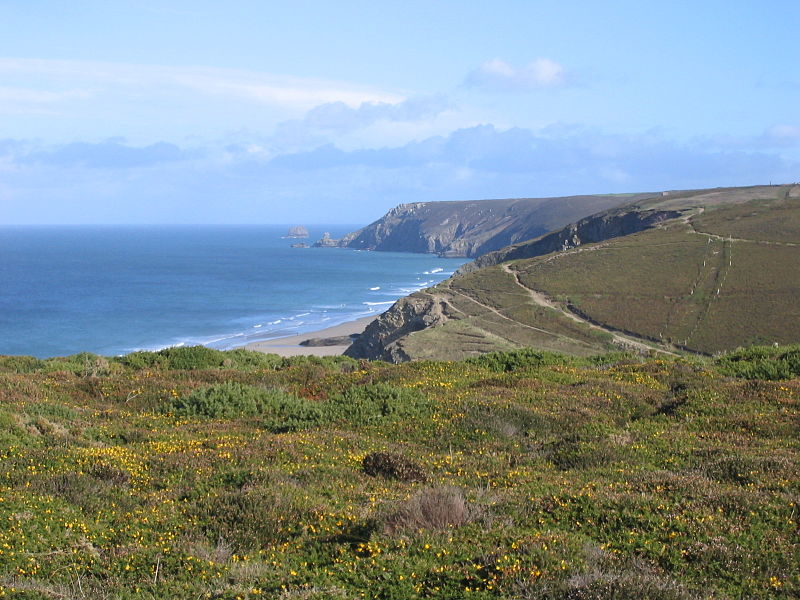
The cliffs at Porthtowan, inspiration for Harbram
First, there’s nothing quite like immersing yourself in the culture of your characters, especially your main character. Not everyone can indulge in a two-week vacation in their MC’s culture or experience it firsthand, but there are ways around that. Read up on your subject: history, lifestyle, idiosyncrasies; the Internet is a bountiful and endless source of information about this sort of thing (also many times erroneous, so do be certain to double-check your resources). Talk to people who live the lives of your characters, in experience, background, even outlook. With so much programming out there, it’s likely you can even find some television shows or movies about your subject! (Be mindful of artistic license with this one, though.)
All this is to say, you don’t have to rely solely on your imagination to create the world in which your characters live. Many times, you shouldn’t rely only on your own brain, because you will probably be missing out on a lot of important facts or details that can end up making or breaking your story. (I cringe every time I read a story set in Japan where characters do not take off their shoes before entering the house!)
There’s a lot of information available at your fingertips. Use it to build a full, lush, beautiful world in which your characters will play, dream, cry, and live.
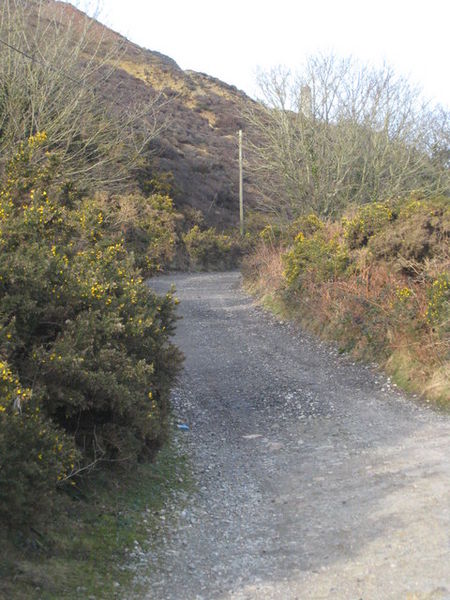
Porthtowan’s Mount Hawke footpath, the inspiration for my Crow’s Point path.
What techniques do you use to create your characters’ world?
by Mayumi-H | Sep 29, 2012 | Process
We all go through periods where we don’t want to drag our behinds out of bed to do some work, whether that’s duties around the house, a job at the office, or staring at the glaring computer screen. One way to be certain you stay at your creative best, though, is to make sure you are (wait for it) healthy.
I hate to sound like my grammar school physical education teacher, Miss Sobolowsky, but exercise truly is good for you. (She was the first person to suggest I exercise to reduce the discomfort of menstrual cramps, and darn it if she wasn’t right.) Not only is regular exercise good for your body, but it’s good for your mind, too. And a healthy mind is invaluable to an artist.

(Actually, this is Israeli high jumper Danielle Frenkel, not my grammar school PE teacher.)
Feeling “uninspired?” You may be amazed what wonders a brisk walk or run, a swim, or a sweaty workout will do to get your creativity flowing again. Part of the reason, I’ve found, is because the rush of endorphins brought on by physical exertion opens the blood vessels, which gets your heart pumping faster, sending more blood to your brain. (Nothing like a natural head-rush!)
Depending on your choice of exercise, it also allows you time alone, which you can use to clear your head and maybe consider a new way out of that tricky corner into which you’ve written your characters.
I realize not everyone has time to devote to a regular workout, of course, especially those with hectic household or occupational schedules. But play time with [insert animal or child of choice here] can function as exercise, too. The same can be said for doing the chores (raking leaves, for example, can be a monotonous task…until you put yourself in your character’s shoes, and think about how they’d deal with the job) or running errands. Even a 30-second dance break at your desk can give your body – and your brain – a quick recharge. (Have a rave in your chair. It’s fun!)

In space, no one can hear you exercise. So why not grunt as hard as you can?
So, the next time you’re feeling like the world – either the one you’ve created or the one outside your window – is getting you down, jump up and get your blood pumping. You really will feel better.
What’s your favorite kind of exercise?
by Mayumi-H | Sep 15, 2012 | Fearless, Process
I was going to talk about how it’s important to stay healthy while you’re working on any project (even a writing project), but I’ll save that for another time. Because I seem to be coming down with something, and because, earlier this week, my thought processes were waylaid by a few different posts about what it means to be a woman, and how society views women. I’m not taking a stance on whether one or both of these posts is right or wrong. They simply made me think. About myself, and specifically about my female characters.
I’ve talked about this conundrum before: how important (or not) it is for a character to be likable. It’s the same for women characters as it is for men. Whether they’re likable is often irrelevant, so long as they’re realistic. Likability should come – or not – based on how “real” they are: their sympathies, their reactions, their thoughts and feelings. My current main character is a man, and his big starting flaws are that he’s vain, distrustful, and driven by his biology, to put it nicely. He’s been an absolute blast for me to write, because – particularly early on – he’s free to be so one-dimensional in a lot of his interactions (“Let’s have fun!” “Let’s surf!” “Let’s f–k!”). Since it’s a romance story, he has to face and overcome (or run away from) certain obstacles introduced by the main female character.
This is where it gets tricky.
Women expect other women in stories – especially romances – to be intelligent, powerful, strong. But, not all women are powerful or strong in the same way.
Don’t get me wrong: I love women who kick ass. When I was a kid, I wanted so badly to be Vasquez from ALIENS: she was no-nonsense, stood toe-to-toe with any of her fellow (male) Marines, and went out in a blaze of glory. I loved that! My opinions of strong women haven’t changed as I’ve gotten older…but I have realised a woman doesn’t necessarily have to be a stoic smartgunner in order to be “strong.”

said kickass smartgunner
As I’ve become a woman, myself, I find I appreciate other women – fictional or real – who can embrace their femininity as a kind of strength. My last heroine was a woman who had a hard time reconciling being a fierce warrior but also a young woman who wanted to be loved by her man. That was a fun, enlightening journey to take with her, but I wanted to do something different for my next heroine.
Perhaps it’s because this current story is from a man’s point of view, but I don’t have a problem with my new heroine being girly, sassy, and sexy. (That’s what my hero likes about her!) That doesn’t mean she’s a wimp, though, and I don’t think I’m dismissing The Sisterhood by making her not be a fighter; her strength ends up manifesting in more subtle ways. Simply because she’s a nurturer rather than a hunter shouldn’t mean she’s any less valid as a strong woman character than a ball-busting CEO or tough-as-nails starship captain.
Of course, no one will ever be another USCMC PFC Vasquez, J. (Sidenote: Jenette Goldstein, who played Vasquez, is just as kick-ass as her breakout role. Just check out her shop at http://www.jenettebras.com/ – this is a lady who understands how great it is to be sexy!)
What does a “strong” woman character mean to you?

![Photo by: Andreas Gronski, 2004 [from Wikimedia]](http://mayumi.amorphous.press/wp-content/uploads/sites/4/2012/10/kaffeemaschine.jpg "Kaffeemaschine")


Recent Comments