by Mayumi-H | Jun 12, 2013 | Persona 4 Fan Fiction, Process
This past Monday, I had another photo shoot with my photographer, Celeste Giuliano. It marked the thirteenth photo setup I’ve done with Celeste, since 2007. Of course, it being the thirteenth shoot, we were cursed with a few difficulties (late trains, blown lights, and rain!), but I had an amazing time, as I always do.
I first started these photo shoots as a way to feel better about myself. I’ve never considered myself a Gorgon, but, I’d started to feel plain, unnoticed. Kind of worthless, actually. Especially when I looked around and saw all these beautiful others, who weren’t me.
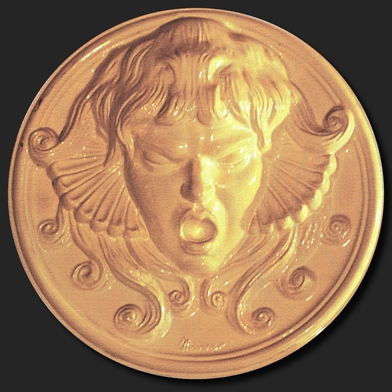
By Italiamoderna at it.wikipedia [Public domain], from Wikimedia Commons
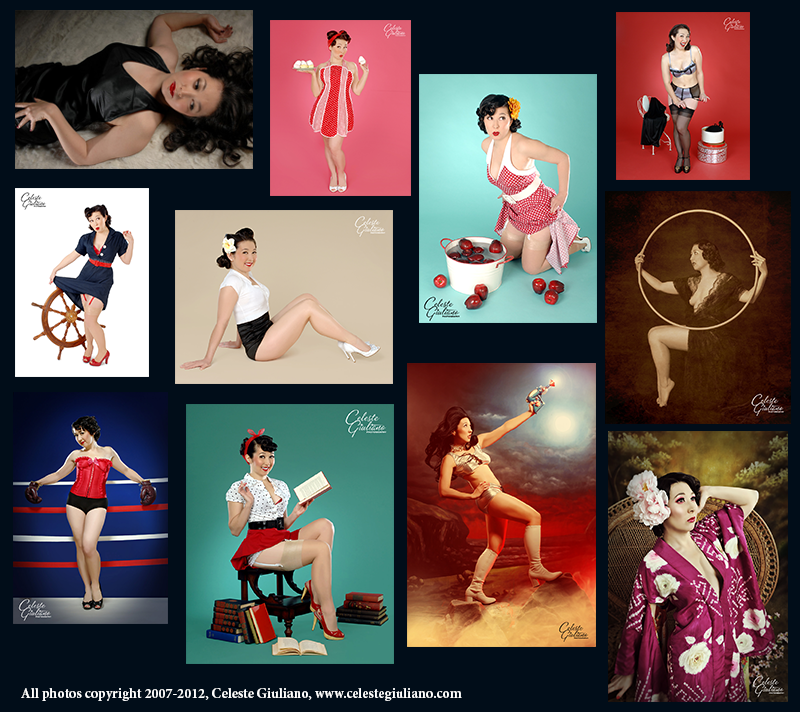 As well as being inspired to do these photo shoots, they also inspire me. For days, even weeks, after a shoot, whenever I look into a mirror, I remember how empowered it feels to be proud of who I am. I don’t see the flaws in myself, but what makes me beautiful. I try to remember those feelings when I look at my work, too.
When we review scenes, chapters, or whole stories for editing, we often focus on the imperfections. That’s not a criticism of editing and revision; it’s important for us to note where our stories can be stronger, what we can change to make them better. But, sometimes, in seeing all those imperfections, we can lose sight of what’s beautiful.
Never forget the essence of your story. It may not be as handsome, as charming, as strong, or as popular as the one you saw while strolling through the aisles of your book shop. But it’s got its own beauty. Nurture that. If you do, you’ll feel – like I did, after my latest photo shoot – like you’re fifty feet tall.
by Mayumi-H | May 22, 2013 | Persona 4 Fan Fiction, Process, Short Stories
A few weeks ago, I wrote about a particular Free Write Friday picture prompt (Free Write Fridays from Kellie Elmore). What came from that free write session was about 1600 words of a relationship story, one that flowed so naturally from my fingers, I just couldn’t stop writing it. As I mentioned in that earlier post, what struck me as I wrote those characters was how much of a role their religion played in their dialogue. Their sexuality also featured prominently, which is one of the main reasons why I didn’t post the piece at the time. Because you never know who you might offend.
Generally speaking, offending potential readers is not something I care very much about. It’s my belief an artist should create Art that speaks from the soul, no matter how dark, bright, raunchy, or chaste. Whether the artist can then sell that creation if they so choose is an entirely different debate. But, the Art at its core should be honest. Otherwise, it’s not so much art or even craft, but simply a consumable.
Side note: I’m not saying there’s anything inherently wrong with producing for consumption. Nor am I saying consumables necessarily exclude artistry, or vice versa. I think A Song of Ice and Fire has proven that pretty well. Besides, every one needs to eat, no matter how high-falutin’ their principles.
That said, I recently revisited that piece of free writing because I was curious to look at it with fresh eyes. I wanted to see if it really was as bad as I’d originally thought. Holding a marker, I went over and redacted everything I thought anyone could possibly find offensive in any way. This is what came of that exercise:
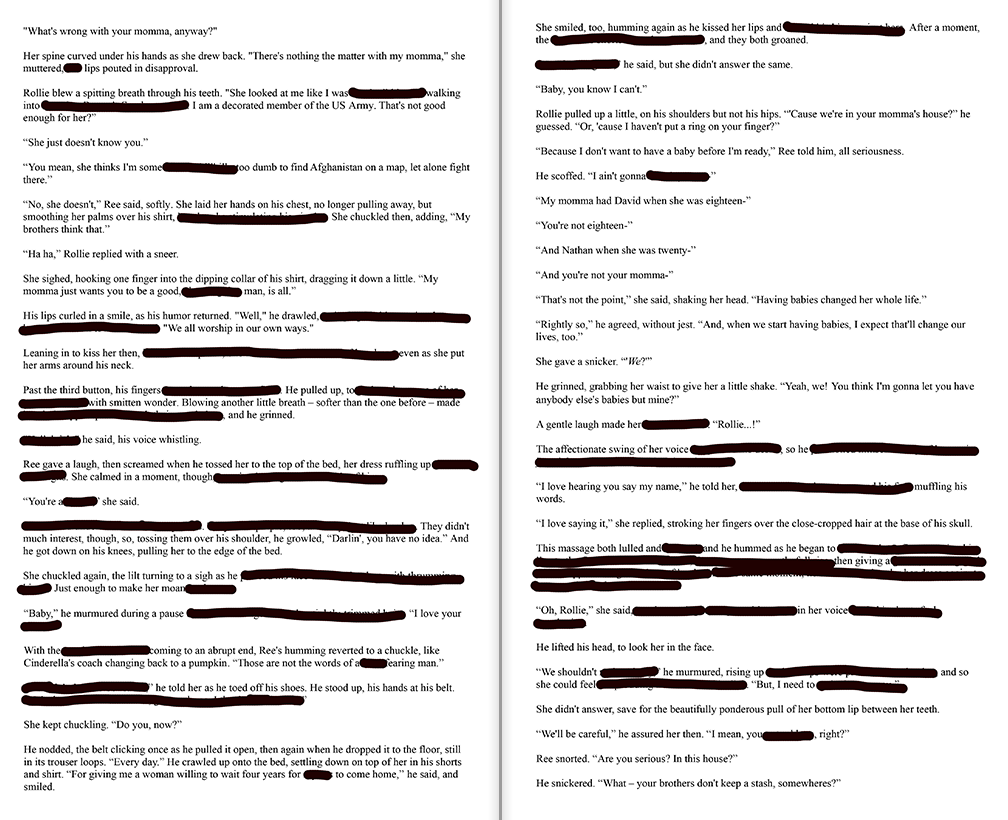
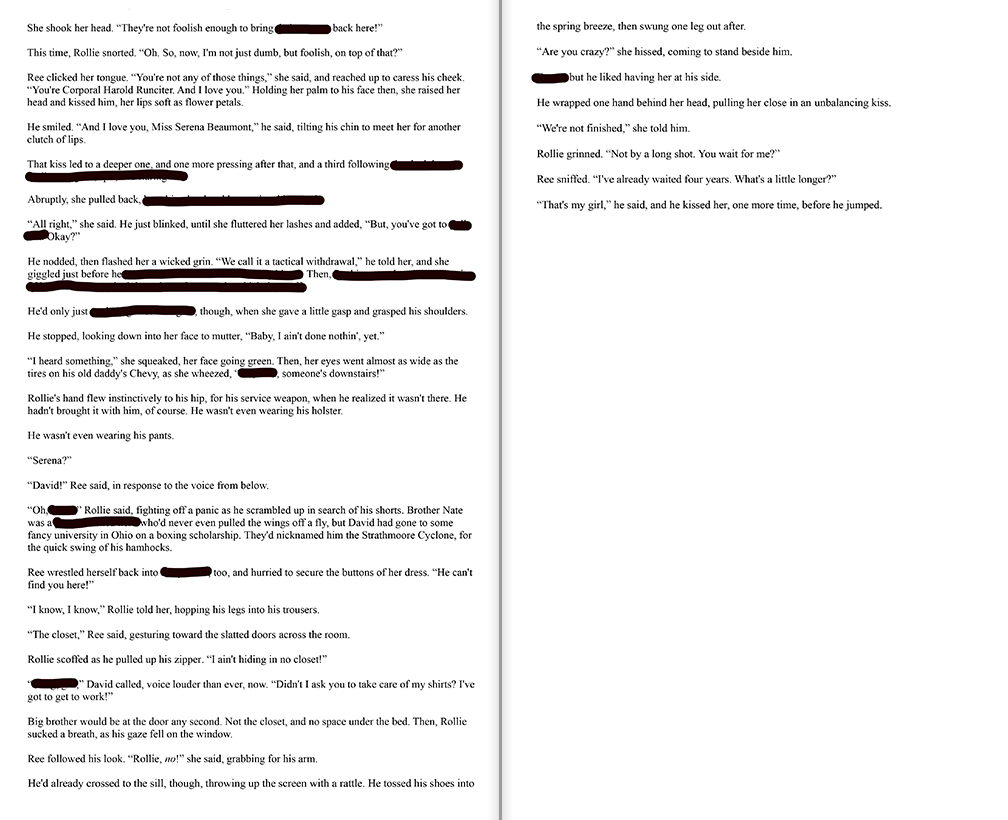
If, for some reason, you’re interested in the actual words, click the images for a more legible experience (they’ll open in a new window or tab). The scene itself isn’t important, though. The reason for this exercise – aside from fueling my own personal amusement – was for me to see just how much black there’d be on those pages.
I’m not particularly smart, so I can’t write good mysteries or thrillers. I’ve only ever held a gun once, and never in a conflict, so I’m not qualified to write a big war epic. But, I understand people, and the everyday conflicts that can arise from personality and heritage clashes. I know love, too, because I experience it in my life every day. And I like sex, because…well, who doesn’t?
I don’t pull many punches when it comes to my stories. I try my best to warn folks ahead of time if a story contains questionable or mature material, but I also believe any individual should be able to decide for themselves if they want to continue or not. But, I’m writing these for me, first, and those topics are the ones I personally enjoy exploring. If they need to be redacted later, to fit someone else’s idea of what’s appropriate or salable, well, that’s life.
Have you ever redacted or edited something you’d written to fit someone else’s sensitivities? Why did you do it? Or, if you didn’t do it, why not?
by Mayumi-H | Mar 6, 2013 | Process

Writers’ Museum in Edinburgh. In Lady Stair’s House. Photo by Jeremy Keith.
Now, I’ve shared my stories with others before: friends, writing buddies, family (once in a while), even strangers. I don’t stress about feedback from any of those folks. They receive my stories as a chunk of text to absorb, and, for the most part, their feedback is a simple, “I liked it,” or “I didn’t.” We may go into slightly more detail than that, but it’s often conversational, with comments painted in pretty broad strokes.
A professional edit, though, picks a story apart scene by scene, line by line, word by word. That’s good. It helps a writer step outside the confines of their little self-imposed world, to have someone examine that world with a sharp, precise knife and cut where necessary. They may do a little triage, too, to keep the story pumping. I’d trust an editor – especially a good one, like I was lucky enough to get – to do that.
When I received the pages back and finished reading through all the comments, I wanted to scuttle back into my NaNo hole and tear the whole story apart again. Not because I was crushed or demoralized by those red marks. Because those red marks showed me there was something there. And I wanted to fight for it. I wanted to dig deeper into myself and that world and those characters, and make the story better. Because, with those fixes and suggestions, I knew it could be so.
I didn’t think I’d pick up that story again. It was a first draft, and first drafts always need work. But, when I crossed the NaNo finish line last year, I thought, Good enough. Now, I know how wrong I was. The best bit? The editor never came out and told me I could do better. It was everything between the lines: all the little ticks and tacks that – when I saw them – I knew were right.
In hindsight, I shouldn’t have worried. The editor’s feedback was great. Not to say it was all glowing praise, because it wasn’t that. Rather, it was observant, critical, and helpful, what a proper edit should be. And, just reading through the comments for that one scene made me realize the story wasn’t all it could be.
I wasn’t all I could be.
So, I decided to take the pages back and start over. Not from scratch, because I do like a lot of the story already. But the suggestions and observations are with me every time I start to play in that world again. And when I play in all my other worlds, too.
The story may never be great, or a bestseller, or even publishable. But I can make it better than it was before.
Better. Stronger. Faster. Dah-na-na-naa! Dah-na-na-na-na Na-na-na-naa!
[youtube http://www.youtube.com/watch?v=HofoK_QQxGc?rel=0]
What words of wisdom do you have for a hopeful aspirant? Got stories of your own to share? Want to trade? Let me know!
by Mayumi-H | Feb 27, 2013 | Process, Uncategorized
One of the great aspects of sharing our work on the Internet is the tremendous community of people available to see it. Many of these folks can provide valuable feedback, insight, and advice, and they do it for free.
But, just because something comes free doesn’t always make it good. Good critique comes with a price. Often, it’s a monetary price. Make no mistake: that monetary price is worth it, if you’re genuinely interested in getting sharp, honest critique of your work, especially with an eye toward eventual publishing. Not all of us are looking for that, though. Some of us just want to get some more in-depth feedback than, “This is great!” or, “Post more soon!”
For those of you just getting into the tricky business of giving free feedback, here are a few (hopefully helpful) tips.
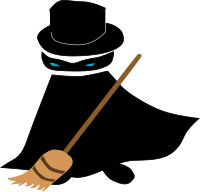
El editor enmascarado! (public domain image)
- Check your ego at the door.
Whether critiquing someone else’s work or having your work critiqued by another, you must swallow your pride.
For the critic, ego-checking should be pretty easy to do. You’ve been asked to do a job, and your goal should be to complete it to the best of your ability. However, try to rein in any impulses to create a mini-You. Each artist has his own style and story, and trying to rewrite that to fit your own won’t help him become a better craftsman.
For the artist, ego-checking can be slightly more difficult, as our stories often feel like part of us. We’ve invested time, effort, sweat, and tears in them, and to hand them over to another person may induce fear and anxiety. But, whomever we trust with critique, we should listen with open ears to their feedback.
Read that last sentence again. Feedback. Listen. Trust. These are not given – or received – easily, which is why you should also remember point number 2…
- Critique unto others as you would like to be critiqued.
If the critique is genuine, there’s no reason to fear the red pen. Any artist who asks for your help will want you to point out what works and what doesn’t. Because learning where we make mistakes should make us more aware of them in the future, and help us hone our craft.
That being said, remember this is a person who has asked for your help. By nature, people are fragile things, artists often more times so.
When you strike with your red pen, do so honestly. But, be helpful, too. If it’s an error you’re marking, illustrate a corrected example. Issues with the plot, characterization, or pacing? Define them for the artist: let him know where you thought the story slowed down and how he might compensate for that. Tell her why you found the plot meandering and what she might consider changing to pick up the pace. If you don’t like a character but you’re supposed to do, tell the author what traits or scenes counteracted their intentions.
The Golden Rule applies to all interactions, though. Work your red pen as you’d want others to do to you. We all come from different walks of life, and we’ve all got different styles. Which brings me to point number 3…
- Assume nothing.
There’s an old saying that goes, When you assume, you make an “ass” out of “u” and “me”.
Avoid assuming anything before you go into a situation or story. Your artist probably comes from a different background from you, so her story will be different from any perceptions you may have at the outset. Which is why you should try to keep those perceptions under control.
Certain aspects of storytelling will hold true unilaterally, across the board: solid plot, good characterization, proper grammar and formatting. Beyond that, though, you need to let an artist find her own way.
Now, an author should do their own research into the subject about which they’re writing, at least to the point of it being reasonable. I wouldn’t expect someone to get a degree in astrophysics just to write a few lines of dialogue, after all. If something doesn’t seem right, mention it. But keep in mind the geographical, societal, even temporal boundaries of the author’s story. Coffee may be the most popular drink where you are, but if in the story it’s tea, then it’s tea. Live with it. If, on the other hand, the author mentions how Kansas is in South America, you need to correct that. An author looking for guidance will thank you for your attention…or, he’ll have an opportunity to explain his choice. Either way, you’re doing your job as a critic.
So far, I’ve been blessed to have readers who have been equally honest, straightforward, and supportive with their critique when I’ve asked for it. I hope you’ll be so blessed, too, either on the sharp end of the pen or not.
What are your tips for critiquing others’ work? Or, for having your own work ready for critique?
by Mayumi-H | Feb 20, 2013 | Fearless, Process, Short Stories, Songbirds

For the scrapheap
Sometimes, a challenge prompt will strike an immediate chord with me, and writing a submission is no trouble. (My Songbirds series vignette “A Deeper Reflection” was one of those easy-peasy efforts.) Other times, a multitude of prompts will converge into a perfect storm of inspiration and interpretation, such as with “Stagger to Sway,” one of my Fearless side stories. And then, there are the times when I’ll start writing one way, go another direction, twist around yet another bend, until I finally end up with a piece suitable for public consumption.
In the case of the “CHERISH” prompt, I eventually settled on a somewhat humorous entry, but below are three other efforts I deemed unworthy, for one reason or another. Take a gander, if it please you.
“Rescue”
That first shriek – echoing along the coastline like a banshee’s wail – made Scott drop his board like it was on fire; Finchy and Niall were already tearing across the sand, arms pumping for speed toward the source of those cries. Scott followed quick as he could do, only to pause at the edge of the scene: a young mum bouncing a screaming little girl close to her breast, while a frazzled dad was on hands and knees, scrabbling in the sand.
“Lost doll,” Niall said, his voice ripe with sour disappointment.
Scott almost snickered, when a glance into that girl’s reddened, snotty face made him think of his own tiny Emma, prompting him to shove both his mates toward the beach with a sharp, “Don’t just stand there. We’re a rescue squad; let’s rescue!”
* * *
“Toothless Shark”
Venus knew they had sex. As quiet as they’d tried to be, the rhythmic creak of used springs was as tattling as a two-year-old. So when she had to creep past their bed to the bathroom, she always kept her gaze trained forward, for the sake of all their dignities. Except for this time, when she glanced reflexively toward the sound of a muffled sniff, and had to cover her mouth and hold her breath against the most itching, adoring whimper, at the sight of Finchy’s face pressed into Amber’s ruffled curls and his fingers linked loosely with hers.
Swinging the bathroom door closed behind her, Venus laughed softly into her palm, wondering what the rest of the crew would think if they saw their resident shark, now.
* * *
“One”
At the precipice, she stood, white and bright and beautiful, the whistling wind swirling her golden curls around her shoulders the same as it ruffled the edge of her dress around her legs.
Seeing her so, warm sweat formed in his palms. He shifted his hands to his sides, to wipe them down, when it suddenly became too late: she grasped his fingers with her own – cool, slender, soft – and moved up close to him, for this moment that would end their lives as two.
They exchanged the words between them, and the precious circles the same. A single kiss, at last, and that was all, to soothe the anxious patter of his heart, and to make them one, for ever.
Now, I don’t think any of these are terrible. I was determined enough to want to finish them, after all (and to be willing to share them, here). But, as you can hopefully see, devoting such effort to these challenges is time-consuming. Even though I’ve decided to cut my blogging down to two posts a week instead of three, these still take plenty of concentration. I don’t like posting my work if I’m not totally pleased with it; I owe you that much.

…Focus…!
So, if you liked any of these scraps at least a little bit, remember this: even if what you write doesn’t make your final cut, keep that effort. Don’t throw it away completely. You never know when you might need that smile.
Where do you keep your scrapped efforts? Have you ever used a scrapped effort to start a new project?



Recent Comments