Select Page

I Really Did Love My Father

…but, for some reason, many of my characters have difficult relationships with their own fathers. It’s the reverse of the Disney Princess situation, where it’s the mothers who are missing (seriously: many Disney Princesses just seem to not have had mothers at all!). In the majority of my stories, main characters challenge their fathers, are estranged from their fathers, their fathers are dead, or some semblance of all three. I honestly don’t know where this particular character detail comes from, since I had a pretty good relationship with my own father, and I honestly did love him. I think the admission of that love is what I’ve enjoyed exploring through these stories of children challenging and reconciling with the patriarchs of their families. Or, maybe it has something to do with the idea of The Patriarch being emotionally removed from his children, so he doesn’t show a lot of love to them. Whatever the reason, the fathers of my characters tend to get the short end of the stick. That must be the reason why, when my characters grow up and have children of their own, they are so determined to be openly loving men to their kids.

Chie, from 1 More Chance!, which I wrote between 2009-2011, rebelled against her father in her choice of boyfriend, but that was a tame conflict compared to the stark animosity Amber showed to her father in Fearless, whose first draft I wrote for NaNoWriMo 2011. Daniel’s conflict with his father, written over the last few weeks and linked to below, is somewhere in the middle between those two perspectives…and, I have to admit, related to some of my own feelings about my dad, which I haven’t examined too closely since he died in 2014.

“Butterfly”
[~13K words / 51 pages Calibri DS- PDF opens in a new window]

This story plays with time in a way I haven’t attempted before, but I’d recently read a novel that jumped back and forth in time in a similar fashion, to share story details between scenes, that I found interesting. I don’t know if I was completely successful in my attempt – I wondered if I should have done more jumping, just to break things up – but I always enjoy writing these characters, and the opportunity felt right.

Two of the guest characters in this story are returns for me, while another is based on a university colleague, and another is an homage to a writer friend’s adventuring archaeologist. I really enjoyed bringing back my own characters into this fold, and I do hope my friends don’t take offense to me envisioning them and their creations in a way that fit into my story. But, that’s the beauty of relationships, right? You never know where they’re going to take you.

On thinking more about it, the challenge of writing this story that I really enjoyed wasn’t so much the technical aspect of skipping around in time or between worlds of my making, but the Daniel character’s uniqueness in this situation, in that he is both a child and a parent, struggling to find the balance between both aspects of himself.

How do your personal relationships with family or friends affect your characters and their stories? Do you ever find yourself writing a little bit about yourself in your stories? From a technical perspective, what are your thoughts on time-jumps in storytelling? I’m happy to hear your answers to any of these questions! (And, if you’re hearty enough to actually read the story, I’m interested to hear your thoughts about that, too!)

I’m sorry (but not really)

Writing this post has made me feel like a bad writer-friend, even though there should be no reason for it to do so. Everyone’s opinion is their own, and part of what makes living in a so-called first-world country so great is that I’m allowed to have that opinion: no one is forcing an agenda or way of thinking upon me. Yet, when it comes to books, I feel ashamed to admit: I prefer paperbacks. I like hardcovers, too, though more for uniformity if it’s part of a series, or a version of the book that I really want to keep in good condition. E-books, though? I just can’t do it.

Part of my trouble with e-books is that, whenever I sit down in front of my computer, laptop, or tablet, I don’t want to read a book. If I’m in front of any kind of input-enabled device, I feel I should be writing. I’ve got enough stories I need to be working on, after all. Reading for pleasure is a hobby of relaxation and subconscious learning, for me. I like to curl up on the sofa with a blanket around me and a cup of hot drink steaming between the open pages of a book as my eyes and brain travel down the paragraphs, soaking up the story. I don’t get the same comfy, relaxed feeling reading from a screen that I do from a collection of bonded pages in my hands. Plus, a computer offers too many distractions, mostly in the form of the Internet. Yes, I know I can turn that part off, but it’s so ingrained in me to be online if I have the option to be online, and, pretty soon, I’m more involved with the technology of my reading device than I am in the book itself.

A friend swears by her Kindle. She is a quick, avid reader, and she enjoys being able to take a dozen books on a trip to the beach with her, all in a device less than the weight of a standard paperback. That is admittedly impressive. And, there is a lot to be said for the saving of paper by not printing a book.

Printing, for those of you who don’t realize it, is expensive by its very consumable nature. When I printed From Hell (A Love Story), each copy cost about $14 to make, full-color cover, 300-some-odd pages, the whole nine yards of processing and publishing. On the other hand, making the e-pub version – using Scrivener – took just a few keystrokes, some online storage space (which I already had), and the time it took to upload. In no uncertain terms: way less than $14. So, I can understand how e-publishing appeals from a business perspective, as well.

Many of my author friends (the real ones, with real books, of whom I do not consider myself a part, let’s be perfectly clear) have produced e-books or e-pub versions of their books. And, I buy them. Because these are my friends, and I want to support them. But, I have to be completely, brutally honest: it takes me at least a dozen times longer to read an e-book than it does a paperback. Some e-books, I haven’t even gotten to. They’ve been sitting in my queue for months, and I feel horrible about it. But when I open them up, and the words appear on the screen, I just. Can’t. Do it. I can’t bring myself to read a book on a screen, no matter how glowy the Kobo, how booky the Nook, or how fiery the Kindle.

I’m not sorry to you, Amazon, because you already get enough of my money. But I’m sorry to my writer friends. I’m sorry to the e-pub-embracing generation of writers and readers out there. And, I’m sorry, trees. But I love my paperbacks, so I’m not really that sorry.

Well, maybe for the trees.

DSC_0020

Me and some of my favorite books
Photo by Celeste Giuliano, http://celestegiuliano.com/

What are your feelings about e-books? Do you have a preference for hard copies or e-pubs? Do you think I’m a bad person?

“The Best Simplicity” [Another “Finding Mister Wright” short]

A reblog of 2015’s Valentine’s Day post, including a romance short featuring Messrs. Wright and McAllister, of my “Finding Mister Wright” universe. All of my stories are about love in one form or another, even the one I’m currently mired in editing, about the five space adventurers running toward a fate of mutual danger. 


“The Best Simplicity”

A “Finding Mister Wright” pre-fic / © 2016 Mayumi Hirtzel


The bar smelled of too much eager libido, in the form of conflicting colognes and pungent perfumes that hung in the air and clung to unsuspecting skin. It thumped, too, pounding into unified time pulses that should have stayed unique, by the overpowering bass on the stereo system. When he did manage to hear himself think, Daniel Wright wondered how in hell he’d let his little brother talk him into this particular scenario.

“You’ve been going out with this guy for, what? Two months, now?” Marshall had needled, in that incessantly annoying way so common to yappy Pomeranians and younger brothers. “And you haven’t even gotten to first base, yet?” Despite any more secretive desires to the contrary, Daniel’s earnest reply that he’d been taking his time, that he liked just getting to know Rob McAllister, hadn’t diminished his brother’s insistence on a night out with the handsome high school history teacher:

“Come out with me and Brandi on Saturday,” Marshall had insisted. “It’s Valentine’s Day, the best day of the year to get busy. Trust me,” he’d added with an exaggerated wink; “with me as your wingman, your man’s pants’ll be down around his ankles in no time.”

Daniel had scowled at Marshall’s perpetually flippant attitude…but he’d come, anyway, especially when Rob had offered good-natured agreement to a night out:

“Should I dress up, or anything?”

“It’s just for a few drinks with my brother and his girlfriend du jour,” Daniel had told him over the phone. But he’d still chosen the nicest smart casual ensemble from his own wardrobe for tonight: his best non-suit trousers, button-down, and cinching vest, the one that most flattered his shoulders and waist.

Rob seemed to have prepared the same, fussing idly with the slim tie around his neck as they waited for Marshall at their high-top round. He had an air of charming boyishness when he fidgeted so, but, in his sport coat and tie, he looked like Paul Newman in “The Hustler.” Daniel had spent many a private moment back at uni staring at a black-and-white photo still of a shirtless Newman clutching a ready-to-be-ravished Piper Laurie….

“You come here a lot?” Rob suddenly asked, in more of a shout than a question.

Daniel shook his head, just in case he couldn’t be heard. “No. Marshall says the wine’s good, though.”

“The what?”

“The wine!” Daniel repeated, lifting his glass of Shiraz, ordered for his brother’s recommendation.

“Oh. Yeah! It’s great.” Rob nodded and tipped his own glass up, sipping around a smile.

Daniel drank, too, again, muttering, “Shit,” into his spicy, smoky drink. They couldn’t even talk in here, let alone get the chance for any more intimate interaction. Not that he thought Rob was ready for that. But how were they supposed to make any kind of connection if they couldn’t hear each other?

“Hey!” Marshall swished up to Daniel’s shoulder, seemingly from nowhere. He had his arm around a pretty if slightly overdone young lady in the business-blousy attire of a flight attendant. “Glad you could make it.”

“We’ve been here for nearly forty-five minutes,” Daniel rumbled. “Waiting for you.”

Marshall pulled back a hair, affecting innocence. “Have you?”

Daniel glared at him. That laddish behavior might work with women, but he was in no mood for it. Still, at least he had his safety net, now, and they could get the evening started. He opened his hand toward Rob. “Rob, this is my brother, Marshall-“

“You must be the utterly fascinating history teacher I’ve heard so much about,” Marshall said, grabbing Rob’s hand for a quick shake. He pulled his own hand back, to gesture to the young lady under his other arm. “This is…?”

“Renee,” the young lady prompted, nodding at them with a too-white smile.

“Renee,” Marshall repeated, as though to remind himself. “She’s just here for a layover, so we’ll leave you two gents and get to our laying over, eh?” He grinned to the woman, who giggled airily.

Daniel laid a pausing hand on his brother’s bicep, fighting against the urge to wrap his fingers into the muscle. Or his arm around his neck. “What do you mean, you’re leaving?”

“Renee has an early flight out,” Marshall half-shouted over the din. He leant closer to Daniel’s ear, to add with more pointed reasoning, “So, I don’t have long to work my magic. Don’t ruin this for me, Danny-boy.”

Daniel shot the girl the most pleasant smile he could muster even as he clawed his fingers into the sleeve of Marshall’s jacket. “But you’re the one who made all the arrangements for tonight,” he hissed through a grimace. “I have no idea what the plan is.”

“Ah, yeah,” Marshall drawled. “I didn’t really plan anything. I just thought we’d all have a few drinks here and then go our separate ways. You know how it works.”

Daniel felt himself blanch. “No, I don’t know!”

Marshall drew him a step to the side, away from the table, to mutter, “You’ll be fine. He obviously likes you, or he wouldn’t be here. Now, please, Daniel, this girl is on a very tight schedule, and, if we don’t leave now, I won’t be able to squeeze myself in.”

“What is that, innuendo?” Daniel muttered after him, even as Marshall put his hand out to Rob again.

“So nice to have finally met you! But, if you’ll excuse us.” And, that was it, before his brother and his brother’s flyaway fling left them alone. Or, as alone as they could get in this crowded bar.

Across the table, Rob blinked in temporary stupefaction. “Well. That was…”

“Shit?” Daniel supplied for him.

Rob replied with an easygoing laugh. “I was going to say, different. But, sure. Shit applies.”

Daniel shook his head. “I’m sorry-“

“Don’t worry about it.” Rob glanced at the remnants of his drink, then back up to Daniel. He called across the table, “You want to get out of here?”

“Absolutely!” Daniel called back, and downed the rest of his wine. Thankfully, they’d paid for their drinks at the bar, so all they had to do was finish up and step out.

The February air nipped at his face, but the relative quiet of the street was welcome. Rob’s cheeks and the tip of his nose turned a blood-rush pink noticeable when they passed beneath a streetlamp or in front of some crowded restaurant or bar casting its lights across the sidewalk, but he still smiled, to spite the cold. His lips were paler than they’d been at the bar, and Daniel faced front, trying his best not to wonder if they’d feel cold-dry and rough or smooth with waiting warmth if he kissed them.

“What should we do, now?” Rob asked as they crunched over a light cover of frozen snow.

“We could try to get some dinner,” Daniel suggested, because ducking into a darkened alley to pull Rob on top of him probably wasn’t the best option.

Rob stopped at the corner. “We’re not going to be able to get in anywhere nice, not without a reservation. I’d say we could just call it a night…” He scratched at the back of his head and showed off a pointed eyetooth in an uneven smile. “…but, it’d be a shame to waste the sitter.”

Daniel chewed on his lip a moment. While he hated the idea of taking a page from Marshall’s playbook, he offered, “You know, I don’t live far. We could get a bottle of wine, I could make us some dinner-“

“Sure,” Rob answered, more readily than Daniel had expected him to do. His smile went full and even. “Anything’s better than staying out here in the cold.”

They stopped into a grocers and managed to find a bottle of Shiraz, since Marshall had been spot on at least about that detail. Rob grabbed an odd collection of foodstuffs, too – a baguette, tomato, spinach, and some brie – and explained, “These are the ingredients for the best easy meal you’ll ever taste, believe me. I learned this one when I spent time at Benelux.”

“Benelux?” Daniel asked while they walked to the flat.

Rob nodded. “It’s an Army garrison, in Belgium. My wife- my ex,” he corrected himself, “her old man worked at Allied Command in Chievres. They wanted me to go career there, but….”

“But, what?”

Rob shrugged, without any remorse. “We had Paige. And, you know, I didn’t want to be running around the globe with a little girl growing up at home without her daddy.” He smiled, his face turning pink again, not from the biting chill. “I know, it’s old fashioned-“

“No,” Daniel assured him. “It’s nice.” He stopped them in the light cast from the apartment complex and nodded. “This is me,” he said, and led them up the short steps to the main entrance. “I’m on four. You don’t mind if we walk, do you? The lifts here are slow as molasses.”

“I don’t mind,” Rob said easily. “A little exercise gets the blood flowing.”

Daniel didn’t let his brain wander to the naughtier places to which that line of thought could lead and instead took the stairs with even, measured steps. He’d walked up and down these flights countless times, but, tonight, when he got to the flat door, his muscles felt tingly, and the keys jangled free out from his grip.

“I seem to be all thumbs, at the moment,” he muttered as he stooped, making the conscious decision to crouch and not bend at the waist, because Rob was standing pretty close behind him and-

“God, would you hurry up?”

“Sorry!” Daniel blurted, rising and spinning with his hands open when Rob let out a little roll of laughter that was equal parts amused and apologetic.

“I’m kidding. Half the time, I do this with three extra bags and a six-year-old slung over my shoulder.” His mouth curled with a different kind of smile, and he added, “But, I don’t want to stand in this hallway all night, either.”

Daniel chuckled, too, mostly for his idiocy. He opened the door and ushered Rob inside first, allowing himself a stray glance along his form. Only one, though, because, despite any gross action his charged libido might press him to do, he genuinely enjoyed spending this time getting to know Rob, not necessarily in any horizontal way.

“This is a nice place,” Rob said in perusing appraisal. “Just you?”

“Yeah. The second bedroom’s too small for anything more than a study. Can I take your coat?”

Rob smiled back over his shoulder with a look Daniel was certain he hadn’t meant to come off as smoky or alluring, but that prompted a suck of his lips to bring some spit back to his mouth. “Sure.” He set the bag of groceries on the close kitchenette counter and shimmied his big shoulders out from his coat with a supple roll of his arms, like swimming a stroke.

Daniel latched both hands around the coat to keep them to himself.

“You want to open the wine?” Rob suggested. He slipped out of his hustler jacket, too, and started to roll up his sleeves, like a clean-cut Cool Hand Luke. “I’ll get to work on the food.”

Daniel nodded and smiled, grateful to have something to occupy his too-busy brain.

He usually – nearly always – cooked for himself, and only for himself. Having another person in the kitchen area with him felt different. Nice. Marshall had a tendency to insinuate himself in the most ostentatious, obtrusive way, pestering Daniel with his bragging and critique, but Rob just worked, pausing only once in a while, to ask where the cling film was or how Daniel would like the leftover spinach kept. As Rob’s hands moved in steady concentration, slicing this and chopping that, Daniel poured their wine and set out some plates, and they both talked about less complicated things than the state of dating for single and divorced men in the big city. When the prep was done, they ate on opposite sides of the island, and Daniel found Rob had been right: the sandwich of brie, spinach, and tomato was the best simplicity he’d ever tasted, and he teased:

“Did you learn anything else from your time with the Belgies?”

Rob pulled his lips together in a tight, embarrassed smile. “Nothing I’d discuss in polite company,” he said, and laughed.

Daniel eased back on his tall seat. “Do you mean me?”

“You’re probably the most polite company I’ve ever had,” Rob confirmed, and laughed again. Daniel did, as well, but with an inner discouragement he tried his best not to let show through. In an effort not to disappoint Rob’s opinion, he returned the rest of the evening’s conversation and interaction to topics basic and above board, like work, hobbies, and films, which Rob brought up after supper, when he drifted over to the shelf of classic DVDs in the main bookcase.

“You’ve got a nice little collection, here. Lots of classics.”

Daniel came over from the sink, dusting the remnants of soap suds against his trouser leg. “My film tastes are a bit conservative, I know-”

“Nothing wrong with that.” Rob turned back to the shelf and pulled “Butch Cassidy and the Sundance Kid” from its place. “You’ve got some outlaws in here, too,” he said, and flashed that knee-weakening smile again before setting the case back again to peruse some more. He made a noise in the back of his throat as he looked at the case for “The Thin Man.” “Paige is in her Disney princess phase, so it feels like ages since I’ve seen a movie with actual people in it.”

“You fancy watching one?”

Rob glanced at his watch and blew another hum. “I’d better not. It’s already nine-thirty, and I promised Maddi I’d be back by ten.”

Daniel shrugged. “You can take some with you, if you like.”

Rob turned to him, eyes bright. “You wouldn’t mind?”

“Not at all. I’ve watched all of these a bunch of times.”

As if by fate, Rob pulled “The Hustler” from its place and examined the jacket. “I’ve never seen this one.”

“Oh, that’s a good one,” Daniel told him. “Newman and Laurie really steam up the screen. Or, you know, as steamy as films got in ’61,” he said, and chuckled.

Rob pulled a hissing breath between his teeth and set the DVD back among its mates. “Maybe I’d better not. Even tame-steamy would feel like I’m watching a porno, with a seven-year-old in the house.”

Daniel laughed at his humor. “Next time, then.”

“Yeah.” Rob smiled wide, but with a slow, thoughtful bob of his head. He popped his brows up. “And, hey, if you ever feel like watching some Disney princess stuff at our house, feel free to come by!”

“Actually,” Daniel said, swinging one finger through their laughter. “I wore out an old VHS copy of ‘Sleeping Beauty’ when I was a kid, because Maleficent was my absolute favorite villain.”

“Oh, my God!” Rob said, grinning like a kid, himself. “We love her, too!” They broke into more laughter, now, and Rob shook his hand between them for emphasis. “That is the only one of those movies I can watch over and over again, just because of Maleficent. You know, Paige will crazy-fall in love with you, if you watch that movie with us.”

Daniel couldn’t stop grinning. “If only it were that easy for everyone else!”

He’d meant the words as a joke, but Rob’s laughter faded with a blink. His smile, too, and Daniel cursed whatever stupid thing he’d said to squelch their heretofore easily growing familiarity.

“I’m sorry.”

“It’s okay,” Rob murmured. “I should be the one apologizing. I mean, it’s been a decade since I’ve been on a Valentine’s Day date. Literally, I was a teenager the last time I did anything like this,” he said, with a short, embarrassed laugh that Daniel thought he had no reason to add. He looked down at his hands, which stretched and played at the air between them. “I really like you, but there are just so many rules, and mores, and I…I don’t know what’s right, or acceptable, these days. We teach the kids at school to respect other people’s boundaries, and never assume, and don’t do anything that could be construed as offensive, or too forward or infringing-“

“Rob?”

“And, Valentine’s Day is so loaded!” Rob went on with a shake of his head Daniel would have called frustrated. “Everything about it is so cliché, and I really don’t want to be just another stupid statistic for a greeting card company…!”

“Rob,” Daniel said again, more gently, now, and the other man lifted his gaze, the jagged rings of green fire around the hazel inner circles flaring bright with cautious hope. Daniel offered them a low, assuring smile. “Would you kiss me? I’ve wanted you to kiss me all night,” he began, but the rest was lost in Rob’s sudden lean, and the press of his lips.

While there was no harsh cut of teeth or lap of tongues, Daniel still tasted the smooth, buttery tannins of the wine, and the softer creaminess of the brie. And, beneath that, a tang of salty caramel that paired too perfectly with the faint smell of cloves he pulled from Rob’s cheek not to be his natural taste. It was a combination at the same time so inscrutably complex and still so sublimely simple, he didn’t think his senses, his perceptions, his whole bloody life, would ever be quite the same after this kiss. And, they weren’t.

 

Writing, Responsibility, and the Conundrum of Characters with Guns

Since the first flash of a projectile from a barrel around 1000 CE, the gun has had a rich and varied history across most all avenues of life: social, economical, political, and creative. It also has the power to divide people and opinions like no other tool before or since. Let’s be clear: a gun is a tool. It is specifically designed to make easier the task of killing, of human or other animal. Now, one can certainly use a gun to accomplish goals besides killing – say, destruction of a barn wall, for those not well-versed in the skill of shooting a target – but their primary function is to kill, with more power, speed, and accuracy than any other weapon (assuming said gun is in the hands of an expert).

Politics aside, I have always found guns fascinating, especially their varied designs, and how beautiful they can be. Take a look at the craftsmanship in the Colt below:

Colt Autentica

I didn’t grow up around guns, but I had my share of toys for games of ranchers and rustlers with the boys next door, and I talked about them a lot with my father, who’d been an Army sergeant in Vietnam and who’d had an intense respect for firearms and war weaponry in general throughout history. He’d impressed upon me at a young age that guns are dangerous, doubly so if they’re not handled with respect. As I got older, we delved into the specifics of them: “I would much rather you know how to properly use a gun and never have to,” he’d say to me time and again, “than find yourself in a situation where you had to use one but didn’t know how.” He never squelched my interest in them, but he always made sure I understood the inherent danger in them, and the enormous responsibility a person has whenever they pick one up.

I’d written stories with characters who’d used guns since I was a kid: Han Solo’s DL-44 heavy blaster pistol, the Enterprise crew’s type 2 phasers, my D&D-inspired thief’s flintlock pistol. In those early forays, guns were simply weapons of convenience that often made a cool noise or shot a bright laser beam, and I didn’t think much about their impact (pun not intended). It wasn’t until a few years ago, when I wrote the gunsmith in From Hell (A Love Story), that I really thought about what I was saying about guns through my stories when my characters squeezed a trigger. There’s a semi-pivotal moment in the story where this gunsmith and the main character argue about throwing blind cover fire into a crowd of civilians. The gunsmith’s argument is that they’re surrounded by people, while the main character points out, “Yeah, and at least one of them is shooting at us.” The ramifications of their choices follow them through the rest of the book, but it was important to me that both of them realize: odds are good that when you pull out your gun, people will die.

Because I’d grown up being taught to respect – not fear – guns, I wanted that respect to come through in this story. Even in the books and stories I was reading to get a feel for a dirtier galaxy based on the Old West, the characters treated their guns like the closest partners they’d ever have, which was probably pretty close to the case in those wilder frontier times.

temperamental-wife

Stories are not soapboxes, though, and it can be difficult for a writer to separate their personal views from those presented within their prose. Firefights offer great opportunity for excitement, high action, and conflict. But a quick-trigger topic like gun use (ha ha) requires at least some responsibility on the writer’s part. Like any weapon, they’re dangerous, and our stories would lose a measure of realism without addressing just how dangerous they can be. We can do this through the actions, reactions, thoughts, and dialogue of our characters, as well as offering realistic depictions of what happens when those characters use their firearms without awareness, caution, or respect.

Have you ever written a gunslinger? What do you think about guns – or any weapons – in stories? While realism is important, how much do you think a story requires to be seen as effective in its telling?

My 2015 (Writing) Year in Review

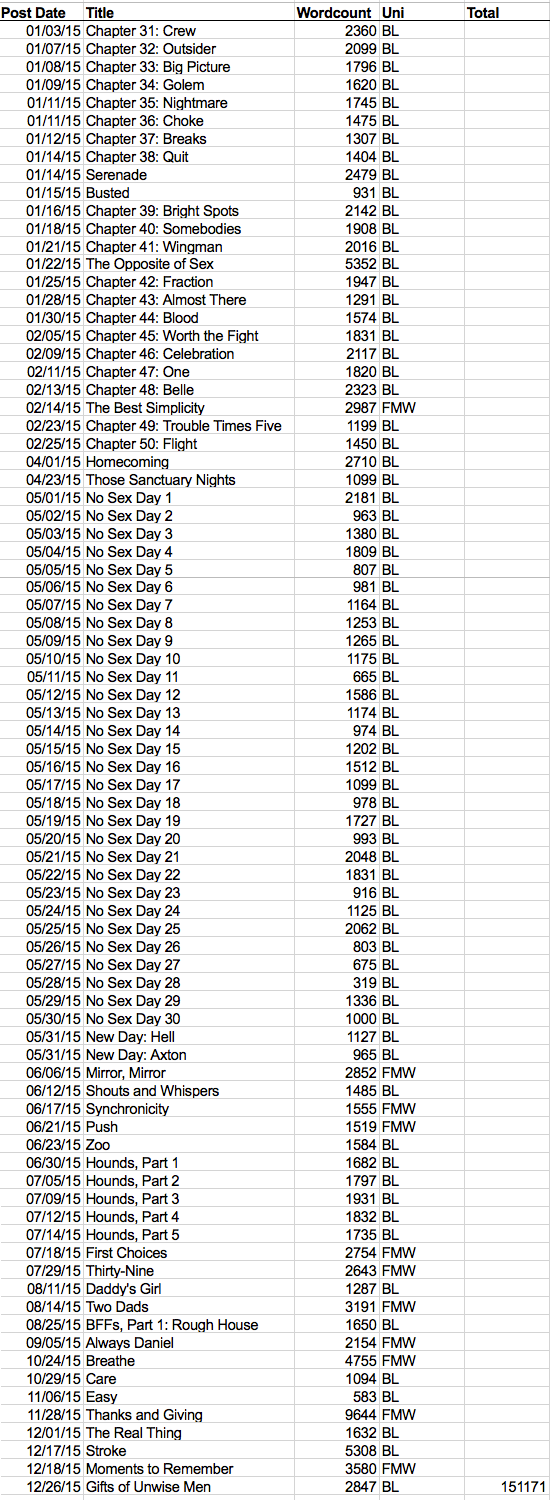
Here’s my list of posted story words for the year 2015:

posted-wordcount-2015

The majority of my story writing through January and February was finishing up my 2014 NaNoWriMo endeavor, Highs, Lows, and In-Betweens, which I’m currently editing for another free book. March was a bad month, so we won’t go there. April brought a return to form a little bit, but I made a concerted effort in May to focus on getting back into my game, by writing and posting a vignette per day, which definitely went a long way toward restoring my good feelings about writing. I managed to keep on through the second half of the year despite very little feedback, proof that I don’t need an audience to keep me interested in my characters and universes, a trait I’m finding increasingly more valuable the more I go back and edit my work. Make no mistake: I love feedback, but my stories don’t generate much of it. Despite that, I wrote and posted just over 150,000 story words  in 2015. Not bad for a no-talent hack.

While I know that the numbers truly don’t mean anything, they do represent my honest effort over time to craft words into theme, plot, and dialogue that resonates. And posting them is a public prod for me to keep developing my skills, in a way that keeping these stories in a desk drawer could never do. Not every story will resonate to the same degree, of course, not even for me…but every single one of them is a tiny piece of myself that I’ve put out there for folks to read and – just maybe – enjoy.

Sharing stories is one of the biggest reasons why I write. I take a lot of comfort and joy in thinking them up and writing them down, but when I hear that someone else has read and found joy in one of my stories, that’s a feeling like no other. That’s why I think it’s so important for us to share our stories, whether we publish our books for a global audience or we just click the “Add attachment” button to send it along to a friend.

Everyone’s writing goals are different, and everybody’s stories are going to be different. But every story made with honesty, care, and love is worth sharing. We might not think so because we see our own writing all of the time, and it can often start to look the same. But what makes our stories unique is that they’re ours, and no one else can craft that story in the exact same way that we can do.

For the coming year, I wish for you many words of the good and precious kind, and, if you haven’t yet done so, the courage to press Publish or Send on a story of your making.

What was your 2015 Year of Writing like?

2015 Holiday Story (not-)Swap: “Moments to Remember”

Last year, I talked about how my sister and I used to swap stories on Christmas morning.  I won’t be spending Christmas morning with my sister this year, but I’ve taken to writing holiday stories even without a swap. The holiday season is about sharing and joy, and writing has always given me great joy, that I like to share.

This year’s holiday story, like last year’s, is with the Wrights and McAllisters, the two families from my “Finding Mister Wright” series of free writes. Only a few folks read the 2015 Thanksgiving holiday story with Rob’s family, but this Christmas-themed one – at Marshall and Caitlin’s new family home – is a shorter, simpler tale. In some ways, anyway. It deals with memories, kids, and keeping the important things in mind during the holidays, which I’m trying to do more every day.

“Moments to Remember” [~3580 words / 15 pages DS]
PDF will open in a new window

Next time, I’ll talk about my writing year in review. In the meantime, happy writing, happy reading, and happy holidays to you all!

“Thanks and Giving” [Another “Finding Mister Wright” holiday free-write]

I’m currently away from the Internet, celebrating Thanksgiving with family, the best way to celebrate any holiday. Those good feelings prompted me to compose the following free-write in my “Finding Mister Wright” universe:

“Thanks and Giving” [PDF opens in new window]
~9600 words / 38 pages DS

This one concerns family, of course, and cooking, just like I promised. It’s long, so I don’t expect anyone at all to read it. But it was a story of Rob and his mother that had been nagging at me for a while to be written, so I answered the only way I knew how, to write it. Paige is here, and Daniel, too, as well as a few new faces. Some of them are even new to Rob and the rest! There are real if subtle conflicts here between mother and son, father and daughter, brother and sister, that I’ve experienced in one way or another across my many years. As always, the stories help me understand those experiences a little bit better, but hopefully if you read this one, you’ll get some enjoyment out of it, too.

Happy families to you all!

Points of Light

NightSkyFlying

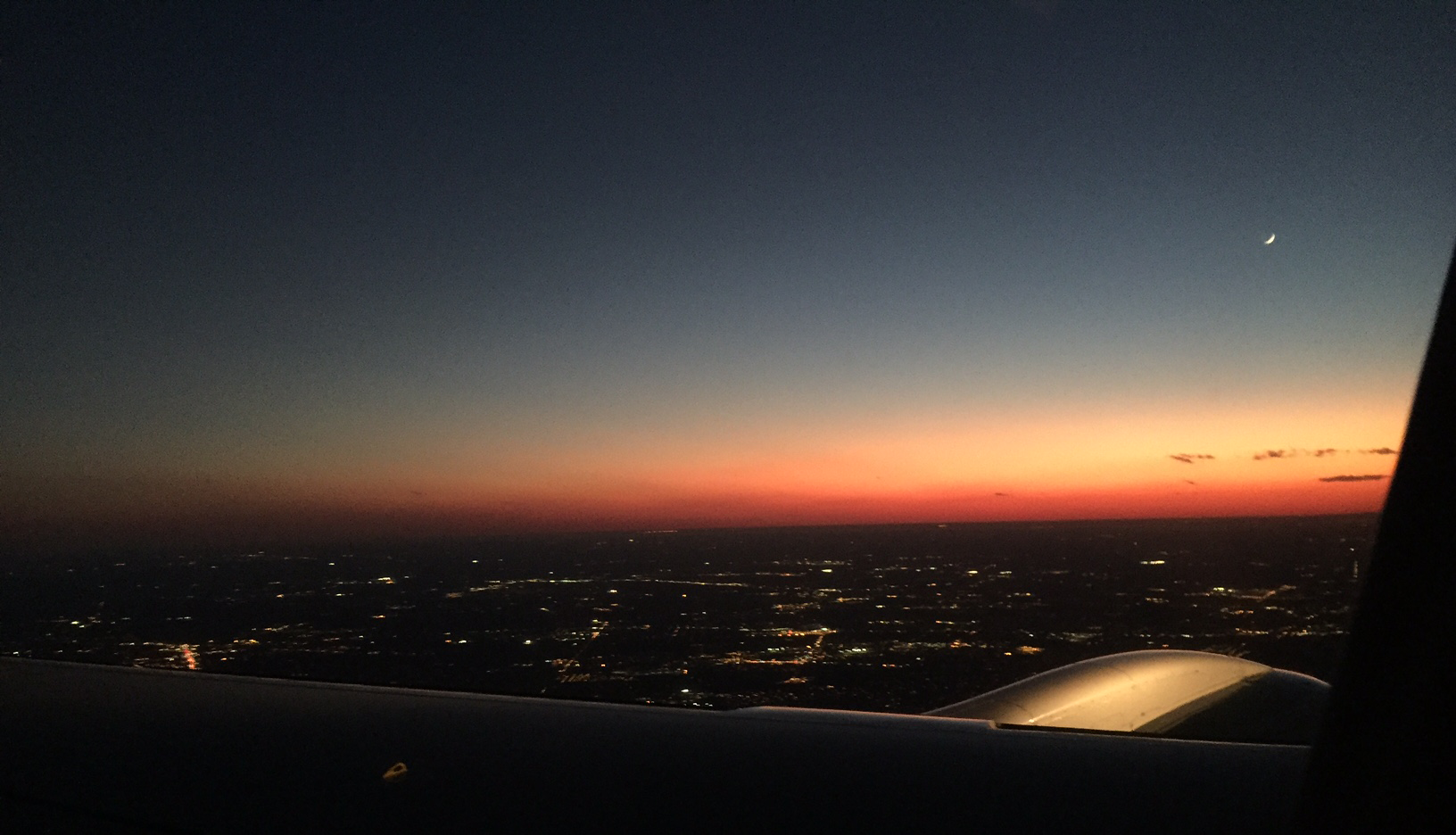
I was flying home from a work meeting on the night of Friday, November 11. While frightening and deadly acts were happening halfway across the globe, this was the sight outside my wingside window. I didn’t have WiFi, so I had no idea what was happening in world news. There was only the thrum of the engines, the buzz of my overhead air vent, and this view, with the city bustle below, the reddening sky ahead, and that sliver of lunar light above.

When I walked out to the family car that had come to pick me up at Terminal B, my husband informed me about the breaking news in Paris. We wondered how people were coping over there, and if the extra security walking around the airport had anything to do with the events still developing in France. Over the next few days, there were political discussions, as well as conversations about safety, social centrism, and the cultural narrow-sightedness of our first world society in particular. But my mind kept coming back to that picture I took from an Embraer window.

I’ve always enjoyed flying. Since I’ve been a kid, I’ve been getting on planes at least two or three times a year, and, despite some of the rigamarole involved in check-in and security lines, it remains one of my favorite ways to travel. There’s a feeling of detachment from the land below when we fly. We can look down from a plane in flight and see for miles around: freeways, farmland, rivers, lakes and oceans, all as a kind of separate spectator. As a child, I often wondered if that vantage point was how spacemen saw us, and how that high perspective affected their opinions. From 10,000 feet, you can’t hear what’s going on below, the prayers or the curses. You can’t see individuals, either, neither their shape nor their color. You can only see the parts of the world as their own wholes: villages, towns, cities. And when you fly at night, even over large expanses of land or water, you look for light. Sometimes, it’s just a point. But, if you keep looking, odds are you’ll see more points, more light, until there’s so many, they’re impossible to count.

When we hear about violence, hatred, and acts of terror, it’s natural to be afraid. It’s human to want to close ourselves off and hide. But it’s important to remember that the world isn’t all darkness. There is light here, too. Sometimes, it’s just one point. But keep looking. You’ll see more.

Cooking it up with my (head)crew

Sometimes, separating the writer from the character is hard. We find ourselves putting our own traits into those of our protagonist, so they become mirrors of us. They may share the same taste in music, food, or hobbies. Their favorite sports team may be ours; that song on the radio we just can’t stand may make them grind their teeth, too.

One trait that I’ve noticed that comes through in all of my favorite characters is an interest in cooking. Their proficiency levels vary (from Chie’s ignorance about what “simmer” means, to Marshall knowing the recipe for drop scones so well he can make them in his brother’s kitchen without a book), but they always enjoy cooking. It may have different meanings for them – a desire to please, a need to control, sometimes just a way for characters to relax or get to know each other better – but even those meanings are from my own experience.

Even though I’m not actively writing while I do it, cooking allows me the freedom to let my mind wander. It’s a time of day I usually spend alone with my thoughts, and those thoughts almost invariably turn to my stories and characters: Does Paige sneak chopped vegetables from the cutting board while Daniel looks away? Does Ross sway with Amber as she stirs some sauce? Does Axton have to stop making breakfast because the hounds won’t settle down?

No matter who the character is – doctor, dancer, reckless bounty hunter – they’re all me, in a way. I’m no doctor; I’m barely a dancer; I couldn’t track a skip to save my life. But there are more basic traits we share between us, like joy for art, work, and – sure – cooking. In honor of that sense of sharing, I thought I’d share a bit of a recent cooking experience: curried shrimp and mango soup. The photos below detail the real-life steps I took, but rest assured as ingredients were browning, bubbling, and coming together in that Dutch oven, my brain was equally bubbling with ideas for where my next story should go. And, of course, there’ll be cooking.

If you’re interested, here’s the recipe, originally from Eating Well:

Ingredients

  • 1 tablespoon extra-virgin olive oil
  • 1 large onion, chopped
  • 2 stalks celery, sliced
  • 4 cloves garlic, chopped
  • 1 serrano chile, minced (optional)
  • 2 tablespoons curry powder
  • 1 teaspoon dried thyme
  • 2 cups seafood broth or stock or clam juice
  • 1 14-ounce can “lite” coconut milk
  • 3 ripe mangoes, diced
  • 1 1/4 pounds raw shrimp, peeled and deveined
  • 1 bunch scallions, sliced
  • 1/4 teaspoon salt

Preparation

  1. Heat oil in a Dutch oven over medium heat. Add onion and celery and cook, stirring occasionally, until beginning to brown, 3 to 5 minutes. Add garlic, chile (if using), curry powder and thyme; stir constantly for 30 seconds. Add broth (or stock or clam juice), coconut milk and mangoes. Bring to a simmer over medium-high heat. Reduce heat to maintain a simmer and cook, stirring occasionally, for 5 minutes.
  2. Puree 3 cups of the soup in a blender. (Use caution when pureeing hot liquids.) Return the puree to the pot and bring to a simmer. Add shrimp and cook until pink and firm, about 3 minutes. Stir in scallions and salt.

What personal traits – if any – do you find you share most commonly with your characters? What do you see your characters doing when you’re cooking, doing the wash, or some other regular chore? Do you think you’ll try the curried shrimp and mango soup recipe? Let me know in the comments!

Writing Therapy

These last several weeks, I’ve felt mostly horrid. It’s been a rather hectic fall semester, with new projects to complete as well as new fires to put out. My students are either going through Senior-itis or studying abroad, so all the work they would ordinarily do falls to me, too. This isn’t actually that awful – what takes my students twelve hours to do, I can do in half that time – but it does mean tasks pile on through the week. Add to that my sleeping schedule is wonky due to changing weather and light, and I’ve felt sluggish and unmotivated.

I’ve also been working on a story edit.

When I edit, I try my best to concentrate on that story. It helps me keep overall voice and continuity better than notecards or Scrivener can do. I still read while I edit, because I learn more by example from my favorite authors on what’s important in a story, how to keep plot threads moving, and when to dangle, when to pull up, and when to trim loose. But the only writing I’ve done for the last month or so has been rewrites of an already-finished draft. Rewrites are good: I changed two whole chapters, cleaned up more than a half-dozen more, and had one character do a near-180 flip on me. It’s all better for the story as a whole, but it was sucking me dry.

I discussed this with my husband, who reminded me that “[r]ewriting is still writing.” But, he is much more comfortable working from what’s already on the page. The blank page doesn’t bother me; I just start writing words off the top of my head. In fact, it’s hard for me to find blank pages in my notebook when I need one, because so many of them are filled with first lines, initial ideas, or jots of dialogue. For some people, that’s all the writing they need to keep going. For me, all of those little notes and ideas are merely warm-up, like stretching before a workout. Have you ever just stretched and not followed up with the real workout? My body reacts poorly to that. It wants to work hard and make a sweat. Why couldn’t I see what that stretching-and-not-working was doing to my writer’s brain?

On my Thursday morning commute, I decided to open up a blank document. I just couldn’t face again one of the annoying scenes in the edit I was trying to make work. I began typing off the top of the head…and, over the next two days, I typed out over 4700 words of a new free write.

I haven’t felt this good in a long time.

Friends and colleagues – real writers – supported this, with cheers like, “Writing is therapy!” and “Writing is the best medicine.” I had apparently forgotten how sapped I get when I don’t allow myself the freedom to write something new and for fun.

Editing strengthens a story. It’s an integral part of making the story the best it can be. And, I do enjoy it, especially to see the finished product. But, sometimes, I have to let myself just write, for the pure joy of the story, the characters, and the process itself.

“Breathe, another ‘Finding Mister Wright’ short-fic”
[~4750 words/16 pages; PDF]

Clicking the link above will take you to the latest chapter in my “Finding Mister Wright” slice-of-life series. It’s about love and family, fatherhood and brotherhood, and the big and little changes those things cause in us. It’s a free-write, so it’s choppy in parts and rambling in others, but I decided not to edit it despite that. Part of what brings me back to these characters time and again is how much joy and love they have for each other, and how much of the same I have for them. I doubt they’d be so therapeutic otherwise.

How is your writing journey progressing? What do you do when you find yourself in a writing or editing funk?