by Mayumi-H | Feb 20, 2013 | Fearless, Process, Short Stories, Songbirds

For the scrapheap
Sometimes, a challenge prompt will strike an immediate chord with me, and writing a submission is no trouble. (My Songbirds series vignette “A Deeper Reflection” was one of those easy-peasy efforts.) Other times, a multitude of prompts will converge into a perfect storm of inspiration and interpretation, such as with “Stagger to Sway,” one of my Fearless side stories. And then, there are the times when I’ll start writing one way, go another direction, twist around yet another bend, until I finally end up with a piece suitable for public consumption.
In the case of the “CHERISH” prompt, I eventually settled on a somewhat humorous entry, but below are three other efforts I deemed unworthy, for one reason or another. Take a gander, if it please you.
“Rescue”
That first shriek – echoing along the coastline like a banshee’s wail – made Scott drop his board like it was on fire; Finchy and Niall were already tearing across the sand, arms pumping for speed toward the source of those cries. Scott followed quick as he could do, only to pause at the edge of the scene: a young mum bouncing a screaming little girl close to her breast, while a frazzled dad was on hands and knees, scrabbling in the sand.
“Lost doll,” Niall said, his voice ripe with sour disappointment.
Scott almost snickered, when a glance into that girl’s reddened, snotty face made him think of his own tiny Emma, prompting him to shove both his mates toward the beach with a sharp, “Don’t just stand there. We’re a rescue squad; let’s rescue!”
* * *
“Toothless Shark”
Venus knew they had sex. As quiet as they’d tried to be, the rhythmic creak of used springs was as tattling as a two-year-old. So when she had to creep past their bed to the bathroom, she always kept her gaze trained forward, for the sake of all their dignities. Except for this time, when she glanced reflexively toward the sound of a muffled sniff, and had to cover her mouth and hold her breath against the most itching, adoring whimper, at the sight of Finchy’s face pressed into Amber’s ruffled curls and his fingers linked loosely with hers.
Swinging the bathroom door closed behind her, Venus laughed softly into her palm, wondering what the rest of the crew would think if they saw their resident shark, now.
* * *
“One”
At the precipice, she stood, white and bright and beautiful, the whistling wind swirling her golden curls around her shoulders the same as it ruffled the edge of her dress around her legs.
Seeing her so, warm sweat formed in his palms. He shifted his hands to his sides, to wipe them down, when it suddenly became too late: she grasped his fingers with her own – cool, slender, soft – and moved up close to him, for this moment that would end their lives as two.
They exchanged the words between them, and the precious circles the same. A single kiss, at last, and that was all, to soothe the anxious patter of his heart, and to make them one, for ever.
Now, I don’t think any of these are terrible. I was determined enough to want to finish them, after all (and to be willing to share them, here). But, as you can hopefully see, devoting such effort to these challenges is time-consuming. Even though I’ve decided to cut my blogging down to two posts a week instead of three, these still take plenty of concentration. I don’t like posting my work if I’m not totally pleased with it; I owe you that much.

…Focus…!
So, if you liked any of these scraps at least a little bit, remember this: even if what you write doesn’t make your final cut, keep that effort. Don’t throw it away completely. You never know when you might need that smile.
Where do you keep your scrapped efforts? Have you ever used a scrapped effort to start a new project?
by Mayumi-H | Feb 13, 2013 | Fearless, Persona 4 Fan Fiction, Process
I was going to put up a post about how to give good (amateur) critique, but I decided to go a different direction, because I saw this come up in my hit statistics…again:
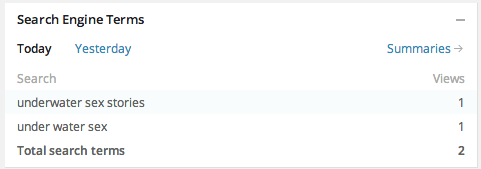
Am I really this predictable?
For those of you who are sensitive to the subject of sex, you may want to steer clear of this post and come back on Saturday, when I’ll post some original fiction. For those of you brave enough to continue, though, let’s get wet!
“So…did you?” Niall asked, and Ross blinked.
“Did I what?”
“Have a bang on the beach last night,” Niall said, and gave a distasteful waggle of his tongue.
Ross scowled. “Sex on a beach is tacky,” he said, which was true…not to mention, sand had a tendency to get everywhere, which also made it damn uncomfortable.
Every good romance has some naughtiness to it, whether it’s of the fade-to-black kind or the in-your-face variety. I’ve written both, and I’m of the opinion that each version has its merits…and demerits. No matter how you choose to write your raunch, though, there are a few practicalities to keep in mind:
1.) Sex on a beach is tacky.

It’s an orgasm metaphor.
Let me save you the trouble: having saltwater shoot up your nose while you’re snogging your lover is not a pleasant feeling, no matter how locked your lips are. We’re not even going to talk about how crashing water will make a swimsuit move all over the place, creating uncomfortable ripples and folds more likely to cause laughter than lust, or how sand does, in fact, have a tendency to get everywhere. Even a wetsuit won’t keep that pesky stuff off your skin. Which is why you should always rinse off before you hit the sheets for a post-surf romp, unless you want to be cleaning sand out of your bed for weeks.
A beach can be a romantic place for a tryst, to be certain. Just be certain to remember what else is on a beach, too.
2.) Water is not the same as lube.

“Come on in! The temperature’s fine!”
But, when it comes to sex, be aware of the surroundings, especially if it’s water. We’ve all heard the story that you can drown in even a puddle of water, but water can also counteract the benefits of personal lube. The human body produces its own lubricant, which is designed to smooth out the sometimes-rough mechanics of sex. Water, on the other hand, being the excellent cleaner it is, has a tendency to wash away that lubricant.
Yikes.
So, next time you think about putting that steamy sex scene in a steamy shower, keep in mind the details of such a situation. And that’s not even mentioning the aforementioned issue of rushing water in the face and up the nose….
3.) You’d never mistake a pool for a condom.
A swimming pool offers all the joy and excitement of a midnight skinny-dip without the associated danger of salt poisoning and night feeders.

The dating scene is full of sharks of all kinds….
Which brings me to my last point:
4.) Lovemaking can be lovely, any place.
Don’t let me discourage you, or your characters. On the beach, underwater, in a pool, even in the rain: sex between two people brought together by love can be beautiful, in any location and under any circumstance, so long as you make it so. Even in the typical locale of a shared bed, sex can be thrilling, romantic, ecstatic, funny, relaxing, fulfilling…all this and more. It’s truly about what your characters – and your readers – feel from that love that’s important.
Just remember to think before you put them in a wet situation. 😉
Have you ever written a watery sex scene? Would you ever write one? Why, or why not?
by Mayumi-H | Feb 6, 2013 | Persona 4 Fan Fiction, Process
I think all of us writers write for joy: we’re driven to create worlds with words, just as painters create with their palettes and brushes. But, some of us are looking to push further with our words, to reach a greater audience. We want that valuable place on someone’s bookshelf (or a tab in their e-reader).
There are many, many stages to becoming a published writer. First, you’ve got to have a story. You write, you edit, you tweak. You set it aside, write something else, come back again. You send out copies to betas. You find a critique partner. You get yourself a story editor and a copy editor (maybe they’re one and the same, maybe not). You tap the brain of your old journalism buddy to help you write a tagline. You treat your friend in advertising for help with your sales pitch. You scour the Internet for tips on writing a great query letter. I could keep adding to this list forever…!
There are some terms and abbreviations many if not all writers use, these days. I’m going to start off a list of them, because I know some of them puzzled me when I first saw them. So, hopefully, you can learn from my ignorance. (Hey, at least I’m good for something!)

I write in English…yet, sometimes, it feels like a foreign language!
- ARC – Advance Reading Copy (or sometimes Advance Review Copy), an almost-ready-for-publication copy of the manuscript (which may still have a few errors) that is sent out prior to publication in order to be reviewed. (provided by Vanessa-Jane Chapman)
- Beta Reader (beta): A beta reader is a draft-reader. Often, someone with whom you can bounce off your early draft ideas. Some folks like to offer beta readers a very loose first draft; others give their betas a close-to-finished product. That’s your decision, as a writer. Many family members or friends should be considered beta readers, since – odds are – they’re not professional writers and/or editors…and their job is really to boost your confidence. Beta readers can also become Critique Partners.
- Bio: Not the class at school, but your Author’s Biography. Your biography is where you can toot your own horn about your writing/publishing experience, your outlook, what awards you’ve won, and so on. Be careful to keep this short and sweet, especially if you’re writing a Query letter.
- Critique Partner (CP): For the longest time, I’d see people mention CP and think they were talking about Unix commands! Then, I realized they meant Critique Partners. A critique partner is like a beta reader on steroids. This is someone you truly trust with your story, to show you where there are plot holes and lag, but also where your dialogue is fresh and your description vivid. It’s a marriage relationship between writer/reader: you give honest, helpful critique, and you get honest, helpful critique in return. It’s not a relationship to enter into lightly. Critique Partners are sometimes a writer’s last personal step before they ship a manuscript off to an editor or agent.
- Draft: A story in not-yet-finished form. Some writers make only one – their first – draft, before shipping their story off to an editor, agent, or publisher. (I think I’m on draft 6 or 7 of my novel….) It all depends on the type of writer you are.
- Graf/Graph: A shortened way of writing “paragraph.” It’s got nothing to do with statistics or charts.
- Ed: Not just some random guy (or horse), “Ed” is short for “Editor,” one of the most valuable partners for your book you’re likely going to have. You might already have a good story, but a competent and careful editor can make that good story a great one.
- Hook: A concise summary of your story, usually no more than one sentence. AKA the Tagline for your book.
Some folks also use the term “hook” to refer to the bit at the end of a chapter that will make the reader want to keep turning your pages. No matter how you use the term, though, it almost universally refers to the reason to keep reading.
- Manuscript (MS): MS is just a faster way to write “manuscript,” which is just another word for your story. Stories in many stages can be manuscripts, but I personally favor reserving the term for a story in its completed form (edited or not); I wouldn’t call a series of scenes mashed together into the same document a “manuscript.”
- Mini-Synopsis: Used for Query letters. See “Synopsis” for an explanation … only the Mini-Synopsis is much more concise, usually only one paragraph.
- Multiple Submissions/Simultaneous Submissions – Important to understand the difference because some publishers/agents specify that they don’t accept one or the other. So, Multiple Submissions is sending more than one book idea or proposal to a particular publisher or agent at the same time. Simultaneous Submissions is sending out one book idea or proposal to more than one publisher or agent at the same time. (provided by Vanessa-Jane Chapman)
- Protag: Short for “protagonist,” or, the hero(ine) of your story. Funnily enough, I see/use the term protag all the time, yet I don’t think I’ve ever seen anyone use the shortened “antag” for “antagonist.” Go figure.
- Query: A query is the letter you send to agents and publishers. It consists of three parts (usually a paragraph each): your Hook, your Mini-Synopsis, and your Author’s Bio. Go here for some more in-depth discussion on writing a query letter.
- Synopsis: Um, just what it says: a concise synopsis of what your story is about. Pluck a book from your shelf and look at the back cover or inside jacket. Usually, that’s where you’ll find the synopsis. Study how to write these, especially if you want to write a successful Query letter.
- Tagline: See “Hook.”
- WIP – Work in Progress. The current writing piece you are working on. (provided by Vanessa-Jane Chapman)
I know I’m missing terms you probably use all the time. So, please feel free to add them in the comments section, and I’ll update this list periodically. If you supply the definition, I’ll be certain to link back to your blog or site, too, so don’t be shy!
by Mayumi-H | Jan 30, 2013 | Process
Many artists – sculptors, poets, fantasists of all kinds – attribute inspiration for their work to what they call their Muse.

“Hesiod and the Muse” – public domain image
Not to be cruel. Because, as artists, we’re all rather flighty individuals, with our minds dwelling at least a little bit in the clouds. That’s okay. Without dreamers, society would be pretty boring. Actually, it likely would have died away by now, without any high thinkers, who wrote some of the most important words of our civilization, from “Shall I compare thee to a summer’s day?” to “We hold these truths to be self-evident….”
But ascribing your talent to some sort of divine guidance is – oh, I’m just going to say it. It’s kooky. More than that, though (and I’m going to catch a lot of flak for this, I know), it’s lazy.
Now, before my ever-dwindling group of blogging and writing friends decides to pull out the lynch ropes, let me clarify.
I’m not talking about artists who decide they need to step back from their art and re-prioritize; those folks know they’re just putting a muzzle on their Muse for a bit. Nor am I talking about the artists who simply know themselves well enough to decide they’ll make their art when it suits them, all in good time.
I’m referring to the people out there who complain they have no inspiration to create…while they can still pick up a videogame controller for hours on end, or head out to the pub the whole weekend long. That has nothing to do with the attention of your Muse.
Now, I completely understand the charm of having some seraphic creature looking over your shoulder, telling you which way to move your pen. And I, myself, believe that – in the throes of a story – a character or characters can take over, using their voices to weave new and intricate tales I’d never even considered while I was in the plotting phase.
But, don’t be misled by the flowery notion of a Muse. Those character voices are your voices. Any new paths toward which they may pull you are functions of your own creative subconscious. It’s a wonderful experience, to guide a story in an unexpected direction, based on the whim of a single word or phrase. But you have created that word, those phrases, that heretofore unknown story arc that turns your hunter into the hero, or your princess into the warrior demon. It didn’t come from any outside force.

What are you waiting for?
It’s not the idea of the Muse with which I take issue. I take issue with the idea of waiting on a Muse to move your pen (or hammer, brush, bow, or lens). That takes the power of creation away from the artist. Even worse, it takes away the responsibility for that creation. When an artist whines, “I’m waiting for my Muse,” that’s just an excuse for being lazy.
You cannot wait for some capricious, aetherial harlot to come knocking on your door, tapping at your shoulder, whispering into your ear that now is the time for you to make real all your hopes and dreams. No outside force is going to make your art for you. You are the only one capable of that. You. Or, I. Nobody else.
Blaming a Muse for lack of inspiration or failure to produce the story, the music, the picture you want is a cop-out. When you call – when you make the choice to apply yourself to your art, whatever it may be – your Muse will come. And, if she doesn’t, you go get her. You grab her by her flowing toga, and you drag her over to your workstation. Because you can’t afford to wait for her.
Because you are your own Muse.
[youtube http://www.youtube.com/watch?v=3C3poU_0sK4]
Now, for those of you still with me after that little tirade, tell me: How do you motivate yourself?
by Mayumi-H | Jan 23, 2013 | Fearless, Process
Your story’s world is a full one. The story itself may be about only one or two main characters, but those people have family, friends, acquaintances, and enemies. And those people have beliefs, fears, experiences all their own. And, even if the reader never discovers these facets in full detail, it’s important for you to know who those people are. From the way they dress to the way they dance, their dietary habits or exercise routines, what they do for work and play, the magazines they read and the television programs they watch…all of these details will help you solidify in your head who each person is, and – in turn – make it easier for your readers to differentiate each character outside of name alone.
You don’t have to do all of these, of course (your time is likely better spent in the guts of your story), but pick a few for each of your characters, to help realize them more fully. Music is a great way to do this.
You’ve heard people say, “This is my song,” when they hear a particular tune. The same holds for the characters in your story. Whether a song describes that character, or it’s their own favorite song, music provides a way for you to make your world bloom. The best part? Unlike plotting your story or designing your world, giving your characters their own songs doesn’t have to take very much work at all!

If you hear a song on the radio (or on your mp3 player of choice), and you’re reminded of a particular character or story moment, set it aside in your mental list of story details. Listen to that song when you’re on your commute, doing your morning exercises, or washing the dinner dishes: this keeps you in-tune with your story and characters even while you have to do the necessary chores of your life. And keeping your story close to you this way (even if you don’t get the chance to write as much as you might like during the day) will help keep it immediate, so you don’t lose too much momentum while you’re, you know, living.
For example, whenever I hear Kevin MacLeod’s lovely piano track for “With the Sea”, it instantly puts me in the mood to write the about quaint coastal fishing village where my novel takes place. When I hear that opening guitar riff for “Bad Reputation” by Joan Jett, I am ready to write Ross’s confident swagger. And, when Pete Townshend sings about how to “Let My Love Open the Door”, Amber’s dimpled smile comes immediately to mind.
Some writers like to work in silence, so, for those of you who do, I won’t impose upon you the suggestion to create a playlist for your story. For those of you who enjoy a bit of music while you plot and pace, though, I’ve got to ask:
What’s your character’s theme song?



Recent Comments