Do you picture your characters in your head, do you hear their voices? Do they flesh out the more you entertain them and actually write about them? … Do you even start out with distinct picture of a character/situation that grabs your attention?
Generally speaking, I do have voices for all my characters. They often don’t change, either. And, it helps for me to speak out a conversation when it’s still in the plotting stages as well as after it goes down on paper. If something doesn’t sound natural to me, I spend a lot of time reworking it. Unless it’s plot exposition, though I still prefer that to have a spontaneous rhythm to it. 🙂
My sister has an uncanny audio memory. She’ll hear something once and remember it for years. Even inflections! I’m not that good, but I do think that reworking fiction conversations in my head over and over until they become second nature has helped my character voices a lot. One thing a few recent readers have commented on is that my dialogue flows really well, so I’m proud of that.
Characters become more real for me the more I work with them. I think that probably happens with all writers, though. And, it makes sense. We spend so much time in the heads and hearts of these people, we come to know them better than we know the physical people around us. Likely because we are privy to all the inside thoughts and turmoils. Personally, I project a lot into my characters, though I try to keep some of them to specific boundaries, because they all have different conflicts. (It’s hard to articulate.)
My inspiration often can be traced back to a single face/moment/voice, and, as time goes on, characters develop into their own people. For instance, Daniel (“Finding Mister Wright”) evolved from Hal (“From Hell”) by way of Aral (“Anywhere but Here”), who was a different side of Ross (“Fearless”). But, they share similarities in look, manners, and voice, which unites them in my head, and allows me to jump into their shoes with much more ease than I might be able to do otherwise. Fresh characters, as it were, take much more time for me to grasp. One thing that my husband mentioned to me when he read “Finding Mister Wright” was that the first two acts work really well, but the third needed more time with one of the late-intro’d characters. As it stands, she feels like a plot device, not a person, as the other characters do. I see his point, and I think it’s because when she was originally written, she was still one of those “new” characters. Of course, since then, I’ve written more with her, so, now, it’s a matter of going back and growing her into a person as fully-fleshed as the others.
My main writing project at the moment has a fair amount of deep-and-dark in it, and when I fear I’m becoming a bit too mired in that sort of thing, I need to take a step back with something a bit more light and flighty. Lately, that’s been the cast of misfit characters from “Finding Mister Wright,” my short story/novella from this past winter holiday break.
I usually write for Marshall’s life when I take up these characters again, but, this time, it was Rob who commandeered my brain. What’s funny is that the original story idea I had for these characters centered around Rob, Paige, and Daniel. In my earliest notes, Marshall barely played a role beyond counterpoint to Daniel. Of course, that changed when I finally started putting voices together in my head, and I found Marshall had a (rather significant) story all his own. The relationship story between Rob and his own family took a backseat to that of the Wright brothers, and Marshall and his loves in particular. But, Rob’s story has remained important, at least to me. He’s just as complicated as Marshall proved to be, but in a way that’s somehow more relaxed.
After my husband read “FMW,” he made the comment that he thought all the characters worked for their own reasons, but Rob was his favorite. “At first,” he told me, “you think he’s just one thing. Then, you learn a little more, and he becomes more than that. And then, there’s [a conversation], and you realize, oh, this guy really has three dimensions to him.” While it might have offered me a greater ego boost to hear my main protagonist was my husband’s favorite character, a part of me was really happy that Rob’s original story shone through in his few scenes, to the point where he made an impression on a reader.
A moment of weakness led to this six-pager (it clocks in at around 2,900 words), which I wrote over three commuter train rides and a lunch hour. It’s rough and a bit scattered, but that’s one of the reasons I find free writing so…well, free. No worries over themes, scope, flow, or any of the important parts of a mature work. It’s just my fingers translating for my brain.
“Romance-in-the-Dark” (PDF, 314KB) I hate to have to offer a warning about this, but be aware: the principal romantic relationship depicted in this particular free-write is about two men. There’s nothing explicit herein, but if you’re uncomfortable with the idea, just skip it and watch the lovely lady in the video below, instead.
The whole thing – Rob’s story, the original idea for “Finding Mister Wright,” as well as this free-write – is heavily inspired by the lovely and awesomely talented Catherine Russell’s rendition of Lil Greene’s jazz standard, “Romance in the Dark,” which you can listen to and watch below. It’s a mainstay in my FMW writing playlist, and I usually hit repeat at least once when it comes up in rotation.
Before we get to Ms. Russell, here’s my question for this week: Have you ever had a minor character hijack a story for his or her own? If so, how did the story turn out?
I did manage one post for June (my flipping the coin villain backstory post), but the rest of the month was a wash, blog-wise. But, I did have some excitement. Drumroll, please….
My husband read one of my stories!
Some of you out there are likely thinking, Big f***in’ deal, but this was a huge deal for me. My husband hadn’t read anything of mine since university, which is…well, let’s just say it’s a long time ago, now.
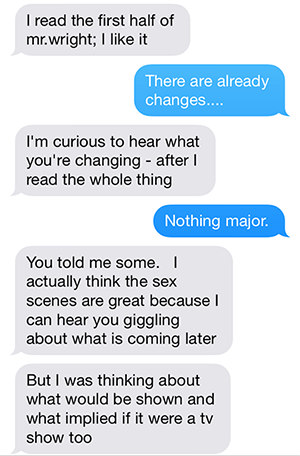
I’d left my original story “Finding Mister Wright” in a file folder on the dressing table a few months back, inviting him to take a look whenever he felt like doing so. I left it up to him because I don’t like when other people force their writing on me. But, as the months went by, seeing that folder left untouched rankled me. So, when he messaged me one evening and mentioned he’d read it, I was walking on clouds!
I know it doesn’t look like I’m excited, but I was.
We spoke about it in some more detail, and I’ve gotten to bounce some ideas off of him, for how to make the third act come together with more punch. One thing he said that made me nearly burst with glee was, “I like how you keep writing these characters after their main story is done. It gives them a much ‘fuller world’ feeling. Like they’re real.”
Honestly, a lot of my characters are real to me, even the fantastic ones. That’s what makes writing so joyous for me. It’s also why I get sad whenever I come to the end of a story. The characters and their relationships grow on me after all that time and effort of pulling their world and all of their conflicts together.
So, as of today, two people have read that first draft of “Finding Mister Wright” (Hi, JM!). Each of those people, with their timely feedback, has made me think about not just this story but all of my writing in a more focused way. I’m still undecided on the best way for me to get my stories out there – querying and sucking up to agents and houses, or hiring an editor and publishing on my own – but I feel like this little boost has fanned the flames of my spirit to be even stronger than before. Brighter, if you will. And each little bit of extra brightness makes the darkness of defeat seem not so foreboding.
I hope everyone out there is having a great summer (or whatever your local season may be). I’m looking forward to sharing more stories and steps forward in the months to come!
Last time, I talked about writing villains. Everybody had great comments, but Vanessa’s sparked a new idea in me. In my head (sometimes on paper), I have backstories for every character who walks onto my pages for any more than a sentence or two. Most of these backstories are rather simple, because I don’t see the point in spending too much time on a character who is basically just a spaceholder. But for anyone with any significance to the story, they have their own story. But Vanessa’s insight offered me a different perspective: basically, that we storytellers should remember that every good villain is the hero of his or her own story.
Now, this doesn’t necessarily mean that your villain needs to have heroic traits. But, their motivations and characterization should come from a place of realism. The best villains are often ones with whom a reader can personally identify. I don’t know if I managed that with the villains illustrated in last week’s post (actually, I doubt it), but it’s a good characterization technique to remember. So, this morning, I drafted up a couple of would-be storylines for each of those principal antagonists, posted below. If nothing else, it was fun to look at them from a new angle. I’d recommend doing something similar for your own antagonists – you never know when you might be struck with new inspiration.
The Red Widow
It’s a man’s galaxy. That’s what they say. Certainly, it seems that way to a girl sold into slavery for men’s pleasure. But this is no ordinary slave girl. This is one who learns from her so-called “masters”: how greedy, vain, and susceptible men are. Especially to a woman’s charms. Justiciar, pirate, or politician: no matter the insignia on their collar or the banner on their ship, men have their weaknesses, and she knows them all. Her marks have called her many names: Anya, Elsbeth, Illia, Una. But the galaxy knows her better as a woman as smart as any justiciar, as savvy as any pirate, as sly as any politician. It knows her as Red Widow. And she’s going to turn this man’s galaxy upside-down.
Into the Light (Lohengrin, the Swan Knight)
Abram had a son, once. A bright, beautiful boy full of possibilities. A gentle boy cherished for his kindness and skill with a tanner’s knife. The air would sing with the strokes of that knife, and wealthy women and men would come from across all districts to watch and buy his work. Abram loved his boy. But the Darkness loved him, too.
One day, that Darkness came for him, in the form of another smooth-faced boy, and lured Abram’s son away. Away, into the Darkness. What choice for a father but to save his only son? And the only way to save him from the dark was to lead him back into the light. With fire.
The Darkness has taken other boys. The Lost Boys, they are. But he will save them. He will take up arms and become their knight, to set them free, body and soul. He will be Lohengrin, the Swan Knight, their savior.
The Body Electric (Reilly)
The Dahl Army gave Reilly everything: a job, a purpose, even something like a family. For twelve fine years, he fought, laughed, caroused, and conquered by the sides of his fellow commandoes and their skilful sergeant. But on what is supposed to be a routine grab-and-go mission on Artemisia, the unthinkable happens: the op goes sour. An explosion and fire burns away half his soldierly body. And what does Dahl do? They dump him like scrap.
When the Hyperion salvage team finds him rotting in an Artemisian infirmary, they see his potential, and make him an offer: Become part of the Body Electric, a soldier enhanced for the technological wars. Of course, a soldier with potential needs a purpose, but Reilly has a purpose: hunt down his old teammates who left him to die, starting with his glory-hungry sergeant, the man responsible for it all.
Every Shot a Kill (Strenk)
Walking around the galaxy with the S&S munitions manufacturer family name stenciled on his uniform has never meant much to Lukas Strenk. Guns are just tools, only as good as the man who holds ‘em. And he is a great man, the best in the Inner Ring. Every shot from Strenk’s Orion rifle is a kill. But even the simplest kills can go wrong. When Galactic Defense redacts his latest target assignment after knowing the job’s already been done, they blame Strenk, of course, never mind his 100% success rate and the value of his name. “Get yourself gone or get yourself dead,” the GD Justiciar tells him. Strenk’s only answer is a bullet.
To hell with the shifting, shifty so-called rules of the Inner Ring. When the galaxy gives you lemons, you shove ‘em straight up its gaping *** and lick the residue from your fingers.
Once again, I think Strenk came out on top as my favorite of these, though I enjoyed the exercise for all. Have you ever flipped the coin on your antagonists? Have you ever found you identify more with a villain than a hero in a story? Let me know!
Recently, I had an interesting dialogue with a writer friend on Twitter. He’d looked through my sci-fi/western/drama/romance and mentioned how “graphic” it is. I agreed that it’s probably “the most gleefully graphic I’ve let myself get in a long time.” Our conversation became more about writing side stories, but I kept thinking about why I’ve enjoyed working with this particular story so much these past few months. Part of that reason is that personal allowance to be graphic, an allowance I haven’t given for my more recent original fiction. There’s a lot of sex, because that’s a big part of the main character’s personal journey, but I’ve also loaded it with more action and violence than I’ve done in a while. Following that thought, I came to realize that it’s the villains who have made this story so much rollicking fun, for me.
I’ve read analyses that say the villain is the most important part of the story. I don’t exactly agree with that wording, because not every story will have a “villain.” In more precise – and also more amorphous – terms, I think it’s conflict that drives a story. I’ve talked about this a bit before, but I want to go into some more detail, here.
Every story needs some conflict, whether it’s external or internal. It’s nice to see characters get a breather or spend some happy time together, but a whole book about that would be rather boring. My drama stories tend to lack a villain in the traditional sense because the conflict usually arises from the hero himself. One of the common characterizations in my stories is that each main character is the principal architect of his or her own happiness…or their own misery. The decisions they make determine how they move forward or backward. Of course, I like development, so they usually set themselves – or get themselves set – on the right path, but the journey’s the fun part, anyway. That said, I hadn’t written a real villain in a long time.
Then, I decided to write a western.
I spent a lot of days reading old westerns, especially the serial stories of Elmore Leonard. The villains in those short stories were varied, violent, cunning bastards. And, even if they only made themselves known for a few pages, they had presence. I wanted my sci-fi shoot-em-up western to have that. Because, while the main character’s internal conflict was perhaps the most important part of the story, he would never be able to make that journey of self-discovery without someone pushing him on. Or shooting at him, as the case came to be.
I love writing my heroes. But, I’ve loved writing these villains, too, each one of them, for their own reasons. Red Widow because she’s a smart, sexy grifter, and deadly for that:
She’d saved her head with her hands, and pushed back against the wall to shove him off. One leg flew out behind her, connecting with Hal’s gut. He staggered with an oof! and she spun, another kick catching him in the ear.
Lohengrin, the Swan Knight, is insane. But his insanity is full of such self-righteous zealotry, his every line full of such grandeur, he makes a formidable foe:
Lohengrin swung his flame toward the popping drehlafette, and licking fire met stoic metal as the autocannon’s barrel slid into place. The muzzle spit its first round, and its second, when the Swan Knight gave a sudden strangled gasp.
Reilly is driven by a simple desire for revenge, but it’s changed him to the point of being unrecognizable even to his old sergeant:
Ax froze at the sight: a gleaming, golden horror of a man, almost seven feet tall with pylons for limbs and black enhancement goggles pressed deep into the puckered flesh of his face. In front of his left eye glowed a red targeting reticle, blazing in the dark. His chest was pockmarked with sparking holes and indentations from the drehlafette, but none of them slowed him down.
And Strenk, who’s probably my favorite of the lot, simply because he has no overarching goal or reason for his grittiness. He’s just plain ol’ nasty:
Strenk’s gaze filled his focus, cold and damning. “Open those pretty petals, tulip.” He dropped his free hand to his crotch. “I want to see if I’ll fit.”
All of these villains do horrible things, and I occasionally feel a bit scared at how easily some of their actions and dialogue have come to me. At the same time, though, I believe in art as a catharsis and unhindered outlay of our personalities, both the dark and light parts of it. Art is also a relatively safe way to explore the more dangerous demons within each of us. I don’t think I could ever pick up a flamethrower and point it at someone, but it definitely gets my senses tingling to imagine that and create it on the page. I suppose what this exercise has truly shown me is that my villains have as much to say about me as they do about my hero. Their danger, their brutality, the sheer ugliness they represent have made this story a crazy-fun ride, because for every dark, twisted action they throw at him, my hero grows a little bit stronger, a little bit wiser, a little more…heroic. But then, isn’t that what a villain is supposed to do?
What is it about your villains that you love? (Come on, admit it: there’s a part of you that loves ’em!)
I’ll be honest: religion does not often feature prominently in my stories. I suppose because my own faith is very personal to me, something I don’t always feel comfortable voicing in public. That makes me something of a coward, I guess, but I neither want to invite criticism for my beliefs nor have to engage others in why I believe x or y (but not z). But, as I’ve delved more deeply into the humanity of my characters, I’ve come to realize that they can’t all be just like me. That goes for their ability to be close to the divine as much as it does for their attraction to the darkness.
I’ve always been able to separate myself from my darker characters, the antagonists and villains. Because, while they can be enormous fun to write, I don’t consider myself capable of some of the despicable things they do. Or, I don’t like to consider myself capable. But even my “good” characters have maintained a distance from religion and faith that I think isn’t necessarily indicative of who they can or should be.
Religion is complicated, though. For me, more so than sex, violence, or any other characterization point. Why? Is it because I don’t want to dictate my beliefs to readers? Because I don’t want to be “outed” as being religious in a community where intellect is valued more highly than faith? I don’t want either of those things, to be honest. But I also can’t deny the power of prayer in my own life, so why should I deny it in my stories?
The link below will take you to another “Finding Mister Wright” free-write I did yesterday (~1400 words, 5 pages). I didn’t mean for it to preach anything to anybody. I simply had a notion about the Marshall-that-was that I felt deserved a bit of exploration.
I’ve been putting these in PDF form because I think it should be your choice whether you want to read or not. Not for any sensitive material, but because I know so many of my blogger buddies are on hiatus or simply don’t have the time (or inclination) to read a longish short story that probably doesn’t help them keep to their schedule. 🙂
Do you find your characters represent you, most of the time? Or, do you use them to investigate differences in opinion? Something in between?

Recent Comments