by Mayumi-H | Apr 9, 2012 | Fearless, Process, Short Stories
The product of a ten-minute writing challenge issued to our Art Night group, which theme was “First Kiss.” Because I can’t draw even a stick figure in ten minutes, I stuck with writing. Not surprisingly, mine was the darkest of the group’s pieces. This little drabble is actually one of the earliest attempts at (and inspirations for) what eventually became Fearless.
It’s the aerosol feel of splashing, salty waves against rocks that reminds her of another time like this one, where her husband once sat beside her beneath a shimmering moon and asked if she would always be his. That’s what makes her turn to the boy beside her now.
He’s so very young and so very strong, like her husband was, so long ago. He’s a different kind of handsome, this boy, though it’s a different era, now, isn’t it? Her husband had a gentleman’s part in his already-greying hair, and it was soft and silken, a controlled coif atop chiseled features. The boy’s blond locks – made coarse and dry by too many mornings spent in this salty sea – fall loose around still-full cheeks; he’s got no crow’s feet or laugh lines. He can barely grow a semblance of a beard over his chin.
But the boy is here, where her husband is not. The boy is beside her, and that is perhaps the reason most of all that she speaks to him, now.
“You’re quite cute, you know,” she says with a tickling smile.
He laughs, looking embarrassed as he glances away. But then he turns back again, and that boyish abashment is replaced by a more manly boldness. “You think?” he asks…though it is much more a goad than a mere question.
He isn’t very good at fishing, but she bites anyway – the hunter playing prey – and inclines her head. “I do.”
She lifts her chin again, stretching her neck. Will he bite, this time, she wonders? She thinks he will; he’s that right blend of curious and bashful: a boy looking for…not quite love, but perhaps a boastful notch on his belt (or on that board sitting forgotten beside him).
“It’s been a long time since I was with a man,” she tells him, and that’s truthful enough. “Would you mind very much if I kissed you?”
He blinks, but he doesn’t look away. “Not at all,” he murmurs, his eyes never leaving hers.
She smiles at his answer; she’s still very much a woman, no matter what any of the crones around this small-minded village say. This boy’s needy kiss is proof enough.
Of course, it’s not just one kiss, and it’s not just two. It’s not even just five or ten or twenty, but a brief misjudgment of propriety that becomes sojourns behind the rocks, and made-up excuses, and a shouting match behind tightly-shuttered windows.
And the tears of a grey-haired man.
And a boy’s broken heart.
But she’s still a woman. She’s proven that much, if nothing else. And that’s what matters.
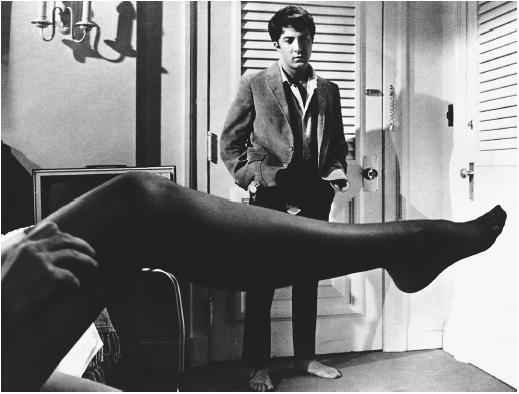
One of the more (in)famous May-December seduction scenes, from "The Graduate"
There’s a lot of taboo around May-December romances, though more often when it’s the woman who’s older. She’s seen as a temptress, a cougar, a sexual predator. This character – who would become the prickly Susanna Braden in the final story – is really not that different, at least from Ross’s point of view. Still, it was interesting to get her perspective on things.
by Mayumi-H | Apr 2, 2012 | Excerpts, Fearless, Persona 4 Fan Fiction, Process
Neville scowled at the doctor’s back. “Twat,” he muttered.
Venus snorted in mild amusement. “All doctors are twats,” she told him. “It comes with the territory. But he’s good,” she murmured, now. “Very good. And well-respected around here. And Amber’s his patient, so they’re more likely to release information to him than to an off-duty nurse,” she added with a shallow shrug.
Ross offered her a smile that he didn’t quite fully feel but managed anyway. “I’d still rather have you here,” he said.
Venus smiled up at him, and reached out to rub her hand over his back. “Thanks, duckie,” she murmured, and he hugged her close for a second in reply. She gave him a returning quick squeeze and sighed. Then she led him back to the chairs against the wall, to sit and sip at their coffee, and wait.
The coffee wasn’t particularly good. It was too bitter and too sweet at the same time, reminding Ross of nothing so much as one morning barely three weeks ago, when Amber had tried her hand at using Freddie’s French press. She’d gotten the balance of grounds to water wrong – or something – and had tried to cover it up with copious amounts of milk and sugar, with less than poor results. The hot mess had ended up tasting so sludgy and so burnt and so utterly terrible that Ross had made her promise never to make coffee again, despite how much she’d protested that she only needed some practice, and if he’d let her try again, she was sure she could do it right.
He would have given anything to be drinking her coffee, now. To have her standing next to him with that cautiously inquiring smile she would use when she was seeking his favour, the one that made one side of her mouth curl up hopefully, pressing one dimple into her cheek. And to feel her cuddle guardedly close, tucked almost under his shoulder, with her hair smelling so clean and her arms already wound mostly around him, itching to hug him when he finally smiled at her.
He pressed his face into the palm of one hand, focusing firmly on his breathing because anything else was simply too difficult to do.
I admit it: I enjoy writing stories in arcs. I like seeing characters through one adventure or crisis for a few chapters, lead them to a resolution, give them a little bit of downtime, and then slap them in the face with a new crisis. I like my videogames and movies and books to do the same thing, for the most part.
Naughty Dog’s “Uncharted” series of games is a good example of what I’m talking about. (There are others, of course. I just like looking at Nate Drake, the protagonist of the series, best.)
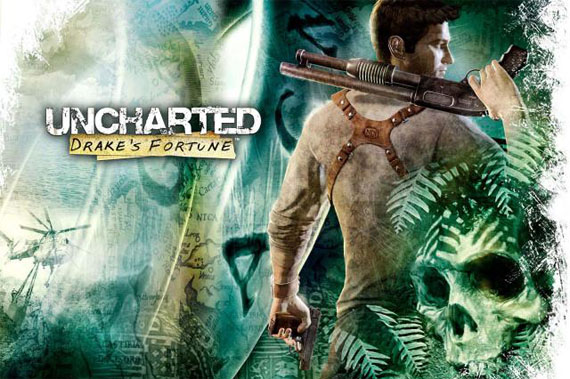
Nate's back!
...and, oh, what a back it is!
The hero (Nate Drake, whom the player controls through the game) bounces from one location to the next, finding clues to the over-arching mystery adventure, which usually involves shoot-outs, corporate thievery, hanging from ledges, and the occasional romantic entanglement. Each point on the adventure map has its own little story, mystery, and climax, but they all contribute to the whole. You can set down the game after each mini-adventure, as it were, and take a breather, before you jump headlong into the next one. (Nate always jumps headlong into everything. It’s a character trait.)
I – and this is just me, personally – like stories structured the same way. If it’s a constant uphill rise or battle toward one grandiose climax, I get tired reading that (or watching it, or playing it). There’s no time for me to relax. For some genres, of course, that can be a good thing, I suppose. In a thriller, you might want to never let up on the tension. (I can’t imagine anyone surviving very long in a story like that, but I’m digressing.) But in a romance/drama/relationship story, which is what I’m writing, I think it’s worth it to the reader to see the characters get some happy time before the next bus comes crashing into the building.
And there are buses. Emotional ones and physical. Because all stories need some conflict.
What does all of this have to do with the excerpt above? I guess I just thought that you were seeing a lot of happy-happy, and I wanted to let you know that the story does actually have some meat to it. Emotional meat. Heavy emotional meat. But there’s an end coming for that, too. You just have to see it through.
by Mayumi-H | Mar 31, 2012 | Fearless, Process, Uncategorized
I wonder how many writers out there are like me, and keep relatively close at hand previous drafts of passages, scenes, pages, or even chapters? For every story I write – even those 100 word challenges – I keep a separate document, where I drop all of the phrases, sentences, and paragraphs that don’t end up in the final draft. Some of these “unused” documents are small, of course, but others are hundreds of pages long. When I was writing 1 More Chance!, I put entire scrapped chapters into that standby document…!
Most of the time, what goes into the scrap heap stays in the scrap heap, but, on occasion, I go back to the well. Sometimes I do this just because I’m bored, and it’s interesting to see what I’ve edited out. But sometimes, I’ll pick up some discarded piece of prose and find a new use for it, with a new group of characters or a new situation. (Does this mean I’m plagiarising myself?)
A “draft” of any of my stories will usually undergo a great deal of change from inception to completion. That’s not to say that I don’t know what’s going to happen in beginning, middle, and end. But the plot (especially for the longer stories) will jump from Point A to Point D to Point G, before moving on to the originally-planned Point B. Even Fearless has done that, a little bit, and I’ve known since the first sentence how that one is going to progress.
I suppose that all of this has to do mostly with the fluidity of stories. It’s not an issue for me, despite what you may glean from the above musing. I just wonder if I’m the only one who holds on to everything to come before. Not that I’m going to change the way that I write. I mean, I like letting the characters and situations take over, for a while. After all, doesn’t that help to make the writing true?
by Mayumi-H | Mar 26, 2012 | Excerpts, Fearless, Process
“This is for you,” he said, clicking open the small velvet-covered jewellery box with a flick of his thumb, to show her the fragile silver necklace with its moonstone briolette and the tiny pearls wrapped around it.
Amber’s delicately made-up lips broke into a wide smile. “Oh, Ross…!” she breathed as she looked from the box to him. “You shouldn’t have done!”
He wrinkled his nose dismissively. “It’s a Christmas present,” he muttered.
She giggled. “That’s still almost two weeks away!”
He shrugged one shoulder. “I know,” he said, and then grinned. “But, I couldn’t wait.”
Even the bright lustre of the chain couldn’t outshine the smile she graced on him. “Well, thank you,” she whispered. “It’s lovely.”
He smiled again, and plucked the necklace from its black bed with his fingers. “Here,” he said, passing her the box as he shifted around behind her. He pushed the blonde curtain of her hair over one shoulder, then lowered the chain in front of her, settling the dangling pearl onto her chest, not far above her cleavage. He fastened the catch and smoothed it down upon the back of her neck, then paused very briefly, to lay a light kiss just above it, between the scooping collar of her coat and her hairline.
“Thank you,” she whispered again, pressing back into his hands, which he’d settled on her shoulders. Then she turned about on her toes in a graceful little pirouette, and wound her arms around his neck. She didn’t say another word, just rose up and kissed him, while the rain came down upon the awning above their heads.
Recently, I’ve had several conversations about the value and necessity of depth of description in stories. Personally, I’ve always been something of a word-hound, and I like setting scene and offering details. I have been known to go overboard with my details, though. (That’s one of the reasons why I’m really enjoying the 100-Word Challenges; they really make me think about the words I’m putting down on paper.) However, I think that – especially in a genre such as romance – details are quite important.
Even though women tend to be the main readership of romance, writing from a man’s perspective has made me consider how visual men are, as a gender. They’re stimulated by what they see. Not that women don’t have that visual stimulation, too, but with men it seems to be so much more acute. The male voice also tends to be a lot more immediate than the female voice, at least for my men. So, with this story, I’ve tried to concentrate on offering details mostly when they’re warranted, and when they’re in relation to what Ross would notice in the world around him: such as the way Amber looks, feels, smells, and moves.
It’s been very interesting to find a voice for Ross. I hope that readers can sympathise (or even empathise) with him along the way. But, even if they don’t, even if I don’t find readers for this story, it’s still been a fun and enlightening experience for me.
by Mayumi-H | Mar 17, 2012 | Excerpts, Fearless, Process
A bit of odd background on this scene. Husband and I were watching the Danish crime drama Forbrydelsen late last year, and we had (almost word-for-word) this same conversation.
It’s always fun to incorporate actual dialogue from my own life or the lives around me, but I also thought this would be an interesting little commentary on the developments that have occurred between the characters:
Neville joined them upstairs in the flat for curry and the Danish crime drama that had captured their attentions over the last several weeks, during which Amber curled herself close under Ross’s arm, sucking thoughtfully on the last of the pulpy mangoes they had for dessert, while the guys sat quietly engrossed in the subtitles.
“Those two are totally going to do it,” Ross interjected during the closing scene of the episode.
Beside him, Amber broke into light giggling. “I know!” she said, tumbling gleefully against his chest; without the on-screen drama and tension, she turned lively and lighthearted once more. “I was going to say the same thing.”
Sitting on the floor in front of the sofa, Neville craned his head around to look at Ross. “Why does everything with you have to be about sex?”
“It doesn’t,” Ross told him. He gestured toward the screen. “But they’ve got chemistry! I mean, look at them. You can see that she wants him.”
Amber poked him in the chest. “He wants her, you mean! He can’t trust his old lover anymore, not after she planted that evidence. But he can trust this woman. And you can tell he really wants to trust her; you know, he wants someone he can believe in, someone he knows is honest and worthwhile.” She bobbed her head knowingly. “That is prime love material, right there.”
Yes, it is, Amber, love. Yes, it is.
Have you ever used any real-life conversations in your own stories?
by Mayumi-H | Mar 10, 2012 | Excerpts, Fearless, Process
…[I]f the whole truth were to be known, Neville wasn’t the only one who found the ups and downs of this romance mystifying; Ross himself had trouble figuring out just what it was he was supposed to say and do for Amber, and when. Women before her hadn’t seemed at all to care about his thoughts or his feelings, just that he performed to a degree of satisfaction.
But Amber constantly pressed him for his opinion on things, even of the most mundane nature:
“Which do you prefer?” she asked as they were browsing the produce at Crispin’s later in the week. “Cherry tomatoes, or plum?”
“I don’t care,” he muttered, picking up one yam and trading it for another of heftier quality that he dropped into their basket.
She made a sniffing sound. “What do you mean, you don’t care?”
“I mean, I don’t care,” he replied. “A tomato’s a tomato.”
“They’re not all the same,” Amber insisted. “If they were, they’d all be called just ‘tomato.’ Not ‘Roma’ or ‘Campari’ or whatnot.”
He turned to her with an exasperated groan. “What does it matter? They taste essentially the same-”
“Ah-ha!” she snapped, pointing her finger at him, nearly into his nose. “So you admit that they aren’t all exactly alike!”
Ross pushed her hand away from his face. “It doesn’t make a difference.”
“It makes quite a bit of difference!” she told him with a nod. “If you prefer one over the other, then we should get that one, and not settle for something you don’t like as much, just because you don’t want to commit to a decision about it.”
He groaned again, and then – because there were other people about – he leaned toward her, rumbling, “I don’t care! And what’s more, I don’t understand why this rubbish is so bloody important to you!”
She paused, then straightened on her heels, feet together, and blinked. “I just want to please you,” she said from between half-closed lips, her soft-spoken response quieting and humbling him instantly.
So he stood back again and felt his shoulders slope, as he let go a low breath. The honest, trenchant look on her face was so precious that he relaxed, and he was struck by a now-familiar surge of affection for her. He smiled then, and told her, softly:
“Cherry.”
She smiled back at him. Then she reached out and with one deft, quick stroke of her hand she stole one of the tiny tomatoes from their wooden case, and rose on her toes to pop it quickly into his mouth. And the sudden burst of sweet juice between his lips then was as nothing compared to the sweetness of her kisses later that same day, when they were back at the loft, clutching tightly to each other as she bounced up and down in his lap.
This lead-in has some light-hearted happiness to it, but there’s also a touch of conflict, if you look. Lovers experience a whole gamut of emotions when they’re courting, not all of it dealing with the sexual side of things.
In some stories, characters fall in love and that’s their story. I almost never end with just that, though. Because real love is about so much more than physical attraction or mutual affection. It’s also about the growth of trust and honesty, the overcoming of fear and uncertainty. Sometimes, love occurs from huge leaps of faith. And sometimes, love happens in the little moments. I like examining both, because I think that both are very real.
As a love story, Fearless doesn’t have any gargantuan revelations or crescendos of thrills. It’s more about people learning about themselves and about each other. It’s quiet and gentle, but I’m also hoping that it is honest, too. Because that’s what I like in the stories that I read.


Recent Comments